

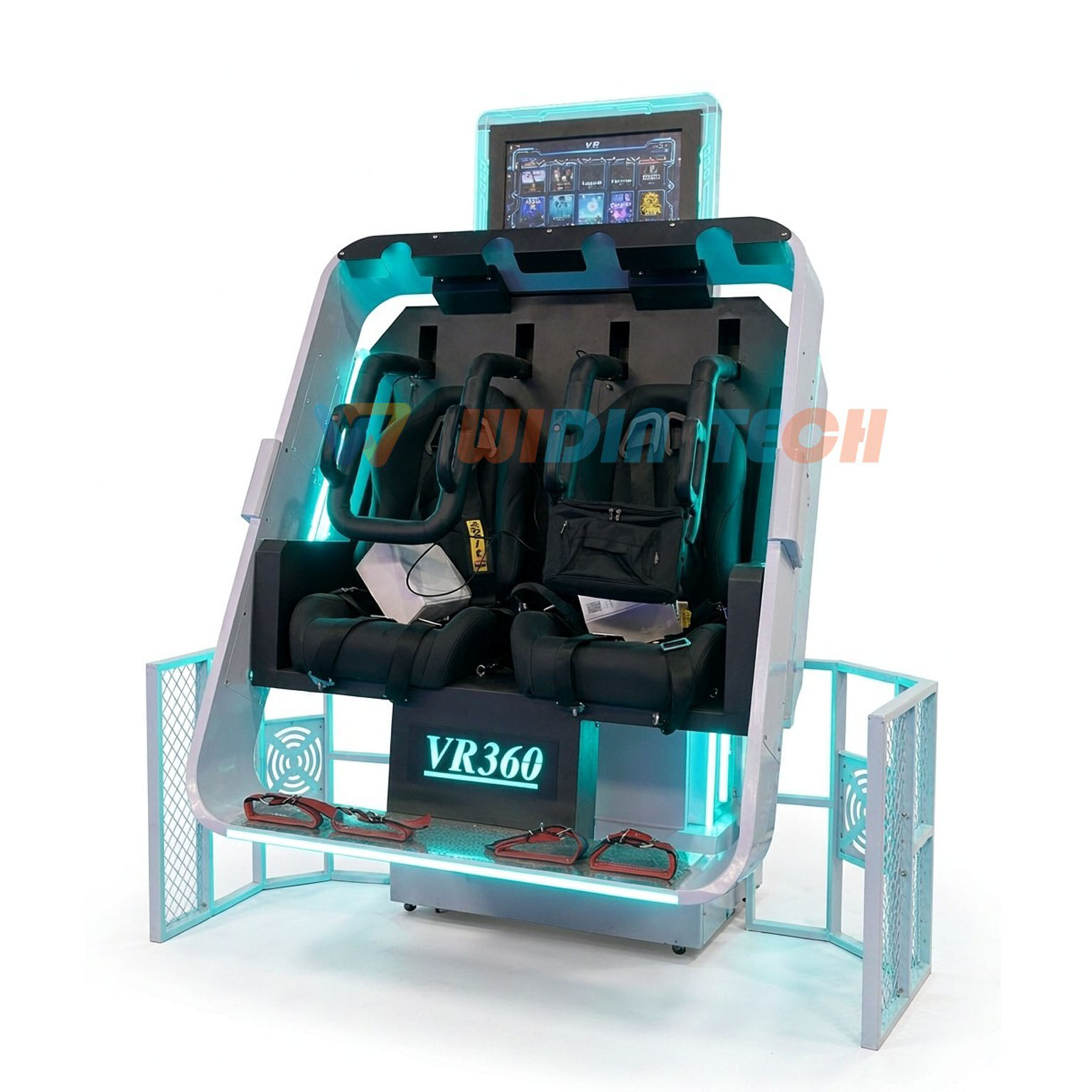
VR360 2-Seat VR Motion Machine
- Product name: VR360 (as branded on the cabinet)
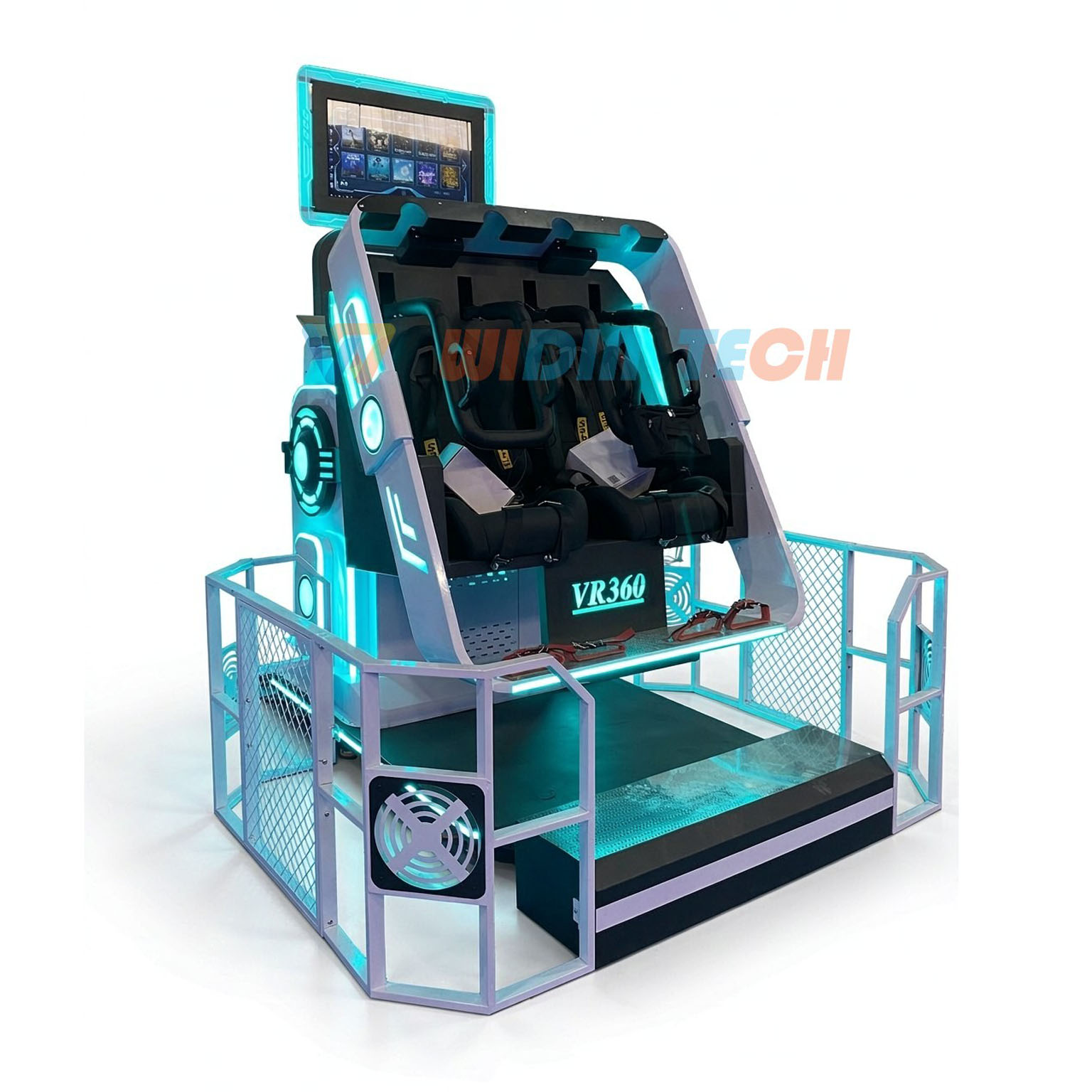
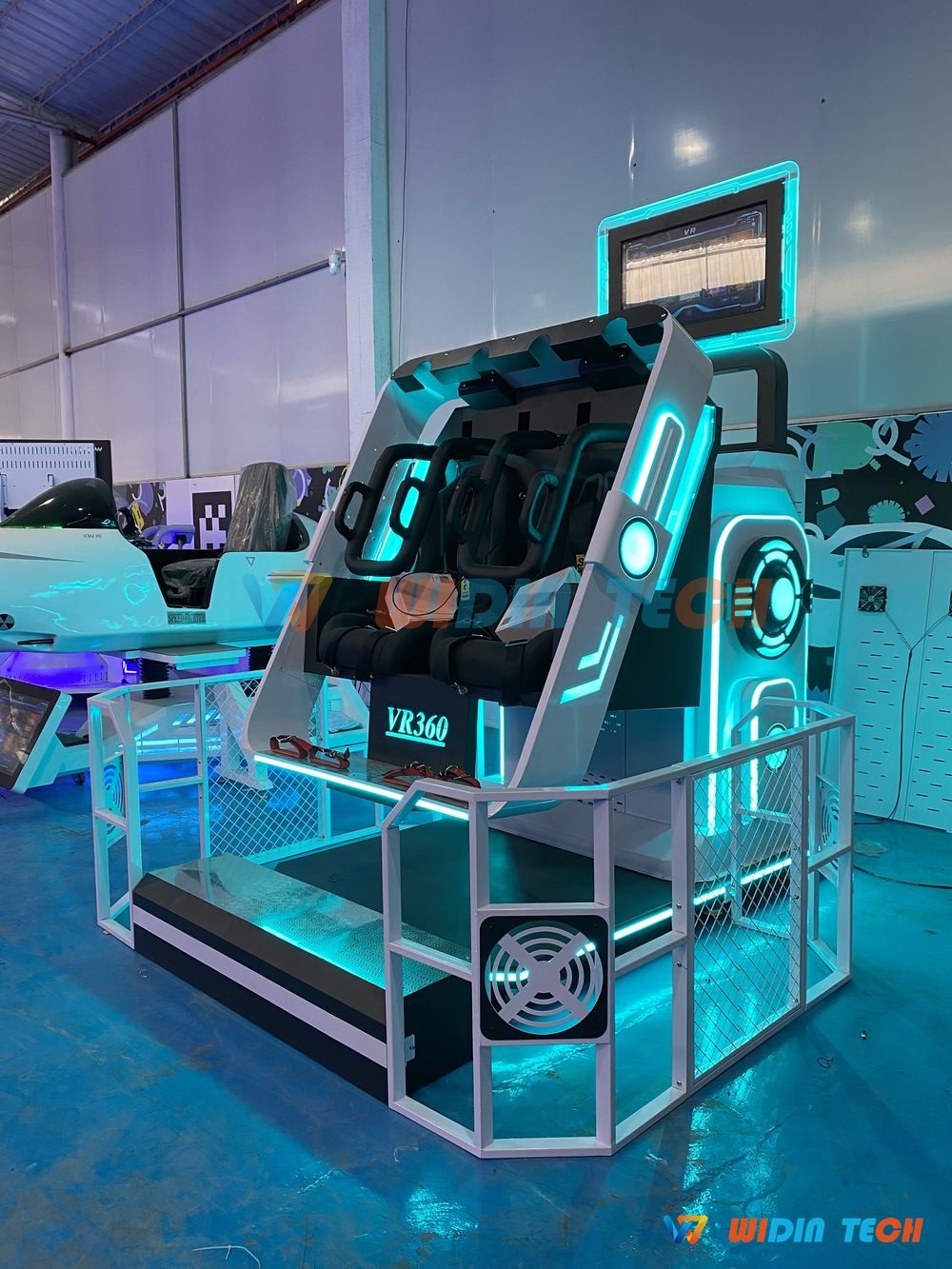
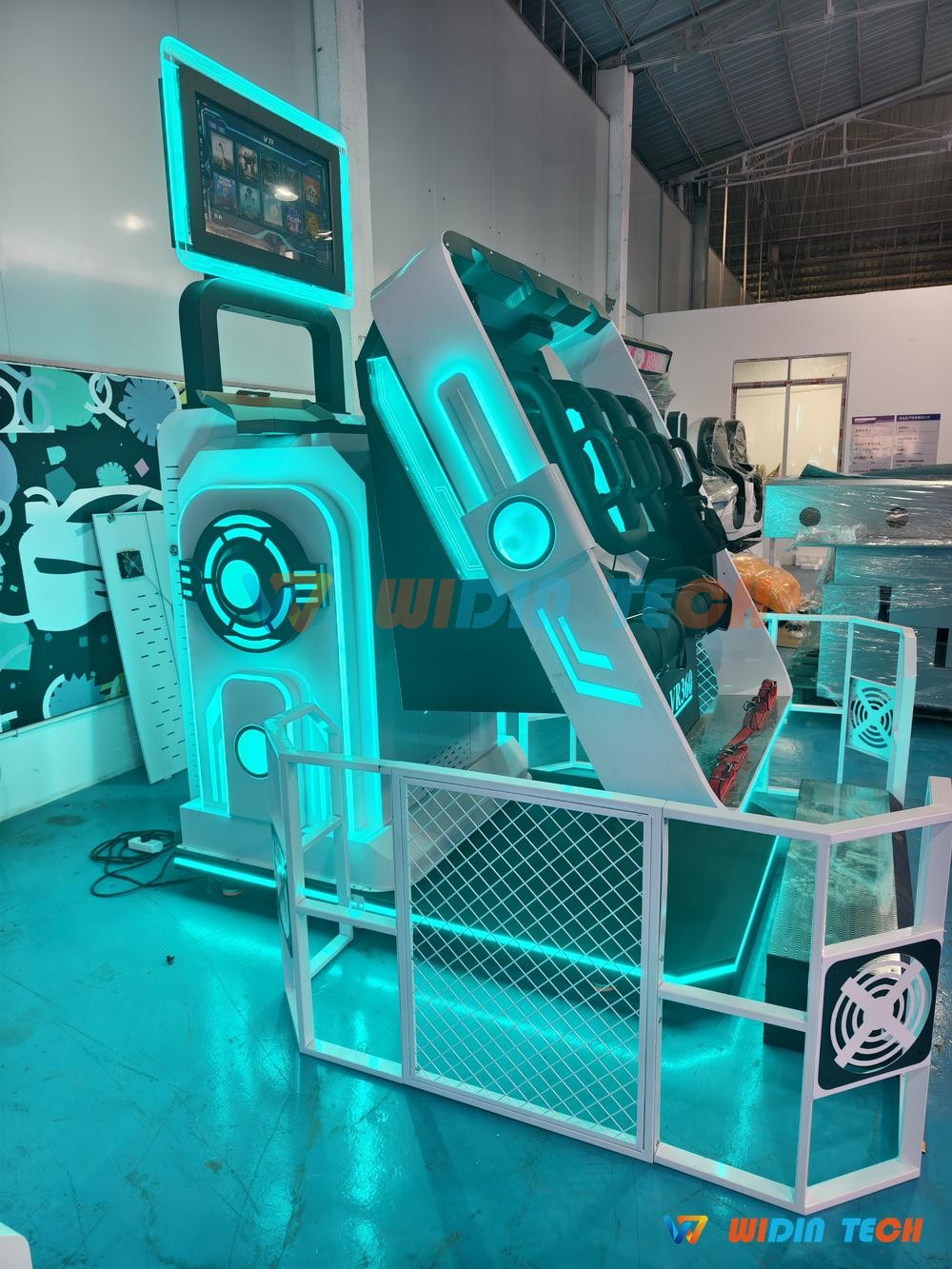
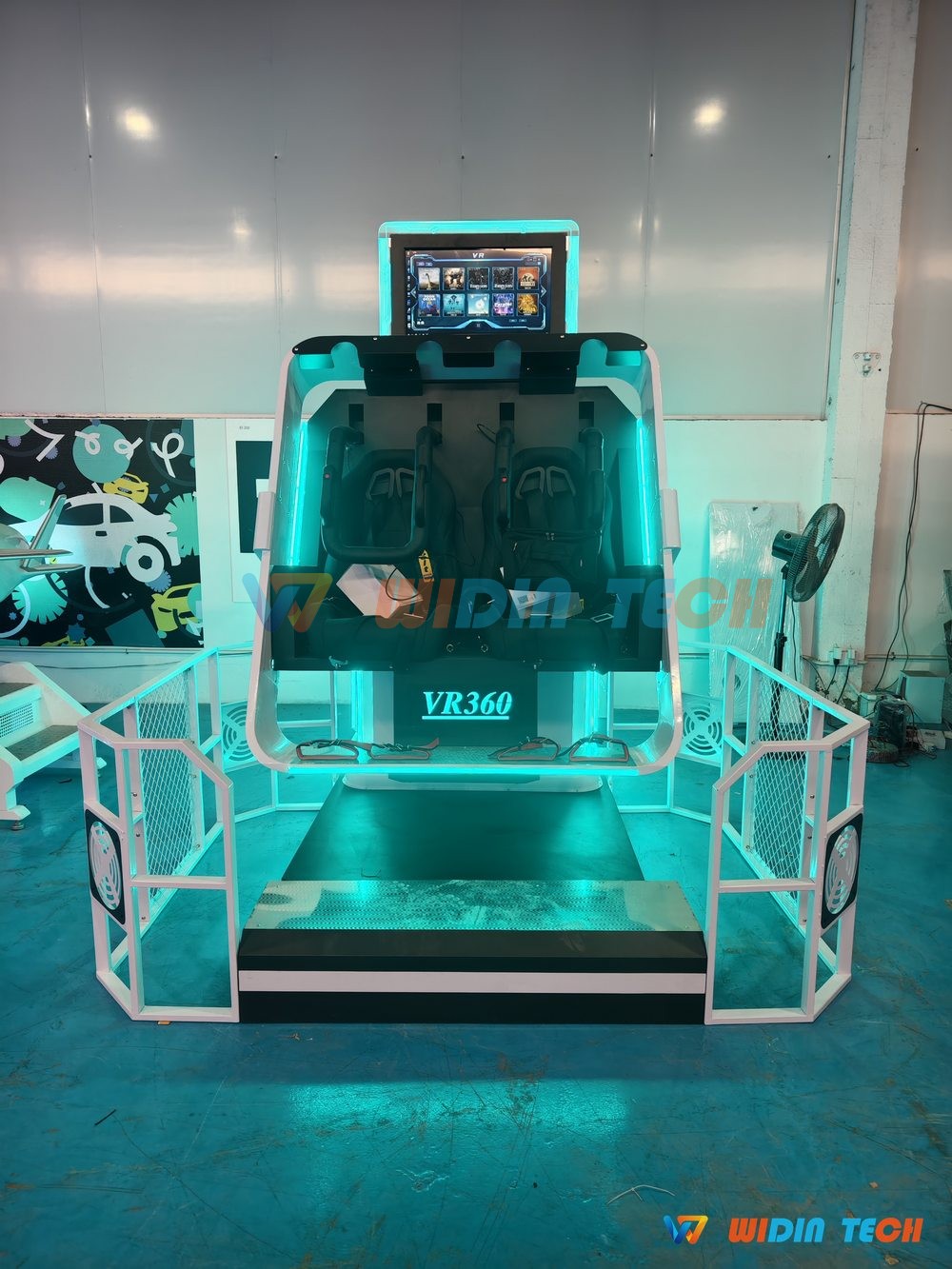
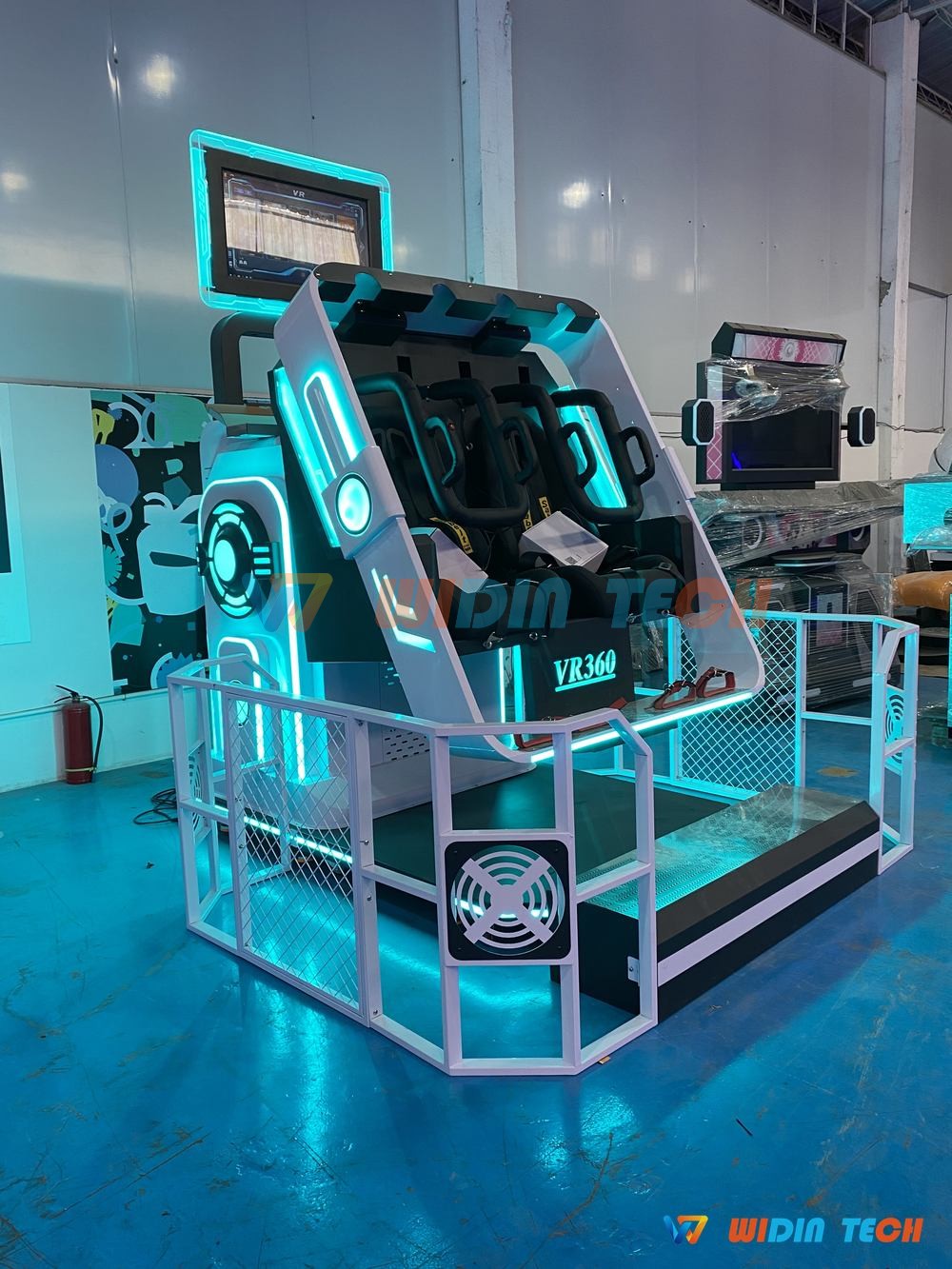
- Format: 2-seat VR motion machine on a fenced platform
- Players: 2 per session, seated side by side (visible in photographs)
- Restraint: Over-shoulder harness per seat, plus foot straps on the platform (visible in photographs)
- Display: Game-selection screen above the seats; screen size [待填:屏幕尺寸]
- Weight: 100 kg
- Power supply: AC 220 V, 1,500 W rated (as quoted — confirm the 110 V option for your market)
- Payment system: Coin-operated, optional: bill /card/ QR payment
- Game library
- 23 VR titles as quoted; languages — the screen in the photographs shows a multi-title selection menu
- OEM / ODM: Supported — cabinet artwork, branding, game language and payment system are configurable
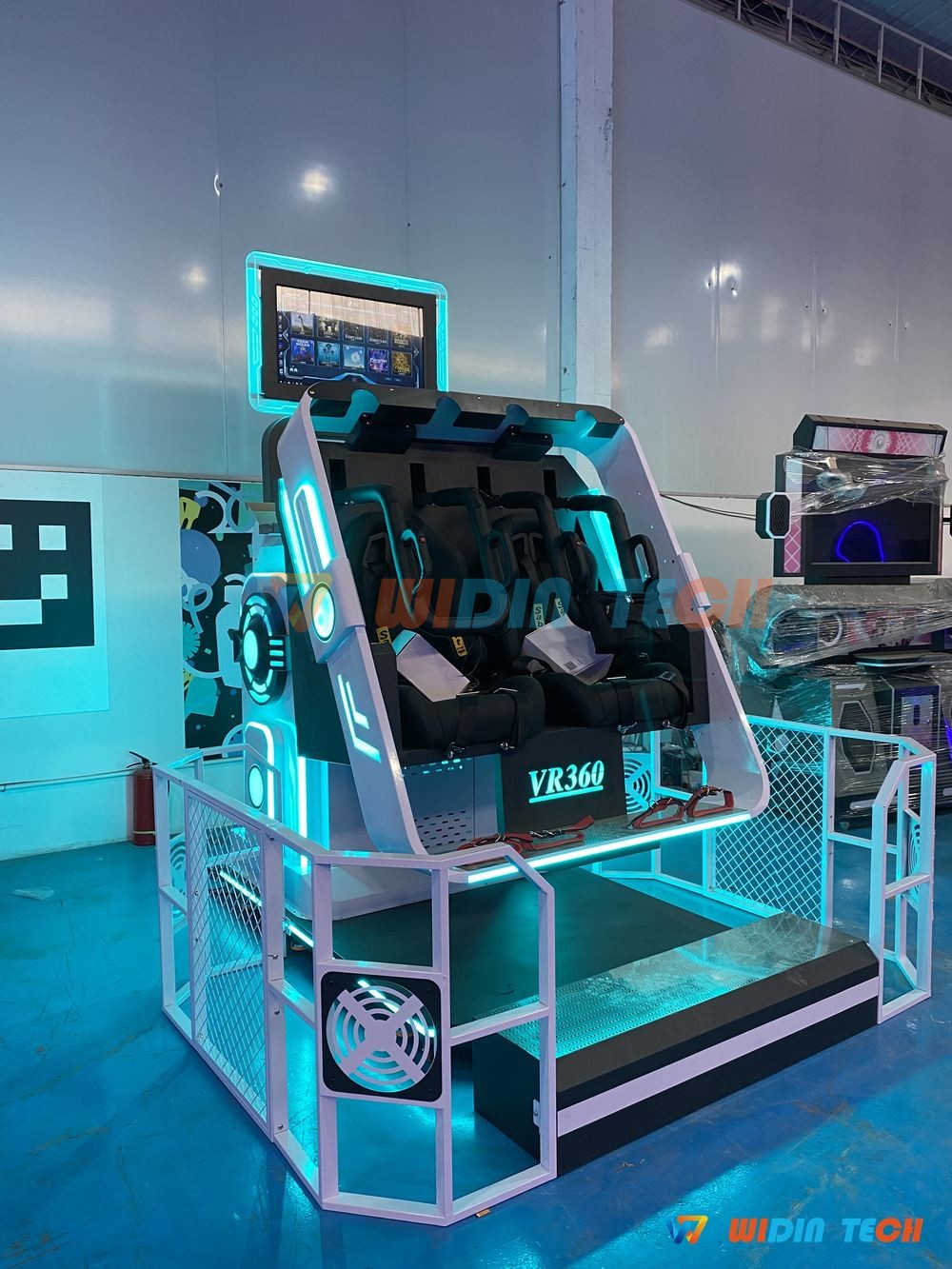
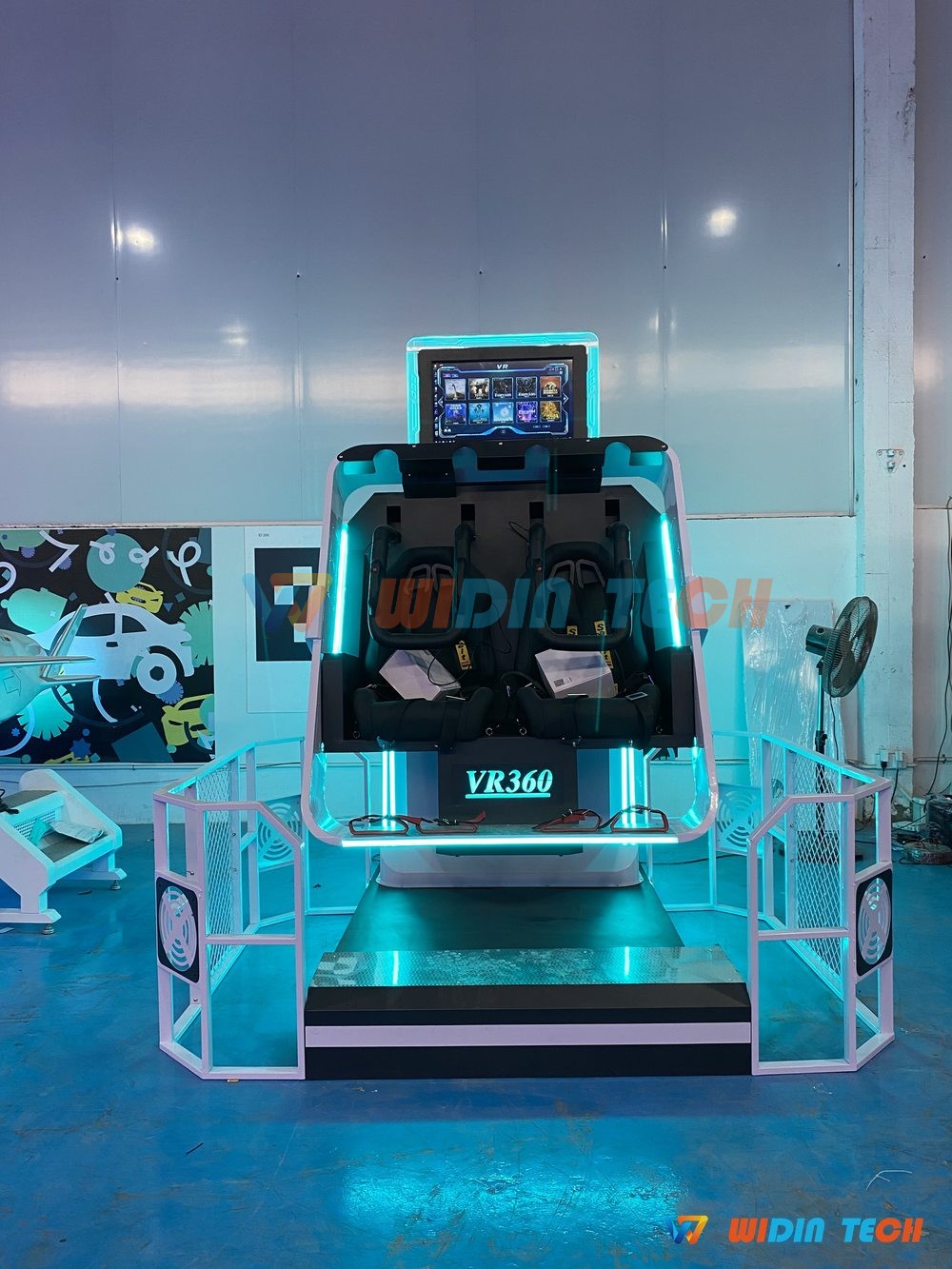
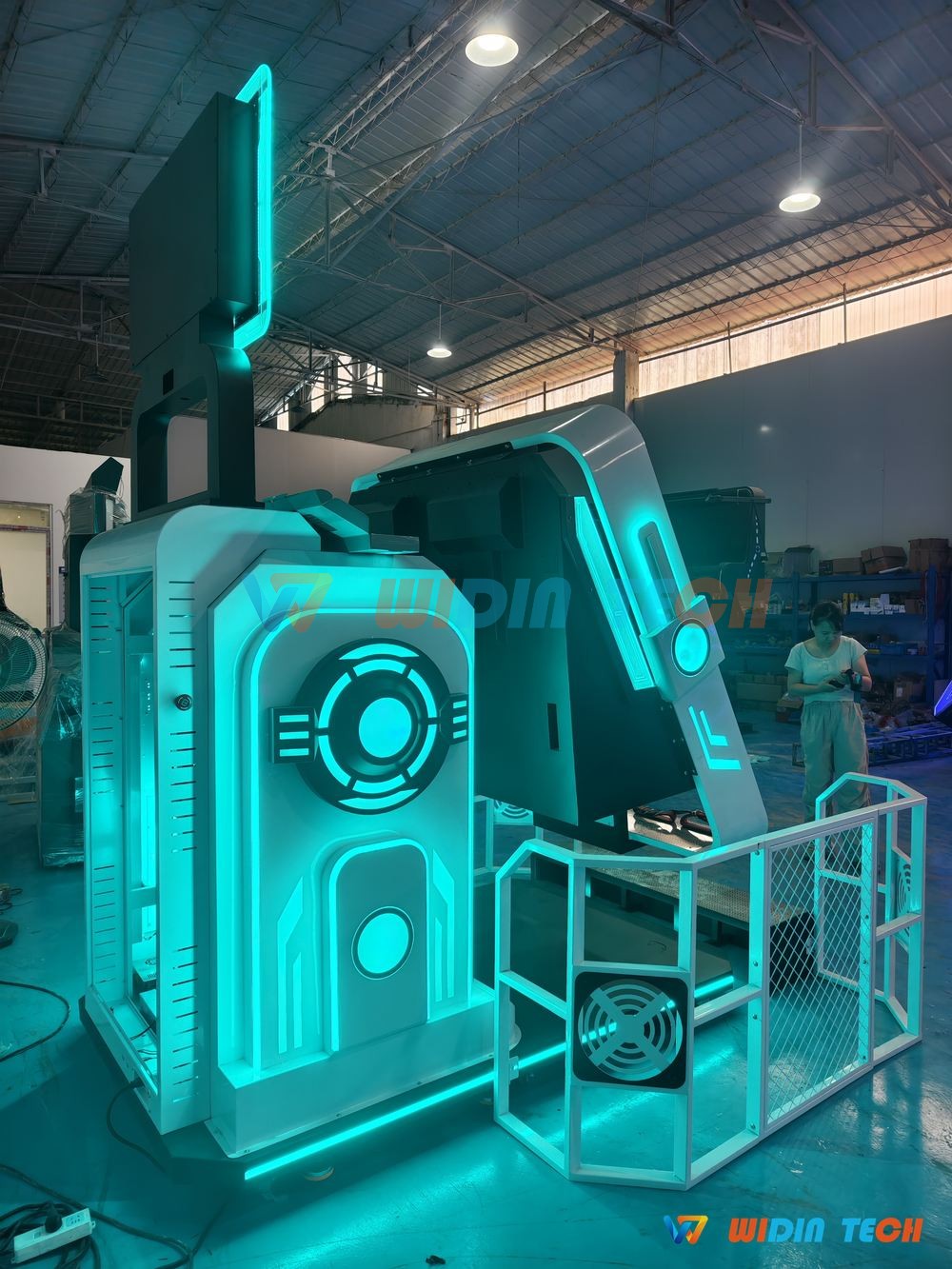
The VR360 is a two-seat virtual-reality motion machine built on a fenced platform: two riders sit side by side in bucket seats with over-shoulder harnesses and foot straps, pick a title from the game-selection screen mounted above the seats, and ride the motion platform while the fence keeps bystanders clear. Wind-effect fans are built into the fence panels, and each seat has a headset pouch within reach of the rider. The unit is quoted at AC 220 V with a rated power of 1,500 W and a library of 23 VR titles. Three things decide most purchase conversations about this machine: the fenced platform defines the real floor footprint — larger than the cabinet alone, so measure the fence, not just the machine; the motion intensity sets the age policy, which needs to be confirmed in writing before you buy; and headset turnaround between riders sets your hourly throughput, which is a staffing routine before it is a hardware question. The overall cabinet dimensions are still being confirmed with the factory and are marked in the table below rather than estimated.
What to Check Before You Order
Floor space and the fence
On a fenced VR ride, the fence, not the cabinet, is the footprint. Everything inside the fence — platform, steps, motion base, clearance for the seats to move — plus the fence line itself is floor you cannot rent out to anything else, and the queue forms outside it. On a per-square-metre business, that floor has to earn, and the arithmetic of what a zone must recover is the subject of our arcade startup cost breakdown. Until the fenced-platform figure is published, measure from the photographs or ask the factory for the platform outline drawing with the fence included. Plan the queue outside the fence on your own floor, and keep one sightline from your attendant position to both seats: a harness machine needs someone who can see a rider struggling with a strap. The per-player figures published on WIDIN's other VR machines exclude queue space, and this machine's figure will too, so treat them as the machine's minimum, not the zone's total.
Access route and ceiling height
Cabinet height for this model is 200.2cm. The route check is the same arithmetic used across the WIDIN range: a standard interior doorway is roughly 200–210 cm high, so anything taller travels disassembled and assembles on site. For container context — facts about the container, not this machine — a standard ISO container has about 2.34 m of internal width and a high-cube door height of about 2.58 m, so a machine that exceeds either ships in sections. Measure your receiving route to the lowest obstruction — lighting track, sprinkler heads, ductwork, signage — before you book the truck, and confirm the breakdown scope with the factory in the same email as the quote.
Power and electrical
The machine is quoted at AC 220 V, 1,500 W rated, which puts it in the same electrical class as the rest of WIDIN's VR range — the single-seat F1 racer, the plane simulator and the 6DOF platform are all quoted at 1,500 W, and only the six-seat machine draws more. Rated watts over 1,000 gives hours per kilowatt-hour, so 1,500 W is about 0.67 h per kWh, and a 12-hour trading day draws roughly 18 kWh at the rated figure — a planning ratio rather than a meter reading. Give the machine its own circuit: a motion platform, a screen, LED lighting, sound and headset charging should not share a breaker with the rest of a bay. Confirm the voltage option — AC 110 V or 220 V — for your destination market in the quote, the same way you would for any export machine.
What the Fenced Platform Changes on Your Floor
A fenced two-seat motion ride behaves differently from the open cabinets that make up most of the arcade floor. It earns like a two-player machine — two paying riders per cycle from one payment path —, but it occupies like an attraction: the fence line is fixed, the queue is visible from further away, and the ride needs an attendant within sight in a way a claw cabinet or a single-play unit like the boxing prize machine does not. That is the trade. The table below sets it against the rest of the WIDIN VR range and against the on-screen two-seat racing machine it competes with for floor.
| Model | Format | Players | Cabinet plan area | Area per player | Rated power |
|---|---|---|---|---|---|
| VR360 (this page) | VR motion, fenced platform | 2 | 12.01 m² (3.586 x 3.35 m) | 3.61 | 1,500 W |
| 6-player VR battle machine | Multiplayer VR, 6 seats | 6 | 7.02 m² (2.47 × 2.84 m) | 1.17 m² | 4,500 W |
| F1 VR racing machine | VR racing, single seat | 1 | 3.83 m² (2.47 × 1.55 m) | 3.83 m² | 1,500 W |
| VR plane flight simulator | VR flight, single seat | 1 | 3.31 m² (1.46 × 2.27 m) | 3.31 m² | 1,500 W |
| 6DOF three-screen racer | Screen racing, 6DOF platform | 1 | 4.27 m² (2.07 × 2.07 m) | 4.27 m² | 1,500 W |
| Twin racing set | Seated racing simulator | 2 | 7.37 m² (2.88 × 2.56 m) | 3.69 m² | 300 W (as published on its page) |
Cabinet plan areas exclude player access, staff access, and queue space, and every power figure is a rated value rather than a measured one, so read them as planning ratios rather than bills. The VR360 row will be filled from factory data, not estimated — an unverified footprint on a fenced ride understates the real floor cost, which is the one mistake this page exists to prevent.
The honest read of the table: on floor efficiency per play position the six-seat battle machine wins by a distance, and on price per rider the twin racing set is the cheapest way onto a motion seat. The VR360's case is the format. It is the only machine in the range that puts two riders side by side in a VR headset ride — a two-person shared experience rather than two individuals racing separately — and it is the only one with a fenced platform, which is what makes it read as an attraction from across a hall. If your venue runs short sessions from passing footfall, the fence is an asset; if your floor is dense cabinet rows, the fence is a cost: it buys spectacle with square metres.
Headsets, Hygiene and Ride Comfort
Three routines decide whether a VR ride earns or annoys, and none of them is in the spec table.
Turnaround. Hourly throughput is a formula you control with staffing: two riders per cycle, plus the time to release two harnesses, collect two headsets, wipe them, and seat the next pair. If a title runs T minutes and turnaround takes R minutes, the machine delivers 120 ÷ (T + R) riders per hour per seat pair — so a 5-minute title with 2 minutes of turnaround is roughly 17 riders per hour, while the same title with a 5-minute turnaround drops to 12. The title length is 10 minutes; the turnaround is yours to engineer. Short titles and a rehearsed changeover are worth more than any hardware option on this page.
Hygiene. Headsets touch one face after another all day. The wipe-down between riders needs to be stocked, scheduled, and actually done — facial-contact padding is the one part of an arcade machine your customers disinfect with their own standards in mind. Confirm with the factory what the headset padding material is and whether replaceable hygienic covers are offered as an option; that answer belongs in the quote, because it is a running cost, not a feature.
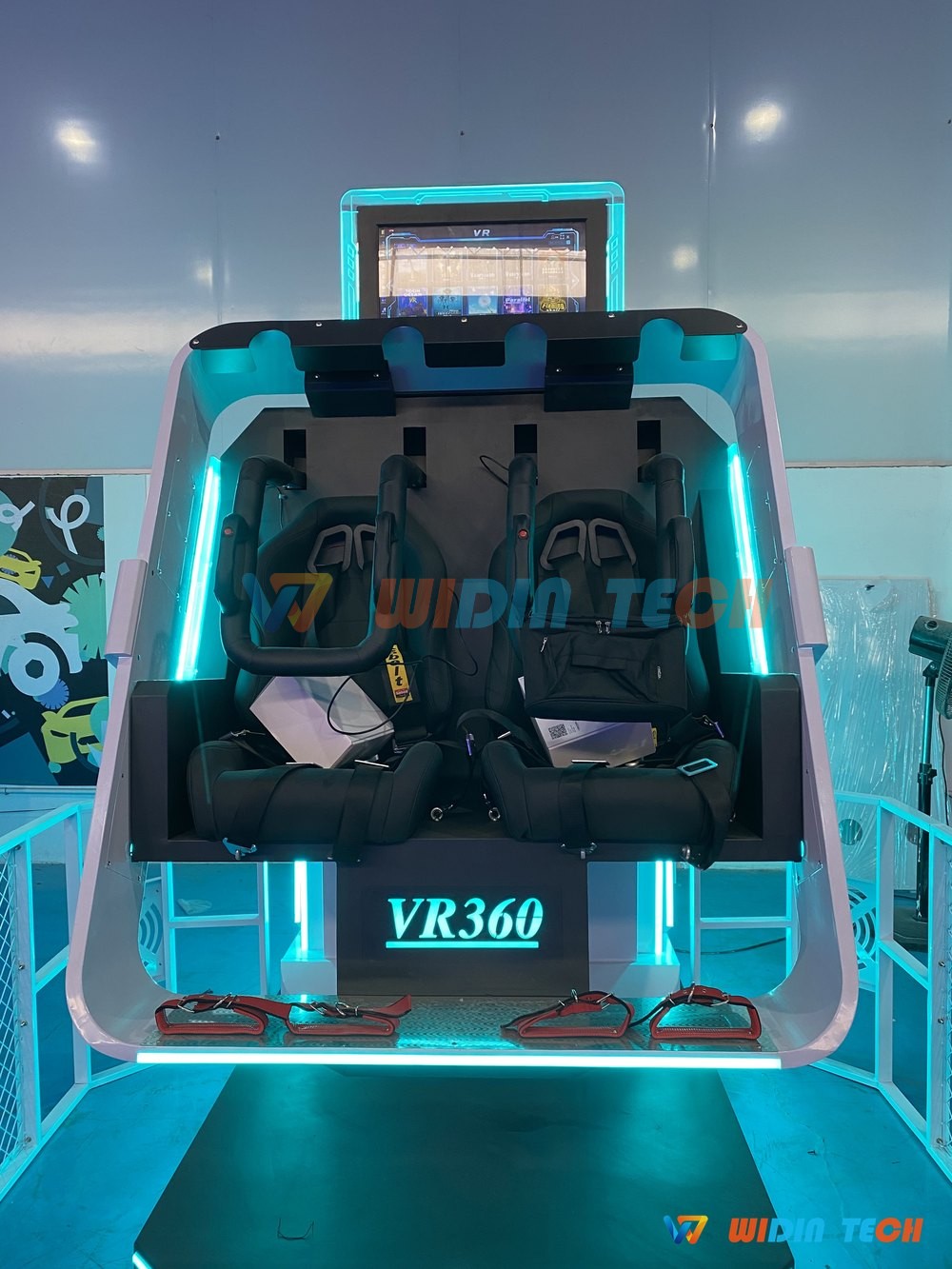
Comfort. Motion sickness is manageable, not eliminated: a harness that restrains the body, a seat that moves with the visuals, and shorter first-session titles all reduce it. The over-shoulder harnesses on this machine do the first part by design. What you control on the floor is title choice — let first-time riders start on milder content rather than the most intense title in the library, and post the intensity honestly. With 23 titles quoted, there is room to keep a mild set for walk-ins and an intense set for repeat riders, provided the library is actually divided that way— if intensity levels are configurable per title, that is a question worth asking before ordering, because it decides whether one machine can serve both cautious and thrill-seeking footfall.
Ride-safety context for buyers writing their own operating rules: IAAPA, the global attractions industry association, publishes safety resources covering restraint use, rider eligibility signage and attendant practice for attractions of this class. They are industry guidance rather than a specification of this machine — but they are the right reference frame for the age policy and supervision rules you will have to write anyway.
Build Quality and Service Life
The VR360 is built under the same process the factory publishes across its range, and those process figures are the verifiable part: before shipment, every machine runs a 72-hour continuous aging test at full load, with no exceptions in the factory's process. Cabinet steel is 1.2 mm reinforced, against the 0.6–0.8 mm common in the category, and powder-coated surfaces take about 8 additional hours of manual finishing per machine. WIDIN rates the stable service life of this build class at 4–6 years, against 2–3 years for conventional workshop cabinets — a manufacturer's rating, stated so you can hold it against other suppliers' claims rather than take "commercial grade" on faith, and the reason the 4–6 year rating changes the ownership maths is argued in full in our piece on how long commercial arcade machines last. On a motion machine, the rating matters more than on a static cabinet, because the motion base adds moving parts and fasteners to the weekly checklist; confirm with the factory whether the motion hardware carries its own maintenance schedule and spare-parts plan alongside the standard warranty.
Custom Builds and OEM Orders
OEM and ODM customization covers cabinet artwork, brand logos, game language, the game software package, and the payment system — coin, bill, card, or cashless, matched to what your venue already runs. For export orders, the two customizations that matter most here are artwork language, since the unit photographed carries its domestic-market graphics and export cabinets are produced with the buyer's target-market artwork, and the game library, which should be confirmed by title list and language before production rather than discovered after delivery. One VR-specific question to put in writing: whether headset hardware, spare headsets, and hygienic covers are part of the OEM scope or ordered separately, because they are the consumable side of this machine. The factory's process is to confirm final specifications before production starts.
Shipping, Packing and Installation
Packing method and crate dimensions are Soft packing for shipment; wooden frame or wooden case packing available as an option. The shipping plan follows the same logic as the rest of the range: the assembled machine travels only if every dimension clears the container — about 2.34 m internal width and about 2.58 m high-cube door height on a standard ISO container — and otherwise it ships in sections for on-site assembly. A fenced platform machine has one packing question the open cabinets do not: whether the fence travels installed on the platform or as a separate crate, because the fence is what turns a machine into an attraction and it is the part most likely to be bent in transit if it is an afterthought. Site requirements before delivery: a receiving path sized for the largest section, ceiling clearance on the full route, a level floor for the motion base, and the dedicated power circuit from the checklist above. Confirm section sizes and assembly scope with the quote — the figures belong in the same email as the price.
Frequently Asked Questions
How much does the VR360 two-seat VR motion machine cost?
For orientation, WIDIN's published two-seat motion machine, the twin racing set, lists at USD 5,215–6,705 FOB, with the price moving based on the payment system, software package, and OEM level — a fenced VR machine is a different format, so treat that range as a sibling reference only, not a quote. Ask for pricing with your quantity, destination country, and configuration.
How much floor space does a two-seat VR motion machine need?
For this model, the fenced-platform footprint is — and on a fenced ride the fence is the number that matters, because everything inside it plus the fence line is committed floor, with the queue forming outside. WIDIN's other VR machines publish 3.31–7.02 m² of cabinet plan area (1.17–4.27 m² per play position), and none of those figures include queue or access space, so budget above them for the zone either way. Get the platform outline drawing with the fence included before you commit to a location.
Will the VR360 fit through a standard doorway?
It depends on the packed sections, and those are Overall packaging. The benchmark is simple: a standard interior doorway is roughly 200–210 cm high, and a standard ISO container offers about 2.34 m of internal width and about 2.58 m of high-cube door height. Anything larger than those limits ships disassembled and is assembled on site, so the question to ask the factory is not "does it fit through the door" but "what are the largest crate dimensions". Measure your receiving route to the lowest obstruction — lights, sprinklers, ducts, signs — before booking delivery.
What power supply does the VR360 need?
AC 220 V with a rated power of 1,500 W, as quoted. Rated watts divided by 1,000 gives hours per kilowatt-hour, so 1,500 W is about 0.67 h per kWh and a 12-hour trading day draws roughly 18 kWh at the rated figure — a planning ratio, not a meter reading. Give it a dedicated circuit, and confirm the 110 V option in the quote if your market needs it. For context, 1,500 W is the same rating as WIDIN's single-seat VR racer and plane simulator; only the six-seat battle machine draws more, at 4,500 W.
How many people ride at once, and how long is a session?
Two riders per session, seated side by side — visible in the photographs, with individual over-shoulder harnesses and foot straps. Session length is 10 minutes. Throughput is then arithmetic you control: 120 ÷ (session minutes + turnaround minutes) riders per hour per seat pair, so turnaround discipline is worth as much as title choice. Confirm whether the machine can run with a single rider when the second seat is empty — that answer changes your off-peak staffing.
How many games does the VR360 come with?
23 VR titles as quoted. Language support is 11 languages. With a library this size, ask for the title list by name and confirm which titles carry your market's language before production, and ask whether the titles are graded by motion intensity — a mild set for first-time riders and an intense set for repeat visitors is worth more on the floor than 23 titles of the same strength.
What about VR motion sickness?
It is managed, not eliminated. This machine reduces it by design — the body is restrained by over-shoulder harnesses and the seat motion matches the visuals, which removes most of the sensory conflict that causes nausea. On the floor, let first-time riders choose milder titles, post intensity honestly, and keep sessions short for walk-in traffic. If intensity is configurable per title — one machine can serve both cautious and thrill-seeking riders, which is worth confirming before you order.
How do you keep the VR headsets clean between riders?
With a wipe-down routine you staff, not a feature you buy: between sessions, collect the headsets, wipe the facial-contact padding with a suitable disinfectant, and restock wipes at the attendant position. The photographs show a headset pouch at each seat, so the headsets have a defined place in the changeover. Ask the factory what the padding material is and whether replaceable hygienic covers are offered — that is a running cost of the machine and belongs in the quote.
What age is the VR360 for?
The manufacturer's age policy and minimum height for this model are Ages 6 and up, height 120 cm and above. The over-shoulder harness and motion platform put it in the stronger-motion class of attraction rather than the kiddie-ride class, so the age line needs to come from the factory in writing and be posted at the machine — for the frame your local rules use, IAAPA's published safety resources cover rider eligibility and signage for attractions of this class. Do not guess this one: an age policy you invented is the liability, not the one you confirmed.
Can I customize the branding, games, and payment system?
Yes — OEM/ODM covers cabinet artwork, brand logos, game language, the game software package, and the payment system, including cashless readers, with export cabinets produced in the buyer's target-market artwork. For this machine, also confirm the headset scope: whether spare headsets and hygienic covers are part of the OEM package or a separate order. Final specifications are confirmed before production starts.
What are the MOQ, lead time, and warranty?
MOQ / lead time: MOQ 1 unit, lead time 7 days. For reference, the twin racing set ships from 1 set with a 1-week lead and a 12-month warranty — those are that model's published terms, not this one's. Get the VR360's own figures in the quote, and put the warranty scope in writing per component: motion base, screen, headsets, and payment system fail at different rates, and you want to know which are covered and for how long.
Request a Quote
A quotation for the VR360 needs three inputs: the quantity, the destination country or port (it sets voltage, plug standard, and freight), and the configuration — payment system, artwork language, and game package. Add two more that this machine specifically needs: your ceiling height and receiving route, so the factory answers the disassembly question with your building's numbers instead of generalities, and the fenced-platform outline drawing, which is the single document that decides whether this machine fits the floor you have in mind. Send all of it through the contact page and the quote comes back with the freight component itemised rather than guessed.
— Chen, Founder & CEO at Guangzhou WIDIN Tech. On a fenced VR ride, the number people get wrong is not the price — it is the footprint. They measure the machine and forget the fence, then discover the queue has nowhere to stand. Measure the fence line, add the queue, and the rest of the decision is easy.