

How Much Does It Cost to Open an Arcade? Complete Investment Guide
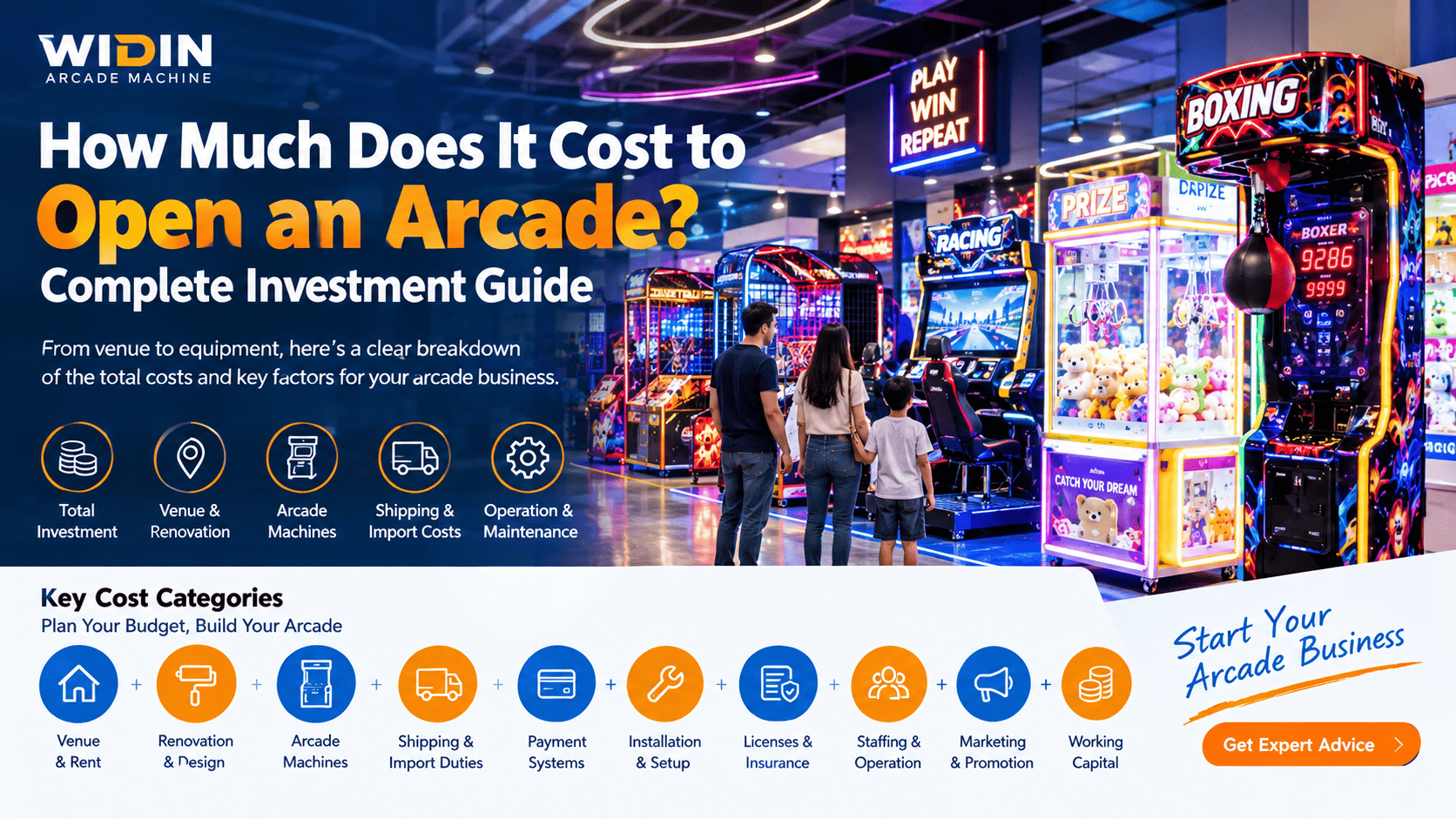
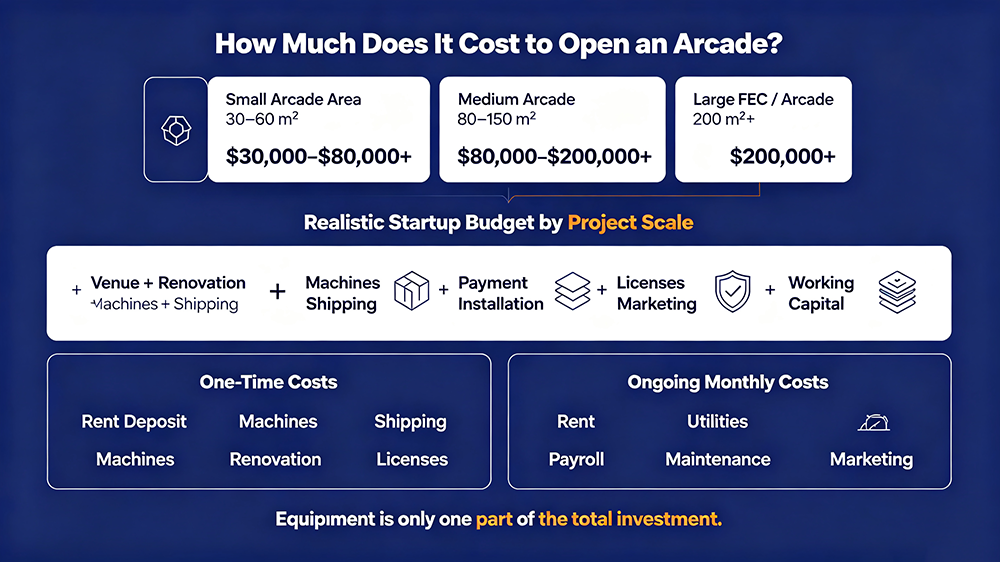
An arcade costs roughly $30,000–$80,000 at 30–60 m², $80,000–$200,000 at 80–150 m², and $200,000 or more above 200 m². Those are planning ranges rather than quotations, because rent, construction, equipment specification, freight, and local licensing move the final number further than anything on a supplier price list.
What catches first-time operators out is rarely the machines. Equipment is one line in a longer list: venue, renovation, machines, shipping, payment system, installation, licensing, marketing, and the working capital you need after opening day. Budget the list, not the line.
That framework is the same one the U.S. Small Business Administration recommends: separate one-time startup costs from recurring monthly expenses, then use both figures to work out how much funding the business actually needs.
What Does It Cost to Open an Arcade? Three Planning Levels
Arcade projects split broadly into three planning levels. Use them to sanity-check a business plan, not to budget a specific venue.
| Arcade model | Typical scale | Planning budget |
|---|---|---|
| Small arcade area | 30–60 m² | About $30,000–$80,000+ |
| Medium arcade | 80–150 m² | About $80,000–$200,000+ |
| Large FEC / arcade | 200 m²+ | $200,000+ |
The spread inside each band is wide, and the reason is location rather than equipment. A small arcade inserted into an existing entertainment business needs far less capital than a standalone venue of the same size that has to be built out from a bare shell. Treat every figure here as a starting range and let your own venue, freight quote, and licensing costs replace it.
1. How Much Will the Venue Cost?
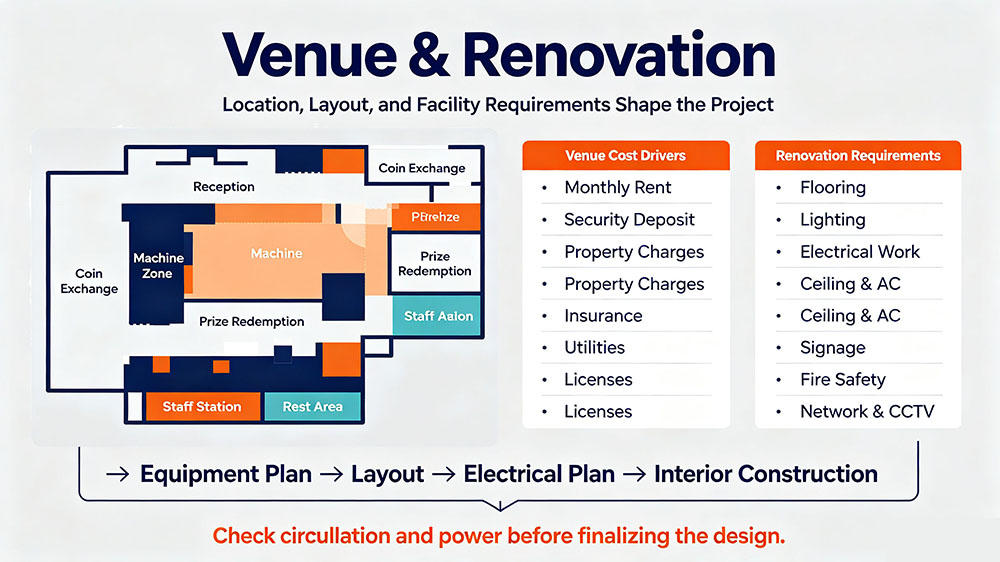
Venue is usually the largest variable in the project and the hardest one to estimate from outside a market. Rent and deposit are only part of it. Location also sets property-related charges, labour rates, insurance, utilities, licensing, and how much renovation the space needs before a machine can be switched on.
Those costs vary not just between cities but between neighbourhoods in the same city, which is why generic rent benchmarks mislead more than they help. The comparison that holds up is traffic against occupancy cost. A unit inside a busy shopping centre often costs more per square metre and still returns more, because customers arrive without being persuaded to. A cheaper unit on a quiet street does not lower the project cost — it moves the marketing spend into your working capital instead.
2. What Does Renovation Add?
Renovation is where budgets drift, because the scope only becomes clear once the building is opened up. Depending on the venue it can cover flooring, lighting, electrical distribution, wall and ceiling finishes, signage, air conditioning, network cabling, CCTV, fire-safety upgrades, storage, and a prize counter.
Three things in that list drive the rest: electrical capacity, fire safety, and the prize counter. Large arcade machines draw real current and need outlets and distribution sized for the actual machine list rather than for a generic retail fit-out, and fire-safety requirements are set by the building and the local authority, not by you.
Sequencing matters more than the line items. Venues that design the interior first and position machines afterwards tend to find the electrical and circulation problems at the worst possible moment, once the walls are closed. Run it in this order instead: equipment plan → layout → electrical plan → interior construction.
3. How Much Do the Arcade Machines Cost?
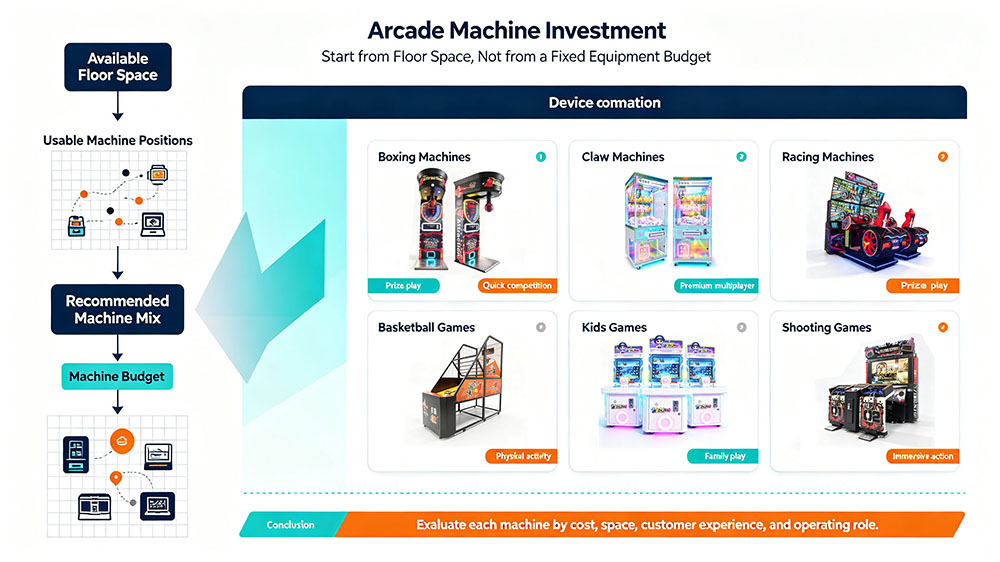
Equipment is normally the second-largest line and the one buyers research hardest. The useful question is not how many machines you can afford but which combination serves the customers you actually expect, inside the floor space you actually have.
| Machine type | Role in the venue | Floor space |
|---|---|---|
| Boxing strength tester | Fast physical competition; players draw a crowd of onlookers | Low |
| Claw machine | Impulse play, prize-based, needs almost no staff attention | Very low |
| Racing simulator | Premium multiplayer attraction, longer single sessions | High |
| Basketball machine | Understood instantly, short rounds, fast turnover at peak | Medium |
| Kids arcade game | Keeps families on site longer | Low |
A mix drawn from three or four categories usually outperforms several machines from one, because it serves different customer groups at the same time of day. A parent spending at a claw machine while a teenager races is two customers earning in parallel; two similar cabinets side by side compete for the same person.
4. How Much Should You Spend on Machines?
Work backward from the venue rather than forward from a budget figure. Equipment budgets fixed before the layout is known tend to produce one of two failures: a half-empty floor, or machines that do not fit the room they were bought for.
Available floor space → usable machine positions → recommended machine mix → machine budget
Judging a machine on purchase price alone also misleads, because two machines at similar prices can occupy very different floor areas and do entirely different jobs. A racing simulator costs more and takes more space, and earns that space back as a premium multiplayer attraction that a cheaper machine cannot replace. A compact claw machine costs less, fits a gap in the layout, and turns impulse traffic into revenue. The real question is which one your floor can afford to give up.
5. What Do Shipping and Import Costs Add?
International buyers underestimate logistics more often than any other line, and it is the most common reason an arcade project lands over budget. The landed cost of an imported machine can include:
Machine price
Export packaging
Wood frame or crate
Ocean or air freight
Insurance
Customs clearance
Import duties or taxes
Local delivery
Port or terminal charges
This is why comparing factory quotations on machine price alone produces the wrong ranking. Supplier A can quote a lower machine price and higher freight than Supplier B and still land more expensive per unit. Ask each manufacturer to separate machine cost, packaging, freight and delivery terms, and on larger orders ask whether filling a container changes the packaging and freight figures — consolidation usually lowers the cost per machine more than a discount on the unit price does.
6. Payment Systems: Budget for the Whole System, Not the Reader
The payment method affects capital cost and daily operation at the same time, so it belongs in the plan from the start rather than being added after the machines arrive. Options run from coin acceptors and token systems through card readers and NFC to QR payment and fully cashless arcade platforms.
A small venue can run on a simple coin system. A larger FEC usually moves toward a centralized cashless platform, where the cost is not the reader but everything around it: readers, controllers, cards, software, network, and a recharge station. Price the whole system across the venue, because a per-reader figure tells you very little about what the venue will spend.
7. Installation and Technical Setup
What installation involves depends on the machine and the venue. Simple cabinets may need only positioning and a power connection. Complex attractions can require assembly, network configuration, payment integration, software setup, calibration and testing before they are ready to trade, plus operator training so staff can handle routine issues without waiting for a technician.
For an international project, confirm in writing whether installation is included in the quotation or handled locally, and if machines ship partly disassembled, what documentation arrives with them. This is the kind of detail that costs almost nothing to settle before the order and a great deal to discover on arrival.
8. Licenses, Insurance and Compliance
Licensing is local by nature and varies by country, state and city — sometimes between venue types inside the same city. Depending on where you operate, the list can include business registration, local business licences, zoning approval, fire-safety compliance, electrical compliance, building permits, equipment certification and business insurance.
A machine supplier can tell you which certifications the equipment carries. It cannot determine what your local authority requires of your premises, and any supplier that claims otherwise is guessing. Confirm that side with the relevant authorities and a local adviser before you sign a lease, because licensing problems are the hardest kind to fix after the fact.
9. Staffing and Operating Costs
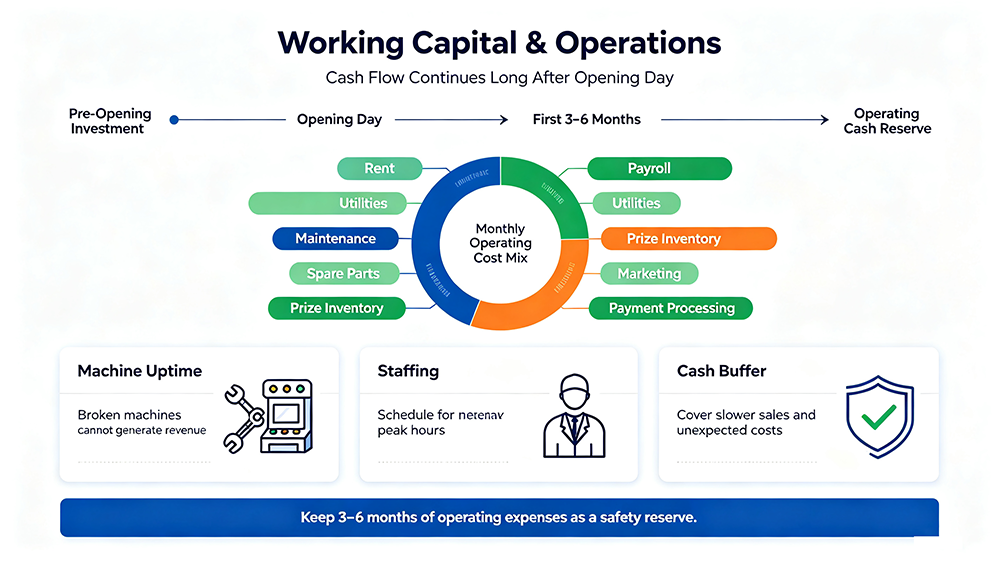
Installation day is the start of the cost curve, not the end of it. Recurring costs typically include staff wages, rent, electricity, internet, cleaning, repairs, spare parts, prize inventory, insurance, marketing, and payment processing fees.
Maintenance is the line operators under-budget most often. A machine that is out of service earns nothing while still occupying rent, so uptime belongs in the investment decision rather than in the after-sales file. IAAPA has made the same point repeatedly in its operator guidance: arcades are not set-and-forget businesses, and maintenance discipline is what separates a trading venue from a floor of dark cabinets.
This is where build quality stops being a spec-sheet item and becomes a number in your cost model. Every WIDIN commercial machine goes through a 72-hour continuous full-load aging test before packing, with no exceptions, and cabinets are built from 1.2 mm reinforced steel where the common industry range is 0.6–0.8 mm. WIDIN rates the stable service life of that build at 4–6 years, against 2–3 years for conventional workshop machines.
Read that as a purchasing decision rather than a claim. Across a six-year operating period, a cabinet rated at 2–3 years has to be replaced once or twice. The lower purchase price is paid again — and so are the freight, the downtime, and the staff hours that go with a changeover. A 4–6 year cabinet is bought once.
10. How Much Working Capital Do You Need After Opening?
The most common financial mistake in a first arcade is arriving at opening day with everything spent. A $100,000 budget that goes $90,000 into venue and equipment leaves $10,000 for a business that has not yet earned anything — and the first months of an arcade are rarely its strongest.
Working capital has to cover rent, payroll, utilities, marketing, repairs, prize stock, and the expenses nobody plans for. The SBA's guidance on startup costs draws the same distinction, and adds a category operators often leave out: the cash needed to cover operating deficits during the early stage of the business, not just the assets bought before it opens.
11. Should You Buy or Lease Arcade Equipment?
Depending on your market and financing options, equipment can be either bought or leased. Buying takes more capital up front and leaves you owning the machines. Leasing reduces the initial cash requirement, normally at a higher total lifetime cost and with contract terms worth reading closely.
Compare the two over the expected operating period rather than month to month. The relevant figures are available capital, equipment lifespan, expected usage, who carries maintenance responsibility, contract length, replacement flexibility, and total cost of ownership. Lifespan carries more weight in a lease than in a purchase, because a lease term that outruns the machine is the worst of both arrangements.
12. How to Reduce Your Arcade Startup Cost
Cutting the budget does not mean buying the cheapest equipment. It means removing costs that do not produce revenue.
Start with a focused mix. Buy for your target customers instead of covering every game category at once.
Use proven models. A standard commercial machine avoids the development cost and lead time of a custom build.
Customize where it shows. Branding, cabinet colour, payment configuration, and selected controls can usually be adapted without developing a new machine from scratch.
Plan shipping before ordering. A lower factory price is worthless if packaging and freight push the landed cost above the alternative.
Tell the manufacturer about future orders. If you plan to expand, saying so early helps standardize components, hold the right spare parts, plan repeat production, and keep future pricing predictable.
13. What Should You Ask an Arcade Machine Manufacturer?
Prepare your own numbers first: venue size, target customers, destination country, machine quantity, preferred categories, payment method, customization requirements, expected order volume, and delivery location. Suppliers quote far more accurately when those are settled, and quotes that arrive without them are guesses with a price attached.
Then ask:
Is this a standard model or a custom build?
What exactly is included in the machine price?
What packaging is recommended for this shipment?
What is the estimated shipping cost?
What is the production lead time?
What testing is carried out before shipment?
Which spare parts should we hold on site?
What warranty is provided, and on which components?
Can the payment system be configured for our market?
Can you support repeat orders and future expansion?
Those ten answers let you compare suppliers on the whole project rather than on a unit price — which is the comparison that actually predicts what you will spend.
14. Why Supplier Communication Belongs in the Cost Model
On a new arcade project, how a supplier communicates changes the final cost almost as much as the quotation does. The chain runs layout → machine selection → customization → payment → packaging → shipping → installation → after-sales, and a requirement misunderstood at the first step is usually discovered at the last one, when changing it is expensive.
The pressure is highest for international B2B buyers working across time zones and languages. What matters in a supplier is whether someone can read a project correctly, confirm requirements before production, coordinate with their own engineering team, and answer when something changes mid-order. A long trading history is one signal of that capacity, but not the only one. A smaller manufacturer with direct access to the people who build the machines can sometimes move faster on a change request than a large one where the message passes through three desks before it reaches anyone who can act on it.
15. How to Calculate Break-Even Before You Buy
Before committing capital, work out the revenue the venue needs in order to cover its costs:
Break-even point = fixed costs ÷ contribution margin
For an arcade, fixed costs typically include rent, salaries, insurance, software subscriptions, instalments on equipment and other recurring overhead. Variable costs include prize stock, payment processing fees, certain maintenance expenses and consumables. Compare the result against a realistic revenue estimate, not an optimistic one.
Treat any assumption about how quickly a machine repays its purchase price as an assumption rather than a schedule. Real performance moves with traffic, pricing, play frequency, machine placement, competition, and operating costs — six variables, most of which you control only partly. The SBA's startup cost and break-even guidance applies the same framework to any small business and is worth reading before you fix your own numbers.
16. Arcade Investment Checklist
Cost these separately before you open:
| Investment category | Key question |
|---|---|
| Venue | How much will rent and deposit cost? |
| Renovation | What construction is required? |
| Machines | What equipment mix fits the space? |
| Shipping | What is the landed cost? |
| Payment | Coins, cards, NFC, QR, or cashless? |
| Installation | Who handles setup and testing? |
| Licensing | What local approvals are required? |
| Staffing | How many employees are needed? |
| Marketing | How will customers find the venue? |
| Working capital | How many months of operating cash are available? |
| Maintenance | How will machines be repaired? |
| Spare parts | What components should be kept locally? |
Working through that list produces a more realistic picture than any single supplier quotation can, because it exposes the costs that a machine price never mentions.
Frequently Asked Questions
How much does it cost to open an arcade?
As a planning figure, roughly $30,000–$80,000 for a small arcade of 30–60 m², $80,000–$200,000 for a mid-size venue of 80–150 m², and $200,000 or more for a full FEC above 200 m². The largest variables are venue cost, renovation, equipment quantity, shipping, and working capital — not the machine unit price.
What is the biggest expense when opening an arcade?
Venue and arcade equipment are normally the two largest lines, and which one leads depends on local rent and how much construction the space needs. A venue inside an existing entertainment business often inverts the usual order, because the renovation is minimal and the equipment dominates the budget.
How much should I spend on arcade machines?
Work backward from usable floor space rather than forward from a budget percentage. Establish the machine positions your floor can support, choose a mix covering three or four customer types, and let that produce the equipment budget.
Is it cheaper to buy arcade machines directly from a factory?
Buying factory-direct usually removes intermediary margin and gives you direct access to customization and technical support. Compare suppliers on total landed cost, build quality, warranty, and after-sales capability rather than factory price, because a low unit price attached to a short-lived machine is paid again at replacement.
Should I buy standard or custom arcade machines?
Standard commercial machines are faster and cheaper to deploy and are the right choice for most new venues. Custom development makes sense when branding, cabinet design, controls, or a unique game concept are central to how the venue competes.
How much working capital should an arcade hold?
There is no universal figure, but the reserve has to cover several months of operating expenses plus repairs and slower-than-expected sales. Do not plan to open with the equipment budget exhausted.
Final Thoughts
The cost of opening an arcade is not the cost of buying arcade machines. It is the cost of venue, renovation, equipment, shipping, payment systems, installation, licensing, staffing, marketing, and working capital — and the equipment line only looks cheap until the other nine are added up.
Two decisions carry more weight than the rest. The first is the machine mix, because the right combination in a given floor space earns more than a larger number of machines from one category. The second is durability, because a cabinet rated at 4–6 years is bought once, while a 2–3 year cabinet is bought again, with freight, downtime, and lost revenue attached.
For international buyers, the supplier belongs in the same calculation. Clear quotations, direct communication, factory testing, spare-parts supply and warranty support are all part of what a machine costs you over its working life, and none of them appear in a unit price.
Bring your venue size, target market, machine quantity, preferred categories, payment method, and destination country, and a manufacturer can help you compare standard against custom, machine cost against landed cost, and purchase price against total ownership value. Send those details to WIDIN to start, or browse the commercial arcade machine range.
Reviewed by Chen, WIDIN mechanical engineering team.
"Most of the cost surprises in a new arcade come from the venue and the electrical work, not the machines — so we ask for the floor plan before we quote."