

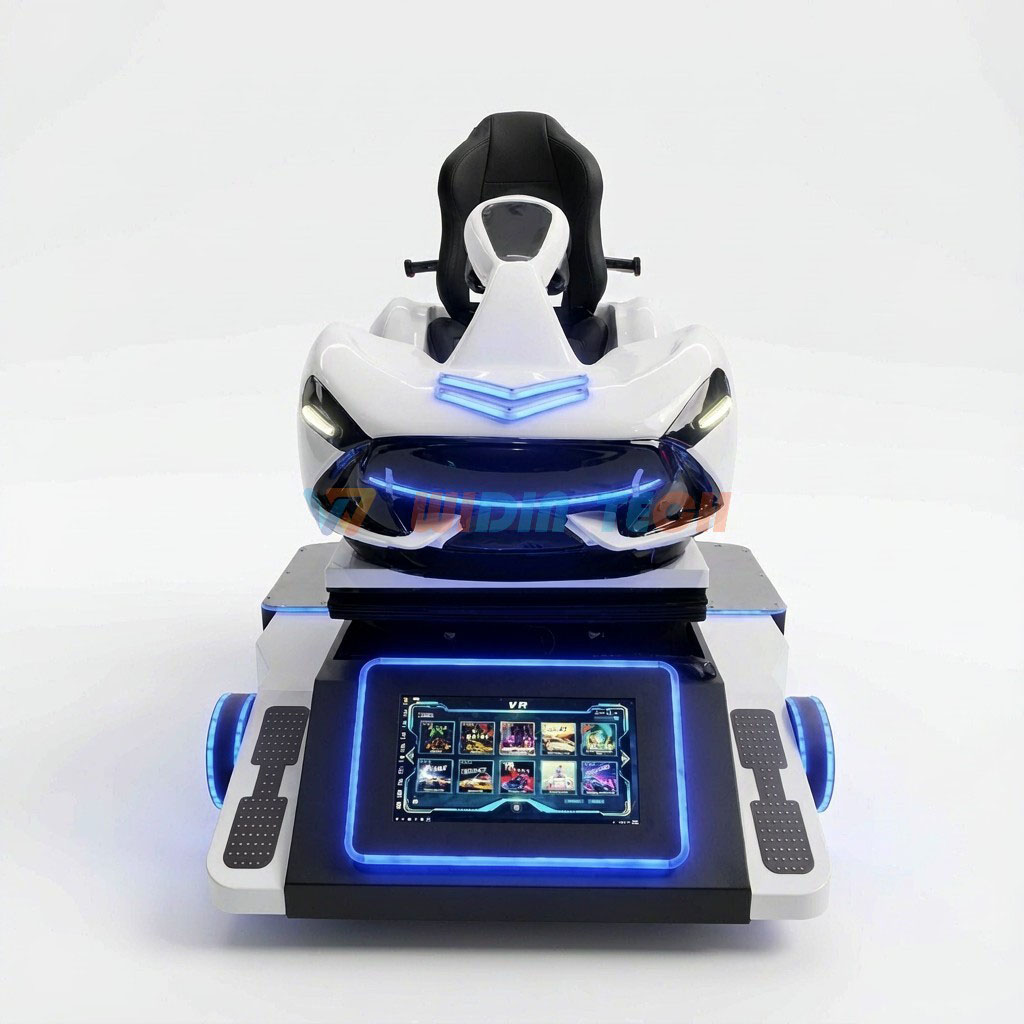
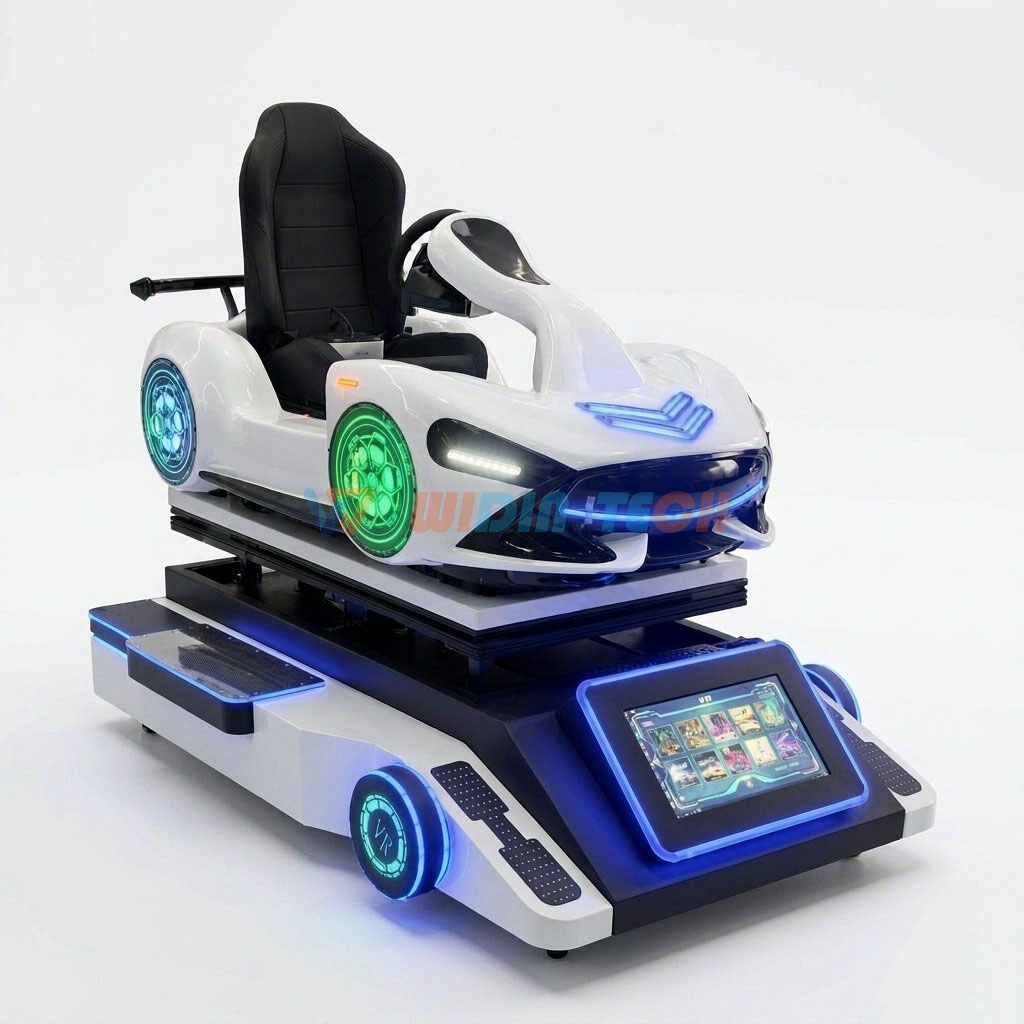
F1 VR Racing Machine
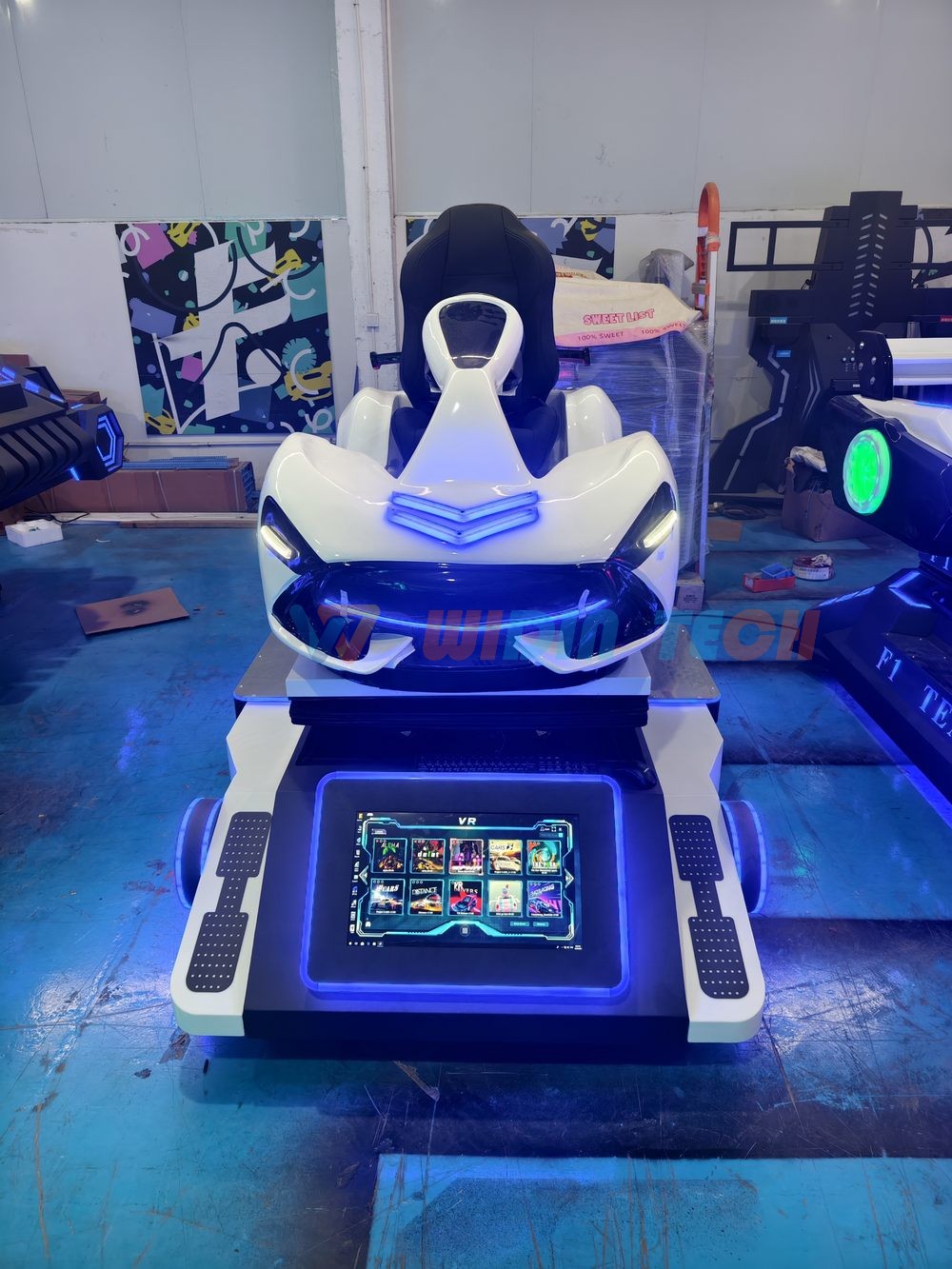
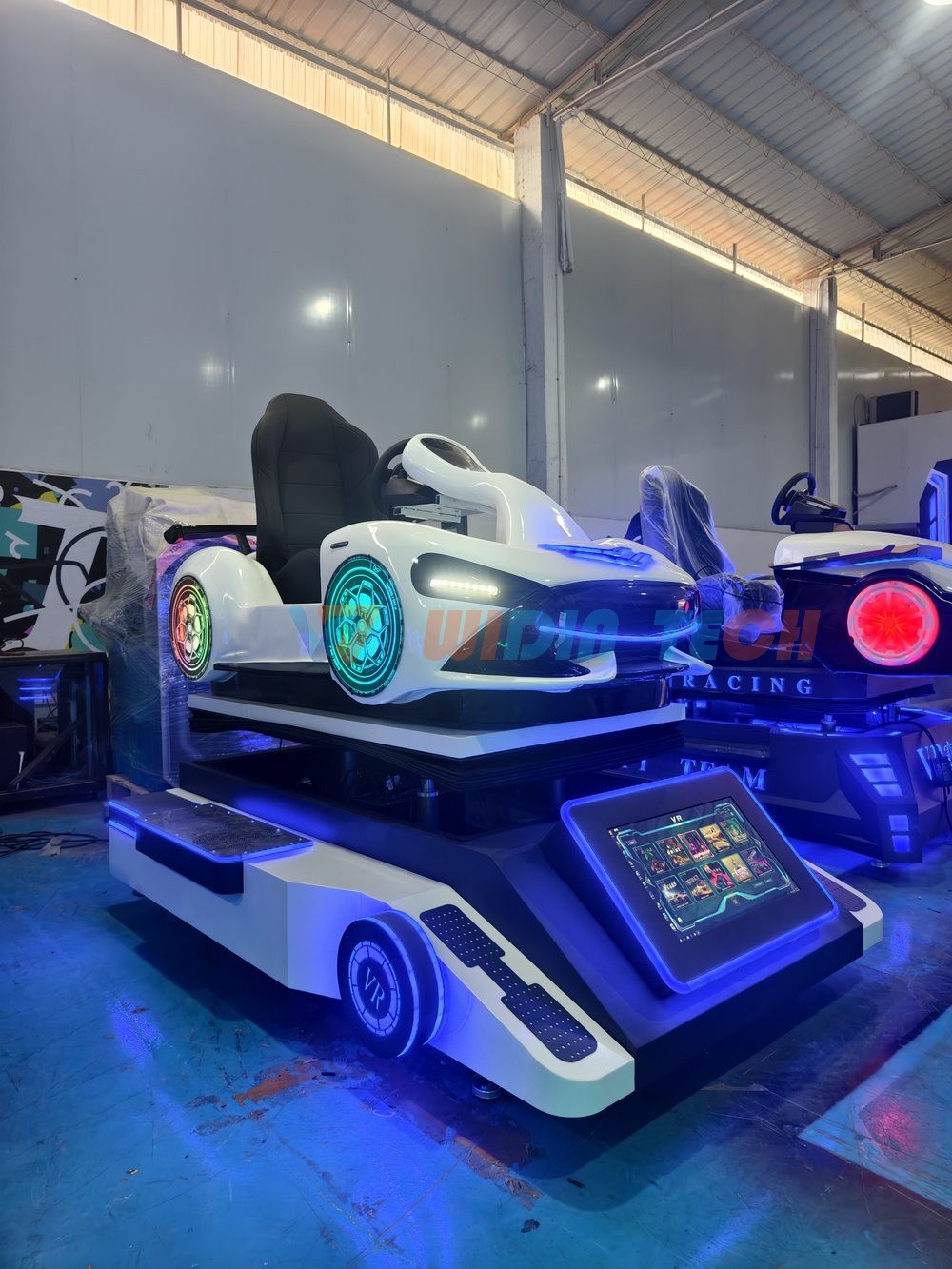
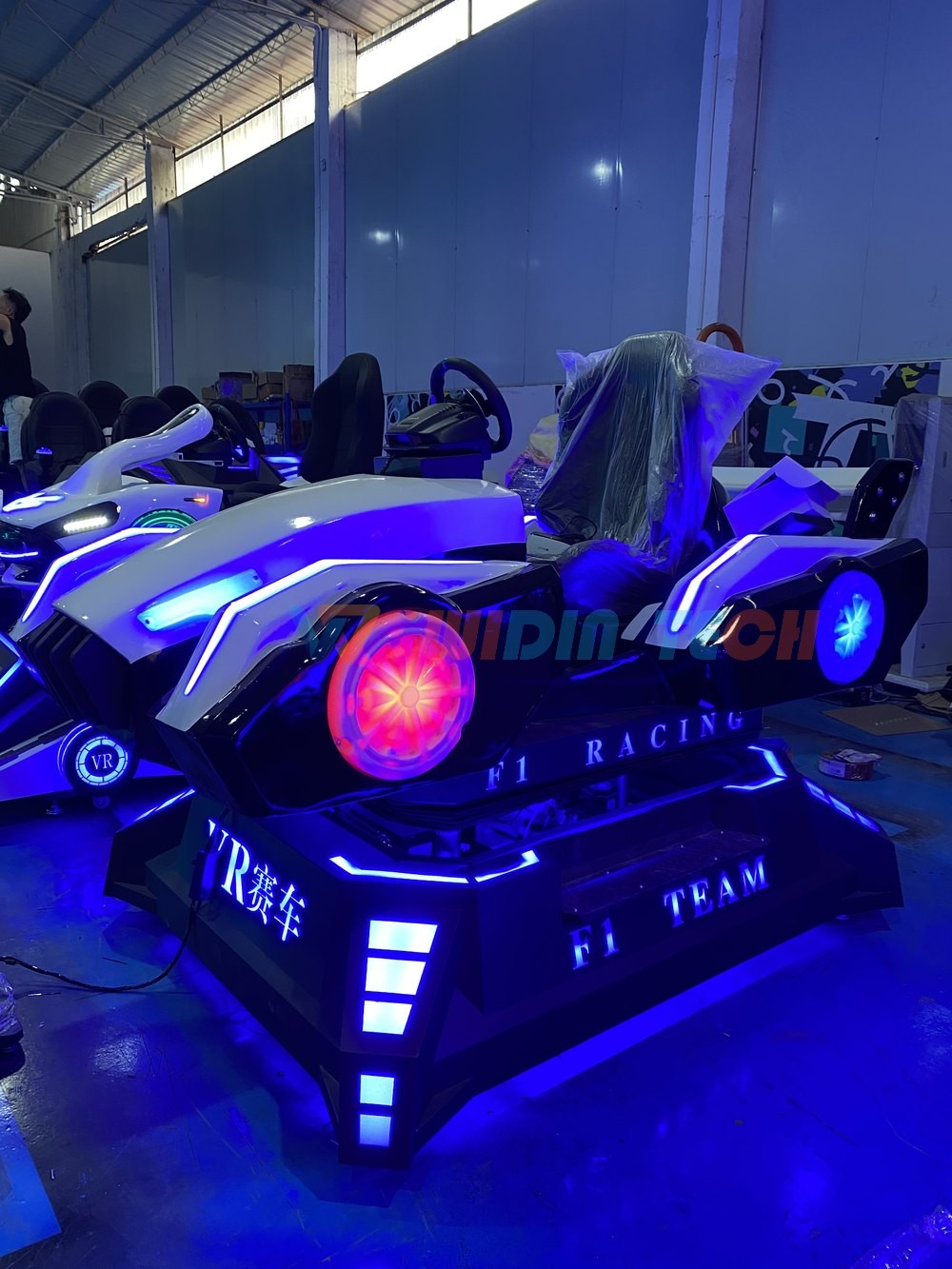
- Product name: F1 VR Racing Machine (cabinet carries F1 Racing / VR赛车 livery as photographed)
- Format: Single-seat racing simulator on a motion base
- Players: 1 per session
- Controls: Force-feedback steering wheel with accelerator and brake pedals; single racing bucket seat
- Display: The race runs through a VR headset — the photographs show no cockpit monitor. A touch panel on the base handles title selection
- Cabinet size: 2.47 m long × 1.55 m wide × 1.83 m high (axis order as quoted: L × W × H)
- Cabinet plan area: 3.83 m² — excludes the space a rider needs to step in, sit down, and get out
- Weight: ≈300 kg
- Power supply: AC 220 V, 1,500 W rated (as quoted — confirm the 110 V option for your market)
- Gaming PC: Gigabyte H310M motherboard, Intel i5-6500, GTX 1060 3 GB graphics, 8 GB DDR4, 240 GB SSD (standard build as quoted)
- Titles: 11 titles as quoted; languages
- Payment system: Coin-operated, optional: bill acceptor/card swiping / QR code scan payment. Warranty: 1-year whole machine warranty
- MOQ / lead time: 1 unit, 7 days
- Packing: Soft package, optional wooden frame / wooden case
- OEM / ODM: Supported — cabinet artwork, branding, game list, language, and payment system are configurable
The F1 VR Racing Machine is a single-seat racing simulator built on a motion base: one rider sits in a racing bucket seat behind a force-feedback steering wheel with pedals, picks a title from a touch panel mounted on the base, and races in a VR headset. Cabinet, base, seat and screens together measure 2.47 m long, 1.55 m wide and 1.83 m high, with 3.83 m² of cabinet plan area and a rated power of 1,500 W at AC 220 V. Three things decide most purchase conversations about a racing simulator of this class. First, one rider per session means throughput is a staffing and changeover question before it is a hardware question. Second, the cabinet plan area is not the floor you need — a rider has to step up into the seat and get out again, and the queue stands somewhere. Third, the racing PC inside decides which titles the machine can run and how long it will stay current, so ask what the standard build is rather than assuming. Figures on this page come from the factory's current quotation sheet for this model and are identified as quoted values throughout.
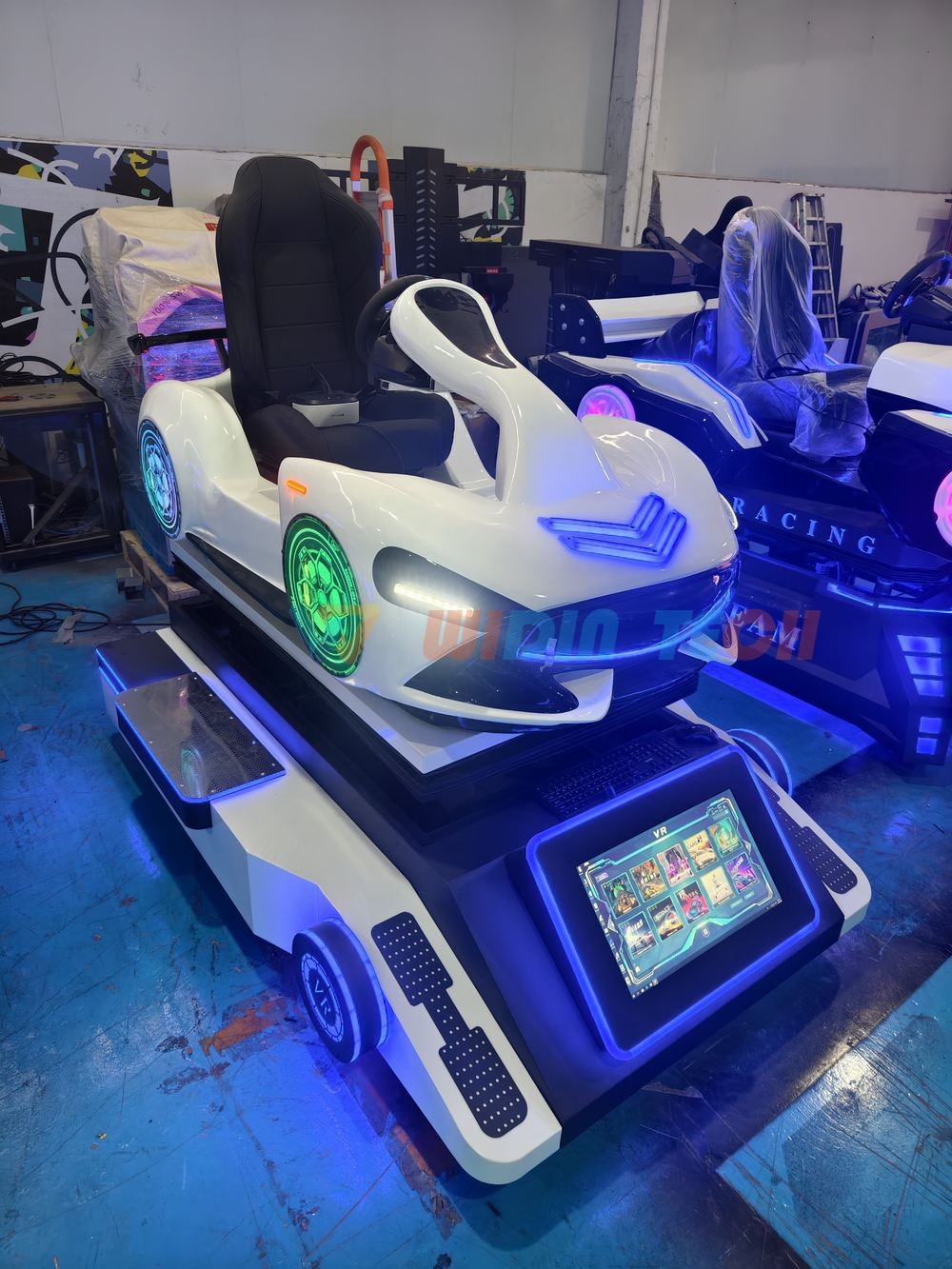
What to Check Before You Order
Floor space and rider access
The machine occupies 3.83 m² of cabinet plan area at 2.47 × 1.55 m, and that figure is a floor, not a budget. A racer with pedals needs a clear approach on the open side — the side the rider steps in from — plus somewhere to stand while the harness, wheel position and headset are adjusted. Budget roughly a metre of clear access along that face, and keep the queue outside it. Racing-simulator zones are usually sold on the promise of a longer session than a redemption game, so the whole point is that the next rider is already standing at the machine when the previous one climbs out; if the queue has to cross the play area, your changeover time doubles and the machine's earning rate falls with it. The arithmetic of what a zone has to recover per square metre is worked through in our arcade startup cost breakdown.
Access route and ceiling height
At 1.83 m high, the cabinet clears a standard interior doorway, which is roughly 200–210 cm. The constraint on this machine is length: 2.47 m is a long single piece, so the check is not the doorway itself but the turns on the way to the bay — a stairwell landing or a corridor corner can stop a 2.47 m machine that passed the door it came through. On containers, the standard ISO internal width is about 2.34 m and a high-cube door is about 2.58 m, so the machine travels upright in one width, whether it ships fully assembled or in sections. Measure your receiving route to the lowest obstruction — lighting track, sprinkler heads, ductwork, signage — rather than to the ceiling slab, and confirm the breakdown scope with the factory in the same email as the quote.
Power and electrical
The model is quoted at AC 220 V, 1,500 W rated. Rated watts divide by 1,000 to give hours per kilowatt-hour, so 1,500 W is about 0.67 hours per kWh — a 12-hour trading day draws roughly 18 kWh at the rated figure, which is a planning ratio rather than a meter reading. Give the machine its own circuit; a motion base, a gaming PC, an LED-lit body, and audio should not share a breaker with the rest of a bay. If your market runs 110 V, put the question in the quote explicitly, because a motion machine is not the item to convert on site with a step-up transformer.
One Rider at a Time: What the Format Costs You
A single-seat racer sells one play per cycle. The six-player machine in the same WIDIN VR range sells six at once from one cabinet, at 1.17 m² per play position against this machine's 3.83 m² and 4,500 W against six separate 1,500 W machines. That is the trade-off in one line: the F1 machine gives one rider a proper simulator — wheel, pedals, force feedback, a seat that moves — and the six-seat machine gives six riders a shared attraction. Neither is the wrong buy; the venue decides.
| Model | Play positions | Cabinet plan area | Area per position | Rated power | Weight |
|---|---|---|---|---|---|
| F1 VR Racing Machine (this page) | 1 | 3.83 m² (2.47 × 1.55 m) | 3.83 m² | 1,500 W | ≈300 kg |
| 6DOF three-screen racing simulator | 1 | 4.27 m² (2.07 × 2.07 m) | 4.27 m² | 1,500 W | ≈2,500 kg |
| 6-player VR battle machine | 6 | 7.02 m² (2.47 × 2.84 m) | 1.17 m² | 4,500 W | ≈1,500 kg |
| Twin racing set (on-screen, 2 seats) | 2 | 7.37 m² (2.88 × 2.56 m) | 3.69 m² | 300 W (as published on its page) | Published on its page |
Cabinet plan areas exclude rider access, staff access, and queue space, and every power figure is a rated value rather than a measured one, so read them as planning ratios rather than bills.
Where this machine has the advantage is the experience per rider: a headset race with a force-feedback wheel and pedals is a different product from two riders sharing a screen, and venues that sell racing as a premium attraction price it accordingly. Where it loses is density. If your floor is short and your footfall is walk-in, the six-seat machine or a twin racer will earn more per square metre; if you already have an audience that will pay for a proper simulator, one seat that does the job beats two that do half of it. The on-screen alternative, WIDIN's twin racing set, needs no headset and no hygiene routine at all, which matters if your venue has no attendant on that bay — that is a real operational difference, not a footnote.
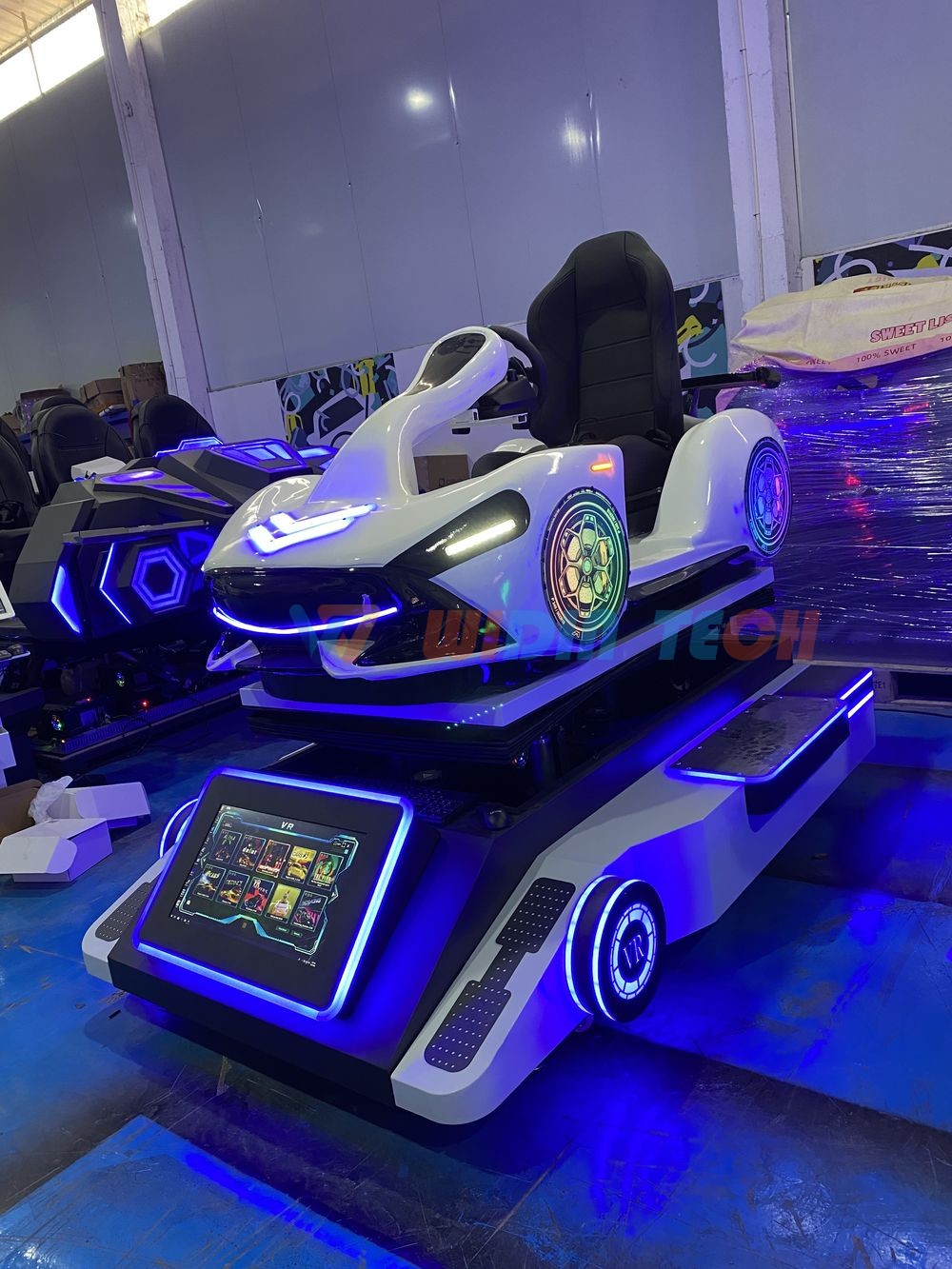
Wheel, Pedals and Headset: What Makes a Racing Simulator Feel Right
Three components decide whether a racer feels like a simulator or a toy, and only one of them is in the specification table.
The wheel. Force feedback is what separates a racing simulator from a steering-shaped joystick: the wheel resists as you turn into a corner and kicks back when you hit a kerb, and that response is what tells a rider the machine is worth paying more for. The photographs show a force-feedback wheel with a digital display on the hub, and a pedal set below it. Pedal travel and the resistance of the brake are the two adjustments riders notice first — ask the factory whether pedal travel is adjustable and whether the wheel force can be dialled back, because a first-timer fighting a heavy wheel will not come back for a second race.
The titles. This machine is quoted with 11 titles. On a headset racer, the library is the product: a small set of good titles beats a long list of filler, and the language list matters more than most buyers expect — if your market is not English-first, confirm which titles have your local language before production, not after delivery.
The headset and the changeover. Sessions end when the rider takes off the headset, and the next session cannot start until the facial padding is wiped. Hourly throughput is arithmetic you control: with a session of T minutes and a changeover of R minutes, one seat delivers 60 ÷ (T + R) riders per hour, so a 4-minute race with a 2-minute changeover is 10 riders an hour while a 6-minute race with a 4-minute changeover is 6. The session length for this machine is 10 minutes; you can rehearse the changeover. Ask the factory what the headset padding material is and whether replaceable hygienic covers are available, because that is a running cost rather than a feature — a charge your accountant will see every month.
Build Quality and Service Life
This machine is built under the same process the factory publishes across its range, and those process figures are the verifiable part. Every machine runs a 72-hour continuous aging test at full load before shipment, with no exceptions in the factory's process. Cabinet steel is 1.2 mm reinforced against the 0.6–0.8 mm common in the category, and powder-coated surfaces take about 8 additional hours of manual finishing per machine. WIDIN rates the stable service life of this build class at 4–6 years against 2–3 years for conventional workshop cabinets — a manufacturer's rating, stated so you can hold it against other suppliers' claims rather than take "commercial grade" on faith. The case for why that rating changes the ownership arithmetic is set out in our piece on how long commercial arcade machines last.
Two components on a motion racer deserve their own line in the warranty conversation. The motion base is the part that wears, so ask for its maintenance schedule — a lubrication interval and a fastener check are normal — and ask what the spare-parts lead time is for the actuators, because a racer out of service for a month is worse than a racer that cost a little more. The gaming PC is the second: the quoted standard build is an i5-6500 with a GTX 1060 3 GB, a 240 GB SSD and 8 GB of DDR4. That is a serviceable 1080p-class build for headset racing, and it is also the component that will date first, so confirm whether the PC is a standard modular unit you can replace locally and what the factory's policy is on graphics upgrades.
Custom Builds and OEM Orders
OEM and ODM customization covers cabinet artwork, brand logos, the game list, game language, and the payment system — coin, bill, card, or cashless, matched to what your venue already runs. On a racing machine, the artwork is unusually visible: the cabinets in these photographs carry their domestic-market F1 Racing graphics, and export units are produced with the buyer's own livery, which is the cheapest way to make a machine look like it belongs in your venue rather than in a catalogue. Confirm the title list by name and language before production rather than after delivery, and if you intend to run two machines head-to-head, put the linking question in the same email.
Shipping, Packing and Installation
The standard factory packaging is soft wrapping; the dimensions after crating are 2.55 m long × 1.60 m wide × 2.03 m high. At about 300 kg, the machine is heavy cargo rather than parcel freight: it needs a pallet truck or forklift at both ends, and a delivery slot when somebody is on site to receive it. Site requirements before delivery are the same three as any motion machine — a receiving path that clears 2.47 m in a straight line through every turn, ceiling clearance over that path, and a level floor, because a motion base on an uneven slab will rock and will eventually loosen. Freight is quoted per destination and per volume, so send the port and the quantity with the enquiry and let the factory itemise the freight rather than estimate it.
Frequently Asked Questions
How much does the F1 VR racing machine cost?
The price for this model is. Racing simulators are quoted on quantity, destination port, and configuration, and the two options that move the number most are the payment system and whether you take the standard PC build or an upgrade. For orientation, WIDIN publishes USD pricing on its on-screen twin racing set; that is a different format and a different specification, so treat it as a sibling reference rather than a quote. Send quantity, port, and configuration and the factory answers with an itemised figure.
How much floor space does a single-seat racing simulator need?
The cabinet plan area is 3.83 m² at 2.47 × 1.55 m, and that excludes the space a rider needs to approach the seat and get out. Budget about a metre of clear access along the open side and keep the queue outside it. Racing simulators have long sessions, so access space is what keeps the changeover short — a queue that has to cross the play area is the most common way a good machine earns badly.
Will it fit through a standard doorway?
At 1.83 m high, yes — a standard interior doorway is roughly 200–210 cm. The real constraint is the 2.47 m length, which makes corners and stairwell landings the deciding factor rather than the doorway. Whether the machine ships assembled or in sections is. Measure your route to the lowest obstruction and ask for the largest crate dimensions before booking delivery.
What power supply does it need?
The model is quoted at AC 220 V with a rated power of 1,500 W. Rated watts over 1,000 gives hours per kilowatt-hour, so 1,500 W is about 0.67 h per kWh, and a 12-hour trading day draws roughly 18 kWh at the rated figure — a planning ratio, not a meter reading. Give it a dedicated circuit, and confirm the 110 V option in the quote if your market needs it.
Is it a screen machine or a headset machine?
Headset. The photographs show no cockpit monitor — the rider looks through a VR headset, and the touch panel on the base is for choosing a title. That means the buying decision includes a hygiene routine and a supply of replacement headset padding, which a screen machine does not need. It also means the machine needs no dark enclosure and can stand on an open floor, which most screen-based motion racers cannot.
How many racing titles does it come with?
11 titles as quoted, running on the standard PC build. Confirm the title list and the language set in writing before production: on a headset racer the library is the product, and a venue in a non-English market that receives 11 English-only titles has bought a machine it cannot market.
How many riders can it serve in an hour?
One per session at 60 ÷ (T + R) riders per hour, where T is the session in minutes and R is the changeover. Session length for this model is 10 minutes; the changeover is the part you control, and on a headset racer it is mostly a headset-wipe and harness routine. A rehearsed two-minute changeover with a four-minute race is 10 riders an hour — better than a longer race with a slow turnaround, and it is free.
What computer runs the machine?
The quoted standard build is an Intel i5-6500 with a GTX 1060 3 GB graphics card, 8 GB of DDR4 memory, a 240 GB SSD, and a Gigabyte H310M motherboard. It is a 1080p-class build sized for headset racing. Because the PC is the component that dates first, confirm before ordering whether it is a standard modular unit you can service or replace locally, and whether the factory offers a graphics upgrade.
Can I put my own branding on the machine?
Yes — OEM/ODM covers cabinet artwork, brand logos, game list, game language, and payment configuration. The cabinets in these photographs carry their domestic-market livery; export units are built in the buyer's artwork. Ask for the artwork template and the print specification with the quote so your designer works to the factory's file format rather than discovering it late.
What are the MOQ, lead time, and warranty?
All three for this model are: MOQ: 1 unit, lead time: 7 days, warranty: 1 year. Get the warranty scope in writing per component rather than as a single number, because the motion base, the PC, the wheel, and the headset fail at different rates: ask which are covered, for how long, and what the spare-parts lead time is for the actuators and the wheel.
Request a Quote
A quotation for this machine needs three inputs: the quantity, the destination country or port — it sets voltage, plug standard, and freight — and the configuration, meaning payment system, artwork language, and the game list. Two more are specific to a headset racer: the title language you need, and whether you want the standard PC build or an upgrade. Send all of it through the contact page, and the quote comes back with freight itemised rather than guessed. If you are buying two machines, say so in the enquiry — the linking question and the freight both get cheaper that way.
— Chen, Founder & CEO at Guangzhou WIDIN Tech. A racing simulator is judged in the first thirty seconds of the first race. If the wheel does not fight back and the pedals do not move under your foot, the rider has already decided it is a toy — and no amount of cabinet lighting changes that verdict.