

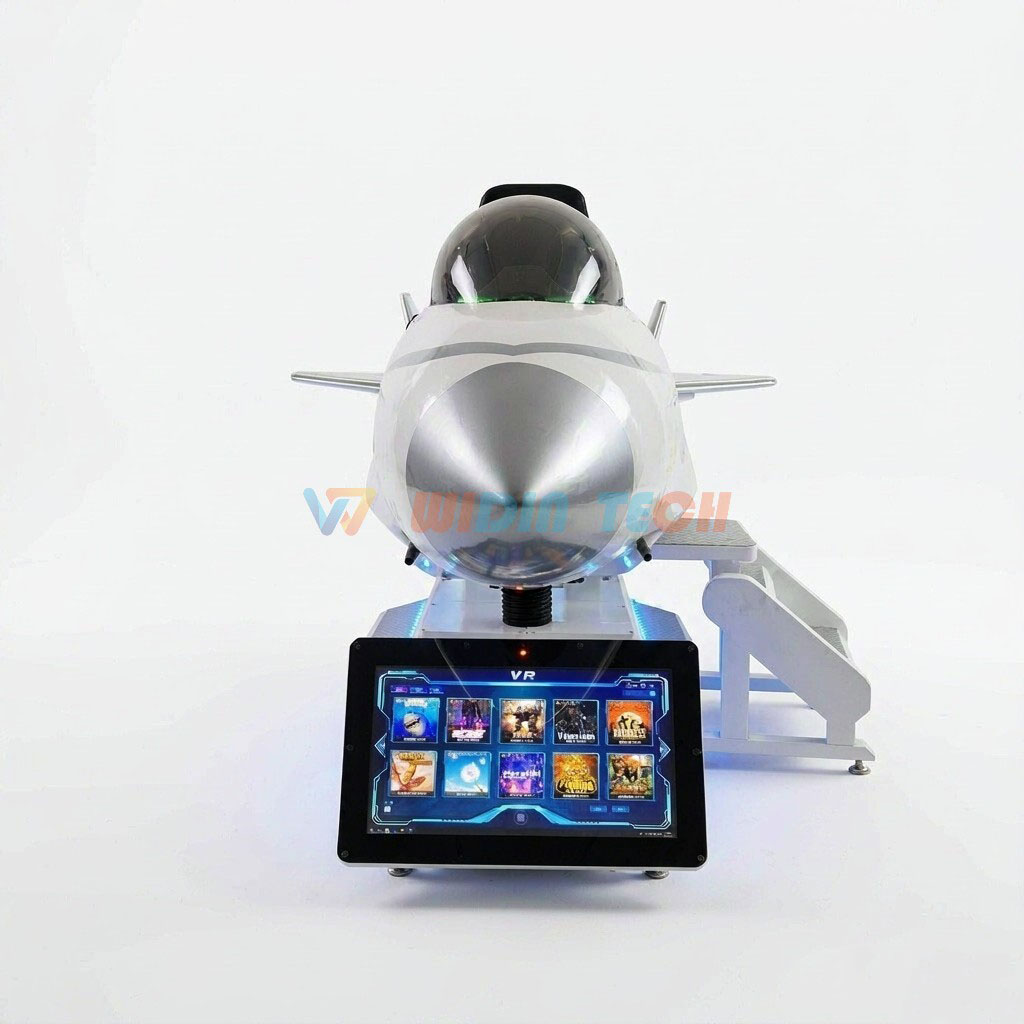
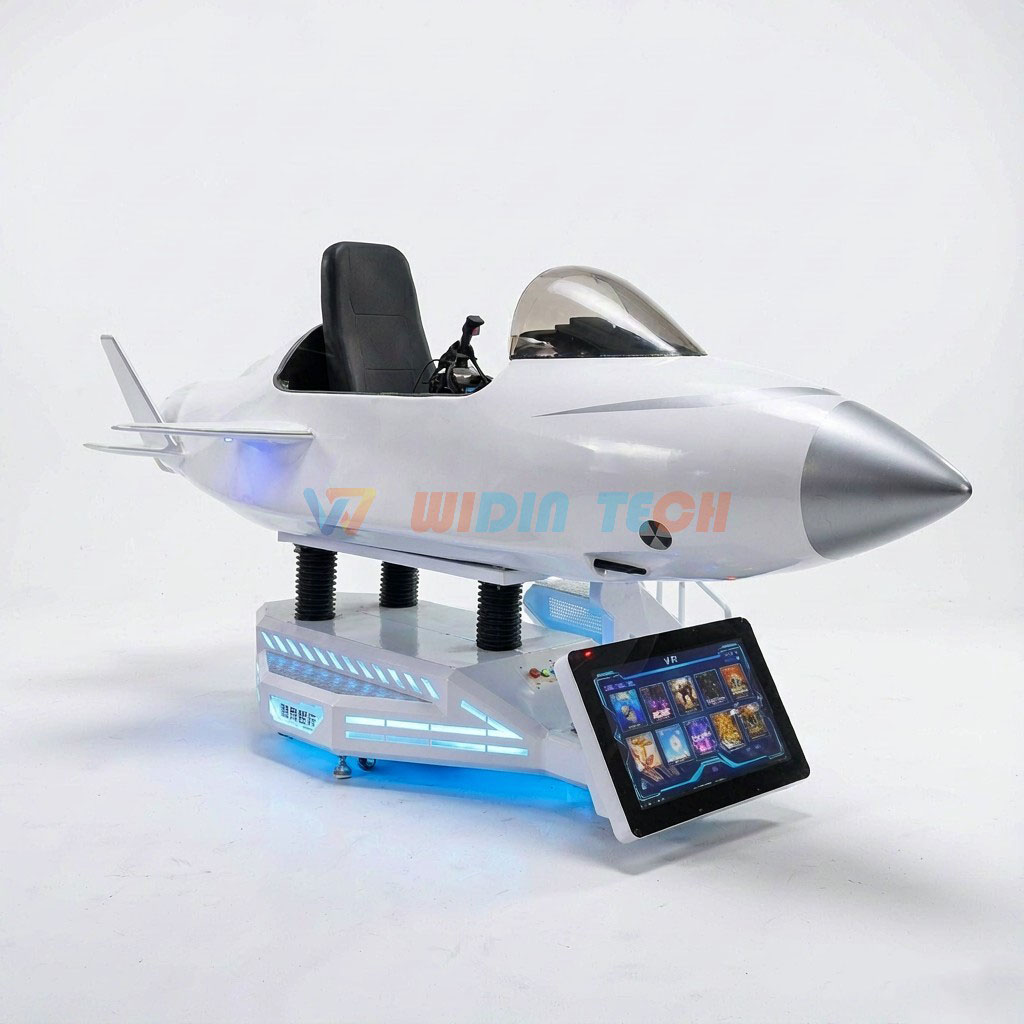
VR Plane Flight Simulator Machine
- Product name: VR Plane Flight Simulator
- Format: Single-seat VR flight ride in a jet-fuselage cabin on a motion base
- Players: 1 per session
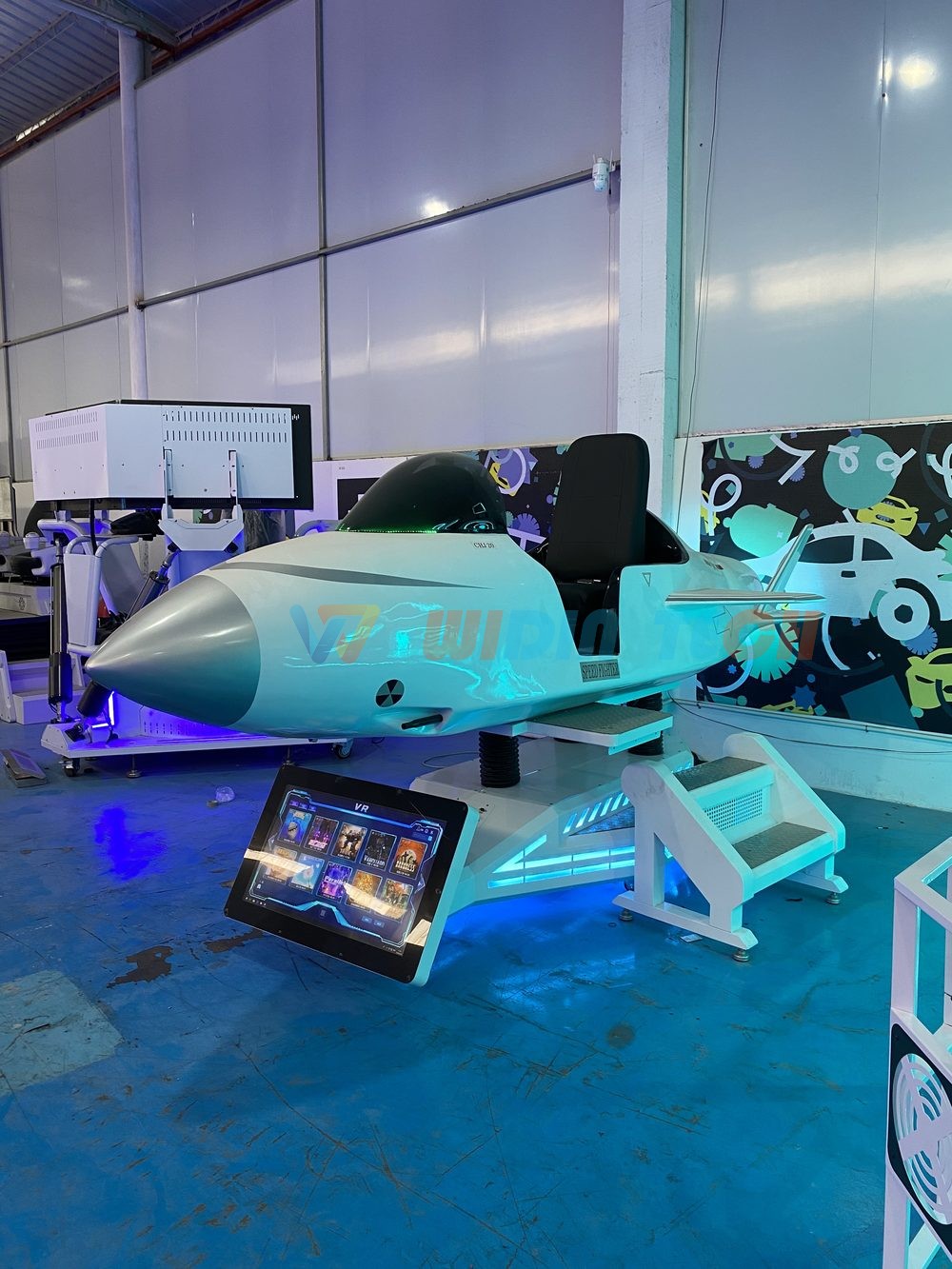
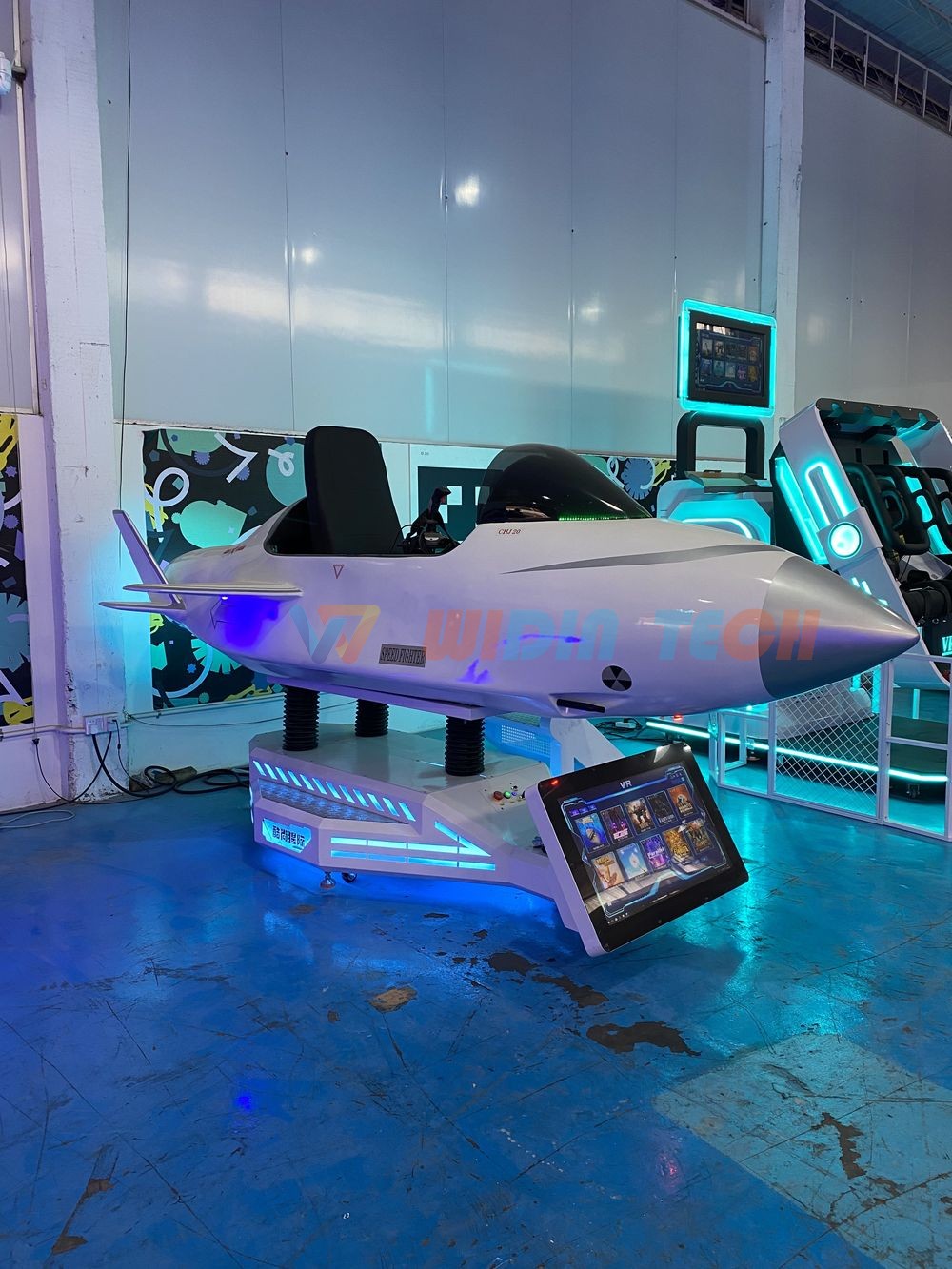
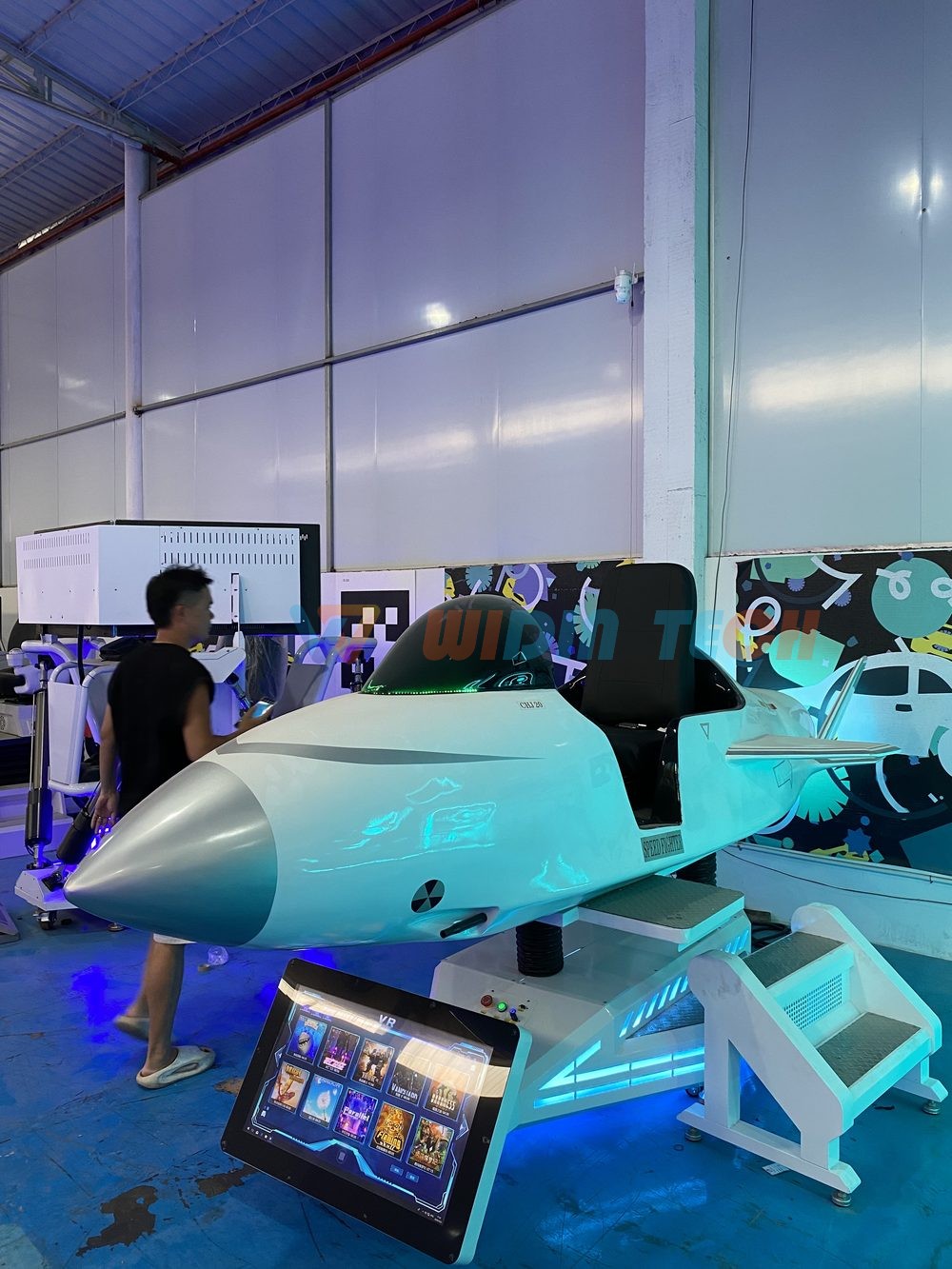
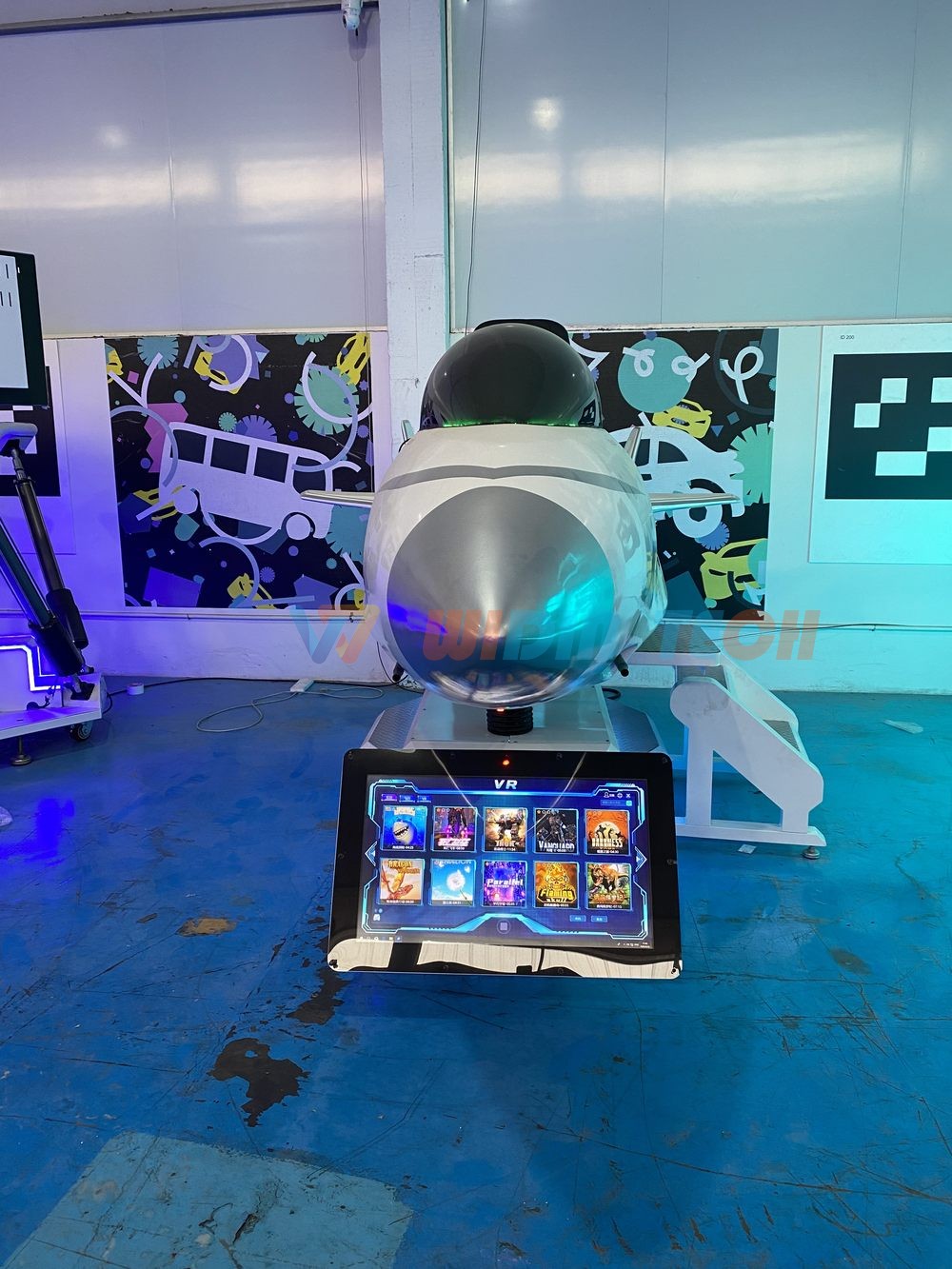
- Cabin: Enclosed fuselage with canopy, racing-style bucket seat and an access step (visible in photographs)
- Display: VR headset for flight; a touch panel at the nose handles title selection
- Cabinet size: 1.46 m long × 2.27 m wide (wing tip to wing tip) × 2.14 m high (axis order as quoted: L × W × H)
- Cabinet plan area: 3.31 m² — the wings define the width, so this is the usable plan figure
- Weight: ≈250 kg
- Power supply: AC 220 V, 1,500 W rated (as quoted — confirm the 110 V option for your market)
- Gaming PC: Gigabyte H310M motherboard, Intel i5-6500, GTX 1060 3 GB graphics, 8 GB DDR4, 240 GB SSD (standard build as quoted)
- Titles: 80 titles as quoted
- Warranty: 1-year whole machine warranty
- MOQ / lead time: 1 unit, 7 days
- -Packing: Soft package, optional wooden frame / wooden case
- OEM / ODM: Supported — artwork, branding, game list, language, and payment system are configurable
The VR Plane Flight Simulator is a single-seat flight ride built around a jet-fuselage cabin: one rider climbs a step into the cockpit, sits under the canopy, and flies in a VR headset while the base underneath the fuselage moves. The machine measures 1.46 m long, 2.27 m wingtip to wingtip, and 2.14 m high, with 3.31 m² of cabinet plan area and a quoted weight of about 250 kg—the lightest machine in WIDIN's VR range. It's rated at AC 220 V, 1,500 W, and comes with an 80-title library, the largest in the range apart from the six-seat battle machine. Three things decide most purchase conversations about a cockpit ride. First, it is not an arcade cabinet — it is a piece of scenery, and it earns part of its money from being photographed by people who never ride it, which changes where you put it. Second, 2.14 m is taller than a standard doorway, so the delivery route is a real question rather than a formality. Third, boarding is assisted: a rider climbs in and gets strapped in, so the machine needs an attendant in sight, and the age policy has to come from the factory in writing.
What to Check Before You Order
Floor space and the wings
The plan area is 3.31 m² at 1.46 × 2.27 m, but unlike a cabinet, most of that width is wing: the fuselage itself takes a fraction of the space the machine reserves. Two consequences follow. The wings are what you cannot walk through, so a flight simulator placed in a narrow aisle will block traffic in a way a 0.6 m deep cabinet does not — put it against a wall or in a corner, or accept that the wing line is a barrier. And because part of the value of a machine like this is that people photograph it, the position that photographs best is usually the position that blocks least traffic: a corner with the nose angled toward the main walkway. The area figure excludes the space needed to climb in, the space an attendant stands in while strapping a rider in, and the queue. The wider question of what floor has to earn per square metre is worked through in our arcade startup cost breakdown.
Access route and the 2.14 m height
This is the one dimension to settle before you order. At 2.14 m, the machine is taller than a standard interior doorway, which is roughly 200–210 cm, so a straight walk-in delivery is not available unless the route has a double door, a shutter or a goods entrance. Add the crate to the height, and the gap widens further, so expect this machine to travel in sections and assemble on site — the fuselage, the motion base, and the wings are the three parts that matter, and the split is integrated transportation. For container context, a standard ISO container gives about 2.34 m of internal width and about 2.58 m of high-cube door height: the 2.27 m wing span leaves only about 7 cm of clearance before the crate adds thickness, which is why the wings normally come off for shipping rather than travelling in place. Measure the route to the lowest obstruction — lighting track, sprinkler heads, ductwork, signage — and ask the factory for the largest section dimensions in the same email as the quote.
Power and electrical
The model is quoted at AC 220 V, 1,500 W rated. Rated watts over 1,000 gives hours per kilowatt-hour, so 1,500 W is about 0.67 h per kWh, and a 12-hour trading day draws roughly 18 kWh at the rated figure — a planning ratio rather than a meter reading. Three loads sit behind that number on this machine: the motion base, the gaming PC, and the cabin lighting and audio, which on a fuselage machine is more LED surface than a standard cabinet. Give it a dedicated circuit and confirm the 110 V option in the quote if your market needs it; a flight ride is not the machine to convert on site.
What a Cockpit Ride Changes on Your Floor
A jet-cockpit flight simulator is a landmark machine. It is the thing visitors photograph and post; it pulls people down an aisle, and it gives a venue a reason to be described as having "the plane" — which is worth money that never shows up in a per-play calculation. That is also its cost: it takes a corner you could have filled with three cabinets, it is too tall for the back of a low bay, and one rider per cycle at a session you have to keep short limits the plays per hour. The comparison below puts it against the other single-seat machine in the same WIDIN VR range and against the two machines that beat it on density.
| Model | Play positions | Cabinet plan area | Area per position | Rated power | Weight |
|---|---|---|---|---|---|
| VR Plane Flight Simulator (this page) | 1 | 3.31 m² (1.46 × 2.27 m) | 3.31 m² | 1,500 W | ≈250 kg |
| F1 VR racing machine | 1 | 3.83 m² (2.47 × 1.55 m) | 3.83 m² | 1,500 W | ≈300 kg |
| 6DOF three-screen racing simulator | 1 | 4.27 m² (2.07 × 2.07 m) | 4.27 m² | 1,500 W | ≈2,500 kg |
| 6-player VR battle machine | 6 | 7.02 m² (2.47 × 2.84 m) | 1.17 m² | 4,500 W | ≈1,500 kg |
Cabinet plan areas exclude rider access, staff access and queue space, and power figures are rated rather than measured values, so read them as planning ratios rather than bills.
The honest reading: on floor efficiency this machine sits in the middle of the range, close to the F1 racer and well behind the six-seat battle machine, which delivers six play positions at 1.17 m² each. It wins on two things the table cannot show. At 250 kg it is light enough that the install is far less of an event than the 2,500 kg 6DOF machine — no structural survey, no crane, and two people can position it once it is off the pallet. And a plane cockpit is a different sell from a racing seat: venues that already have a wall of racers use it to break up the floor, and venues with a family audience get the ride nature of it without the intensity of a full-motion racer.
Boarding, Egress and the Age Line
A cockpit changes the operating routine more than a cabinet does, and this is the section that decides whether the machine runs smoothly at 8 pm on a Saturday.
Boarding is the bottleneck, not the ride. A rider has to climb a step, sit down inside a fuselage and be strapped in, then reverse it afterwards. That is slower than sitting on an open seat, and it happens twice per cycle. With a session of T minutes and a boarding-and-strapping routine of R minutes, the machine delivers 60 ÷ (T + R) riders per hour, so a 4-minute flight with 3 minutes of boarding and headset wipe is about 8 riders an hour — and the whole difference between 8 and 12 is a rehearsed routine, not a hardware option. Session length is 10 minutes.
The age and height line has to come from the factory, in writing. A rider who cannot reach the pedals, cannot see over the coaming, or cannot be held by the restraint should not ride, and the number that defines that is height over 140 cm, age over 12. Post it at the machine rather than deciding at the counter; an age policy invented by an attendant is the liability, not the one the manufacturer confirmed. For the frame your local rules use, IAAPA, the global attractions industry association, publishes safety resources covering rider eligibility, restraint use and signage for attractions of this class — industry guidance rather than a specification of this machine.
An attendant has to be in sight. Unlike a claw cabinet or a single-play unit such as the boxing prize machine, this machine cannot be left to run itself: somebody has to strap a rider in and help them out, and somebody has to wipe the headset between riders. If your venue has no attendant on that bay at any hour, this is not the machine for that bay.
The headset wipe is a running cost. Facial-contact padding touches one face after another all day. Ask the factory what the padding material is and whether replaceable hygienic covers are offered, and stock the wipes at the boarding step where the attendant already stands — a routine that happens where the staff already are gets done; one that happens ten metres away does not.
Build Quality and Service Life
This machine is built under the same process the factory publishes across its range, and those process figures are the verifiable part. Every machine runs a 72-hour continuous aging test at full load before shipment, with no exceptions in the factory's process. Cabinet steel is 1.2 mm reinforced against the 0.6–0.8 mm common in the category, and powder-coated surfaces take about 8 additional hours of manual finishing per machine. WIDIN rates the stable service life of this build class at 4–6 years against 2–3 years for conventional workshop cabinets — a manufacturer's rating, stated so you can hold it against other suppliers' claims rather than take "commercial grade" on faith, and the argument for why that rating changes the ownership arithmetic is set out in our piece on how long commercial arcade machines last.
One thing to check on a fuselage machine: the finish is a large, soft curved surface, and it takes more knocks than a flat cabinet panel because riders climb past it and visitors lean on it. Ask whether the exterior is a gelcoat or a painted moulding and what the factory recommends for scratch repair, because a landmark machine with a scuffed nose stops looking like a landmark. The motion base is the other component worth a line in the warranty conversation — the pedestal under the fuselage carries the whole moving assembly, so ask for its maintenance interval and the spare-parts lead time in the same email as the price.
Custom Builds and OEM Orders
OEM and ODM customization covers cabinet artwork, brand logos, the game list, game language, and the payment system — coin, bill, card, or cashless, matched to what your venue already runs. A plane is the easiest machine in the range to brand: the fuselage sides are a large flat-ish surface, so a venue's own livery, a sponsor's mark or a themed character reads clearly from across the hall. If you are buying for a licensed or themed attraction, send the brand guidelines with the enquiry, and the factory will confirm which parts of the machine can carry supplied artwork and which stay in the standard finish. Confirm the title list by name and language before production, not after delivery.
Shipping, Packing and Installation
Packing: Soft packing for shipment; wooden frame or wooden case packing available as an option. At about 250 kg, the machine is the easiest of the WIDIN VR range to move: it is heavy cargo rather than parcel freight, but two people and a pallet truck handle it once it is off the pallet, and it needs no structural work on a normal ground-floor slab. The shipping plan follows the height rule from the checklist above — 2.14 m does not pass a standard 200–210 cm doorway upright, and a 2.27 m wing span leaves only about 7 cm inside a 2.34 m container width before crate thickness, so the wings travel off the fuselage and the machine assembles on site. Site requirements before delivery: a receiving path sized for the largest section with a route to the final bay that clears 2.14 m on the assembled machine, a level floor for the motion base, and the dedicated circuit from the checklist. Confirm the section list and the assembly scope with the quote so nobody discovers the wing bolts on delivery day.
Frequently Asked Questions
How much does the VR plane flight simulator cost?
Flight rides are quoted on quantity, destination port, and configuration, and the options that move the number most are the payment system and the game list. For orientation, WIDIN publishes USD pricing on its on-screen twin racing set — a different format and specification, so treat it as a sibling reference rather than a quote. Send quantity, port, and configuration, and the factory answers with an itemised figure.
How much floor space does the VR plane flight simulator need?
The plan area is 3.31 m² at 1.46 m long and 2.27 m wing tip to wing tip, excluding the space needed to board, the space an attendant stands in, and the queue. Most of that width is wing, so the machine reserves more floor than the fuselage appears to occupy — plan it against a wall or into a corner rather than in an aisle, and leave the boarding side clear.
Will it fit through a standard doorway?
Not upright in one piece. At 2.14 m, the machine is taller than a standard interior doorway of roughly 200–210 cm, so it travels in sections and assembles on site unless your route has a double door, a shutter, or a goods entrance tall enough. Measure the route to the lowest obstruction before booking delivery.
What power supply does it need?
The model is quoted at AC 220 V with a rated power of 1,500 W. Rated watts divided by 1,000 gives hours per kilowatt-hour, so 1,500 W is about 0.67 h per kWh and a 12-hour trading day draws roughly 18 kWh at the rated figure — a planning ratio, not a meter reading. Give the machine a dedicated circuit and confirm the 110 V option in the quote if your market needs it.
What does the rider control the plane with?
The cockpit photographs show a single seat under a canopy; the factory's quotation sheet describes force feedback and pedals for this model, which reads as a racing control set, so confirm whether the machine ships with a flight yoke or a wheel before you commit — a flight simulator that steers like a car describes itself badly to customers, and the answer is a one-line email.
How many titles does it come with, and in which languages?
80 titles as quoted, the largest library in WIDIN's VR range apart from the six-seat battle machine. Supports multiple languages. On a headset machine, the library is the product, so ask for the title list by name and confirm which titles carry your market's language before production — a large library without your language is a small library.
What age or height does a rider need to be?
The manufacturer's age policy and minimum height for this model are Height over 140 cm, age over 12 years oldand should be confirmed in writing and posted at the machine. Because a rider climbs in and is strapped into a seat inside an enclosed cabin, the practical limits are reach to the controls, sight lines under the canopy, and how the restraint holds a smaller body — all of which are the factory's numbers to state, not yours to guess.
Does the machine need an attendant?
Yes. Two parts of the cycle need a person: strapping a rider in and helping them out of the cockpit, and wiping the headset between riders. A cockpit machine cannot be left to run unattended the way a redemption cabinet can, so if the bay has no staffing at any hour of trade, plan for it or plan for a different machine.
Can I put my own artwork and branding on the fuselage?
Yes — OEM/ODM covers cabinet artwork, brand logos, game list, game language and payment configuration, and the fuselage sides are the largest printable surface in the range. Send your brand guidelines with the enquiry and the factory will confirm which panels can carry supplied artwork. For a themed or licensed venue, this is the cheapest way to make the machine look built for the site rather than delivered to it.
What are the MOQ, lead time, and warranty?
MOQ is 1 unit, lead time is 7 days, and the warranty is 1 year. Get the warranty scope in writing per component rather than as a single figure: the motion base, the PC, the headset, and the cabin lighting fail at different rates, so ask which are covered, for how long, and what the spare-parts lead time is for the pedestal and its moving parts.
Request a Quote
A quotation for this machine needs three inputs: the quantity, the destination country or port — it sets voltage, plug standard and freight — and the configuration, meaning payment system, artwork language and the game list. Two more are specific to a cockpit ride: your receiving route and whether it clears 2.14 m, because the answer decides whether the machine travels in two sections or three; and the control set you expect, so the factory confirms a yoke or a wheel before production instead of after. Send all of it through the contact page, and the quote comes back with freight itemised rather than guessed.
— Chen, Founder & CEO at Guangzhou WIDIN Tech. A plane sells a place, not just a play. People who never climb in still stop and take the photo, and that is why the corner you give this machine is usually worth more than the two cabinets you could have put there.