

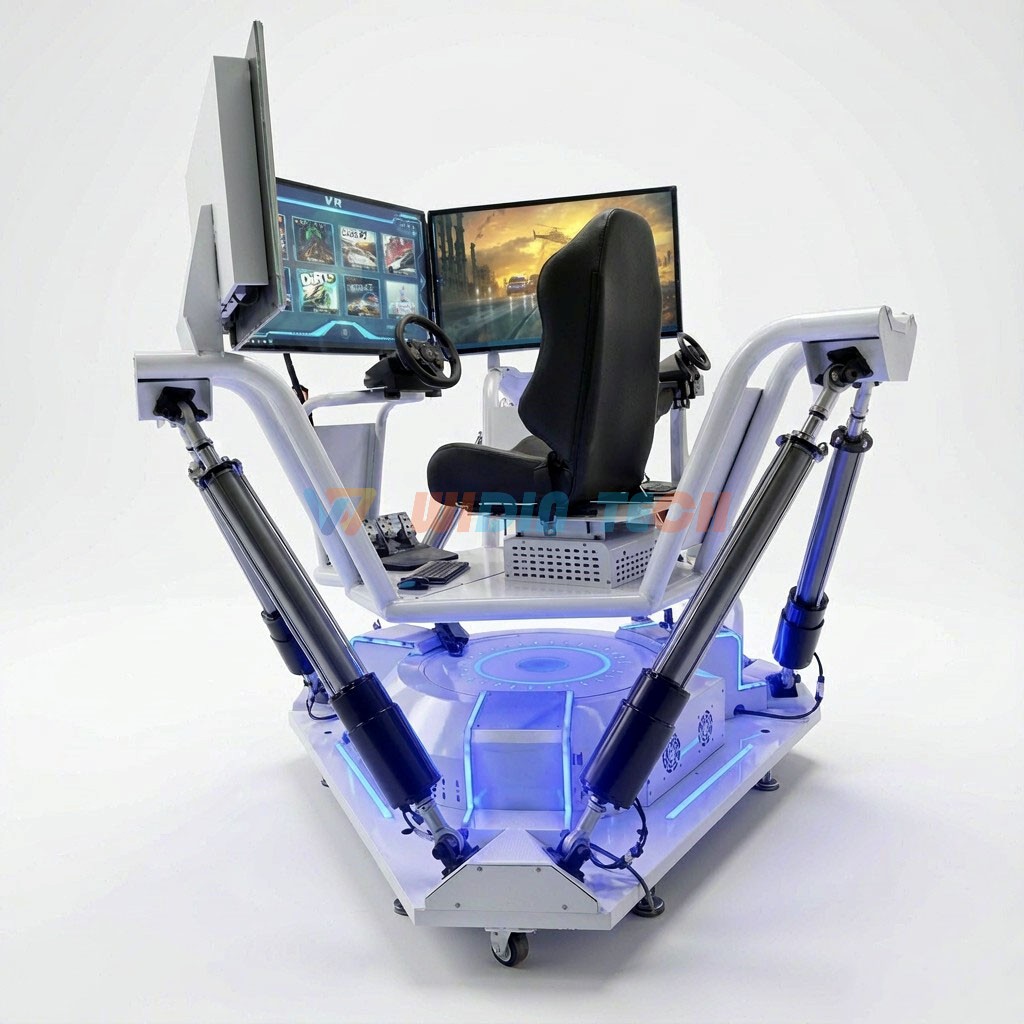
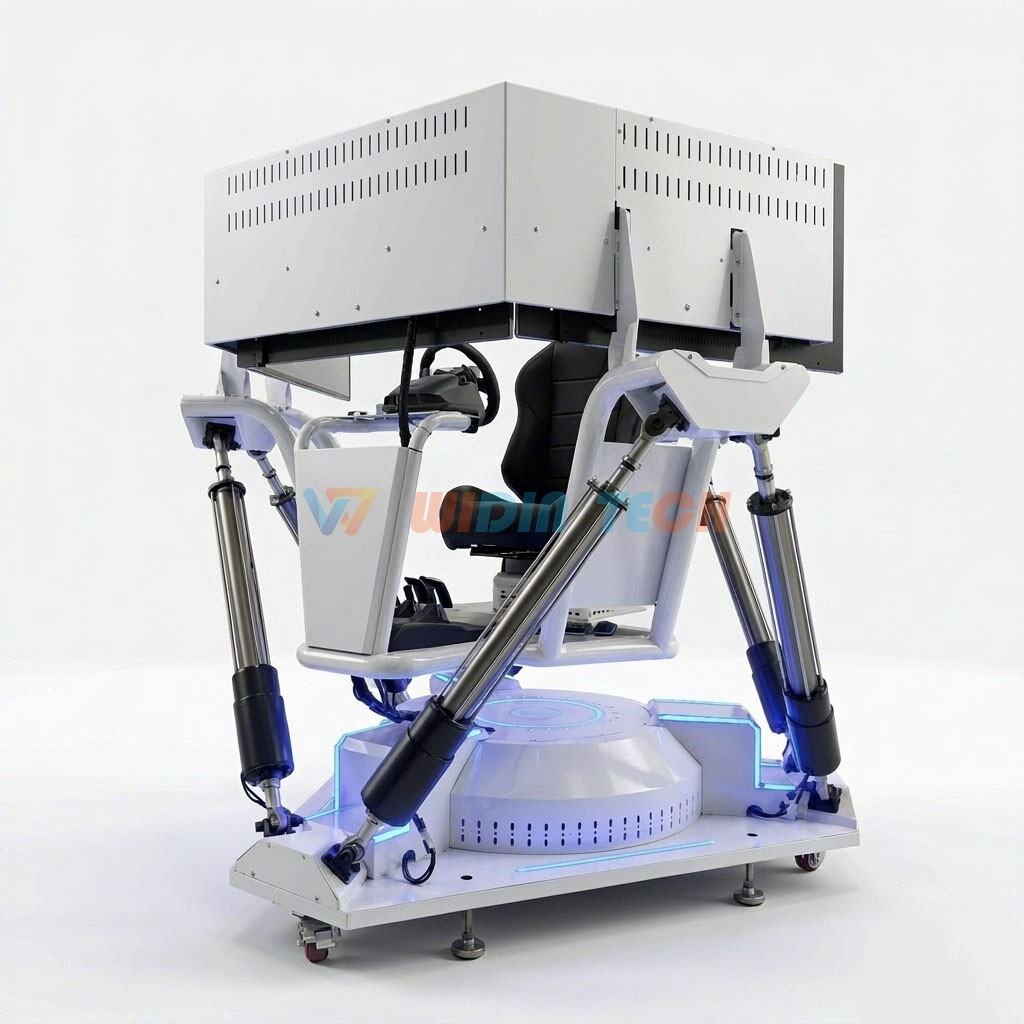
6DOF Three-Screen Racing Simulator
- Product name: 6DOF Three-Screen Racing Simulator
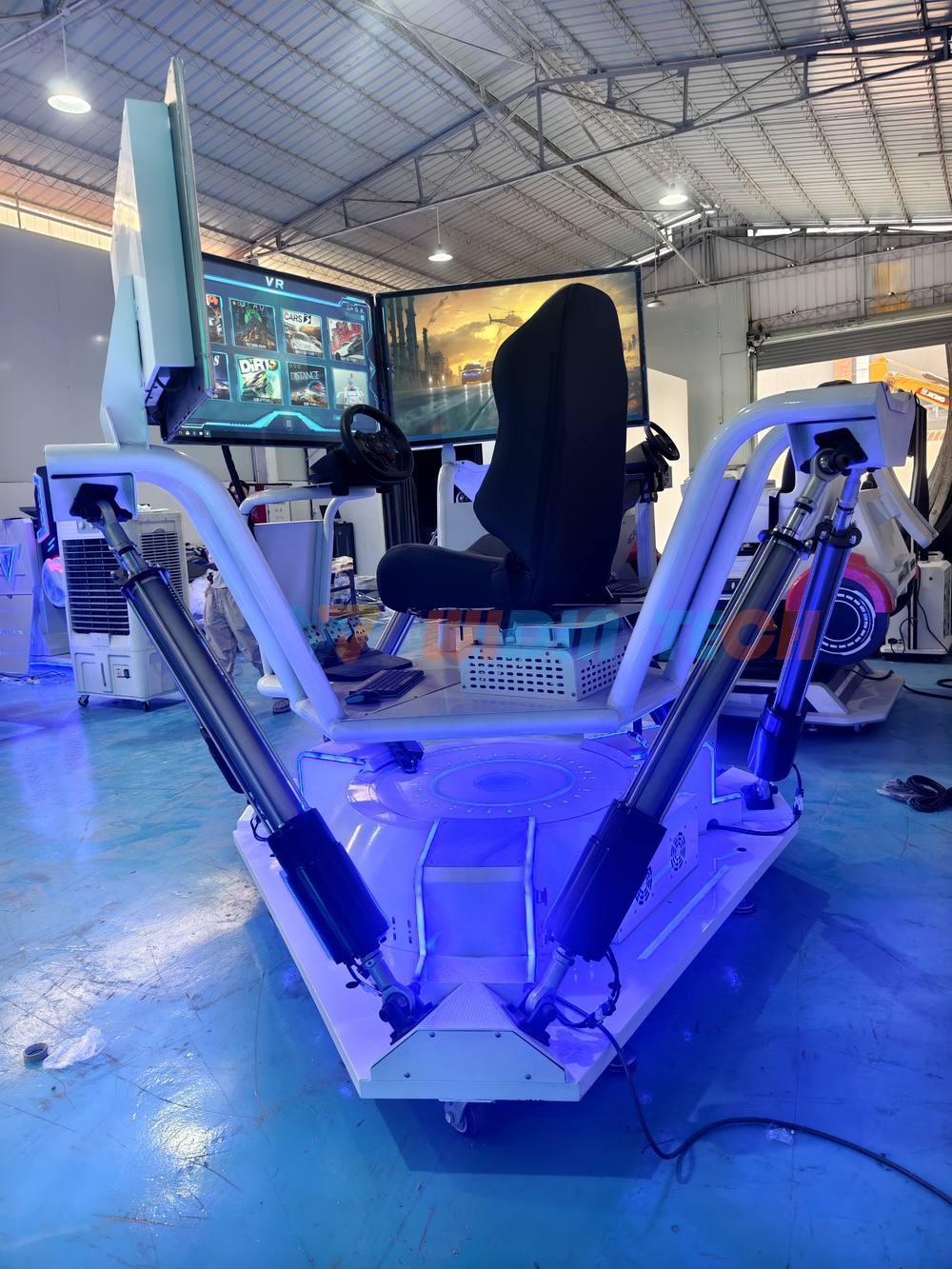
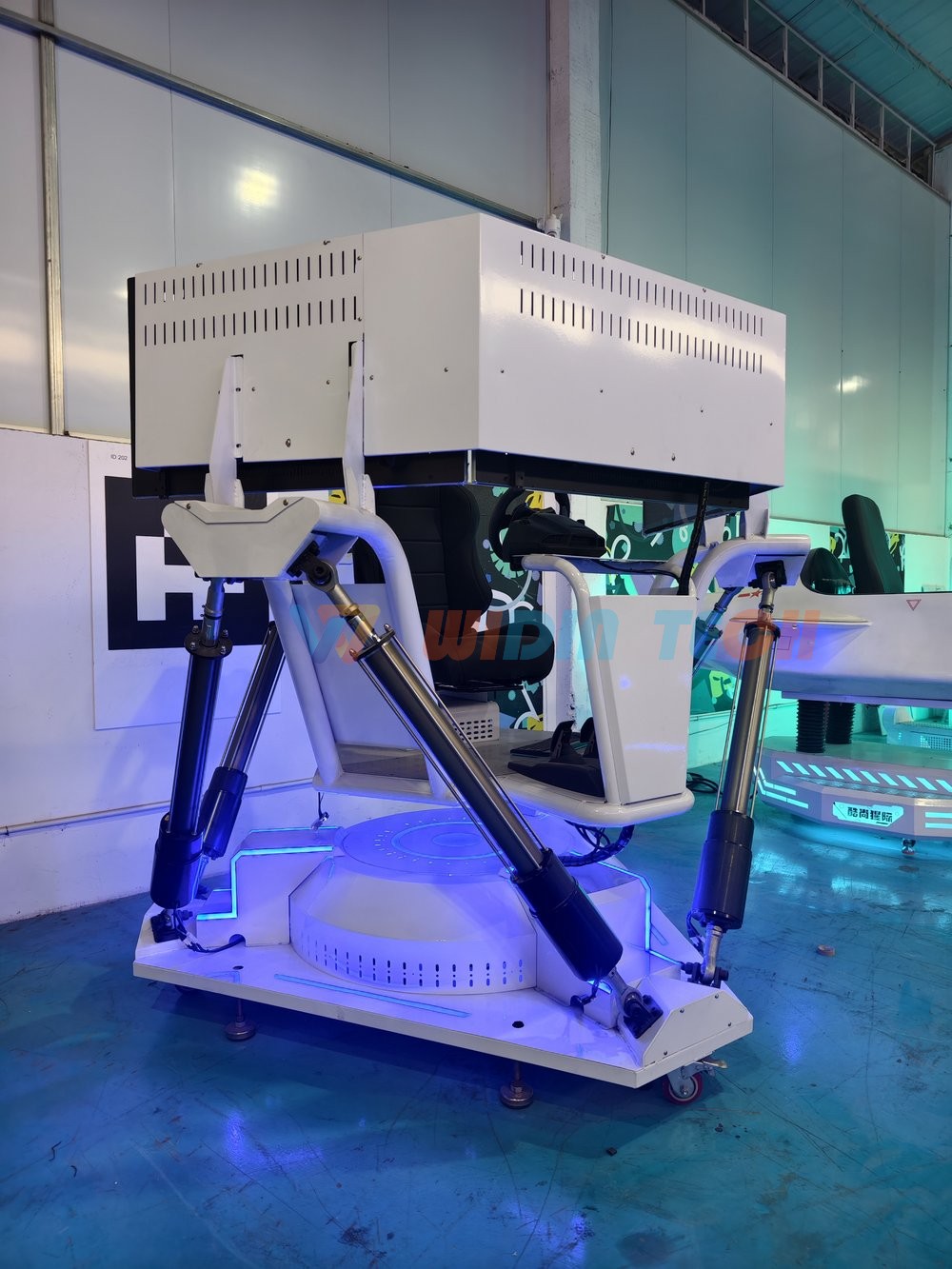
- Format: Single-seat racing simulator on a six-actuator (6DOF) motion platform
- Players: 1 per session
- Motion: Six independent actuator legs under the seat and screen assembly (visible in the photographs)
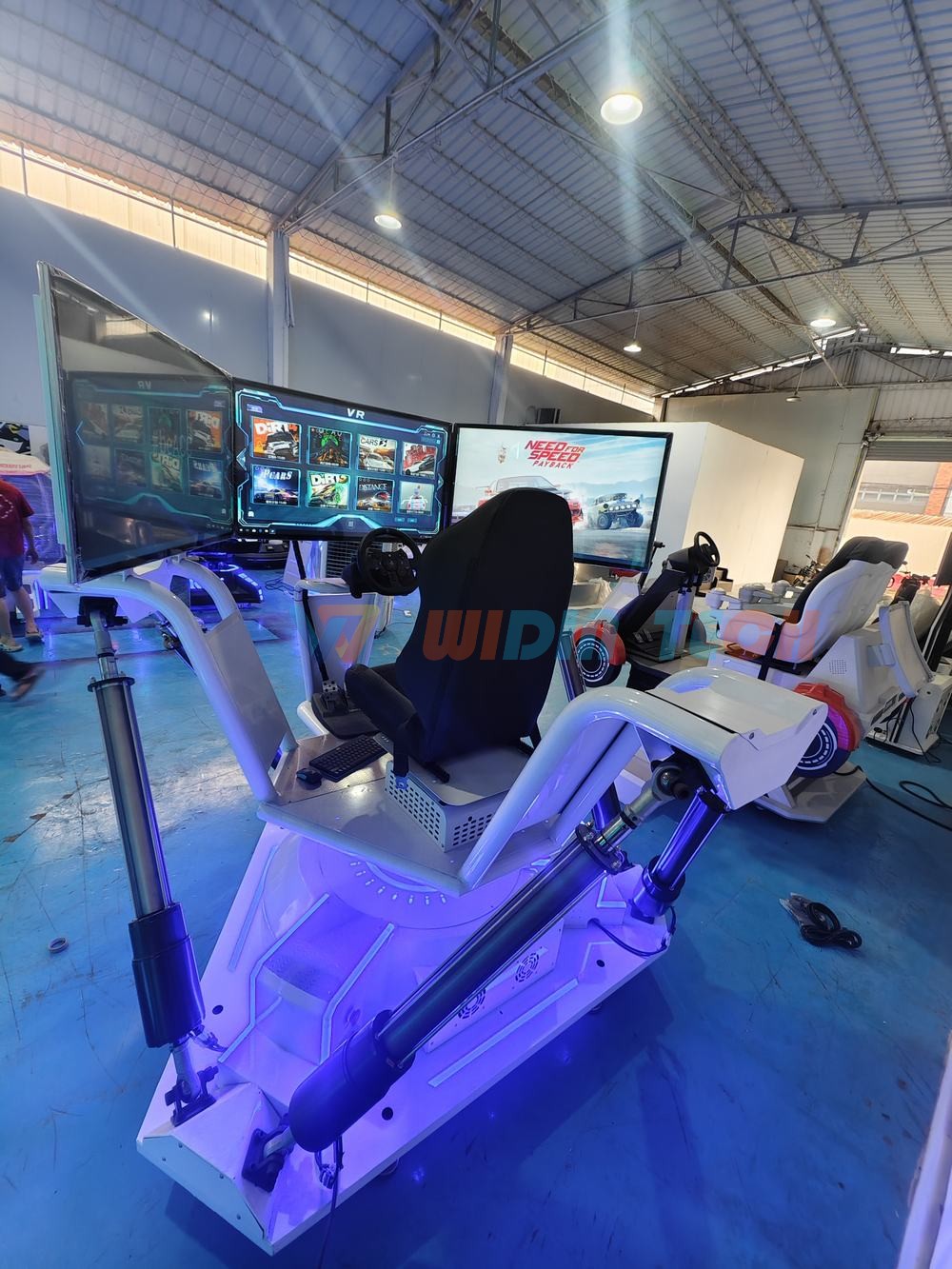
- Display: Three large HD screens, split-synced around the seat; a touch panel handles title selection. No headset required.
- Controls: Force-feedback steering wheel with accelerator and brake pedals (as quoted)
- Cabinet size: 2.07 m long × 2.07 m wide × 1.78 m high (axis order as quoted: L × W × H)
- Cabinet plan area: 4.27 m² — excludes rider access and the platform's own travel envelope
- Weight: ≈2,500 kg
- Power supply: AC 220 V, 1,500 W rated (as quoted — confirm the 110 V option for your market)
- Gaming PC: Gigabyte H310M motherboard, Intel i5-6500, GTX 1060 3 GB graphics, 8 GB DDR4, 240 GB SSD (standard build as quoted)
- Titles: 11 titles as quoted; languages: Chinese, English
- Payment system///; Coin-operated, optional: bill /card/ QR payment.
- Packing: wooden crate packaging is 2.17 m long × 2.17 m wide × 1.98 m high
- OEM / ODM: Supported — artwork, branding, game list, language, and payment system are configurable
The 6DOF three-screen racing simulator is a single-seat racing machine on a six-actuator Stewart platform: the seat, wheel, and screen assembly rides on six independent hydraulic-electrical legs, so the platform heaves, pitches, rolls, yaws, and translates instead of tipping on a single axis. Three large HD screens wrap the front of the seat, the rider steers with a force-feedback wheel, and the cabinet measures 2.07 m long, 2.07 m wide and 1.78 m high with 4.27 m² of plan area and a rated power of 1,500 W at AC 220 V. One number decides most purchase conversations about this machine, and it is not the power: it weighs about 2,500 kg. That is roughly eight times the weight of the single-seat F1 racer in the same range, and it changes the receiving route, the handling equipment, the floor loading check, and the maintenance plan. The other two things worth settling early are what six axes buy your riders over a cheaper two-axis seat, and whether a screen machine or a headset machine suits the bay you have in mind.
What to Check Before You Order
Floor space versus the motion travel envelope
The plan area is 4.27 m² at 2.07 × 2.07 m, but a six-axis machine moves its payload, and the number that matters is the footprint of the platform at the extreme of its travel rather than at rest. The photographs show the platform base sitting inside a wider floor plate, which is the part meant to stay put; treat that plate as the true footprint and add the rider's approach on the open side. This is also the machine in the WIDIN VR range where you should resist tucking it into a tight corner: a rider sitting behind three screens with a moving platform needs the screens at the right distance from the eyes, and the platform needs clearance in front of the base. The cost model for what a zone has to earn per square metre is set out in our arcade startup cost breakdown.
Weight, floor loading and the route to the bay
About 2,500 kg is the constraint that decides where this machine can go. Spread over a 4.27 m² base that averages roughly 585 kg per square metre, which is above the design live load of many upper-floor retail slabs — and because the load arrives on the actuator feet and base plates rather than evenly, the local pressure is higher still. Three checks follow, in this order. Ask the building what the floor is rated for, especially on an upper level or over a basement car park; ask the factory for the base-plate dimensions and the point loads so the question can be answered with numbers rather than a shrug; and plan load-spreading plates under the base if the answer is marginal. For the route: at 1.78 m high the machine clears a standard interior doorway of roughly 200–210 cm, so height is not the problem — mass is, because 2.5 t needs a forklift or a pallet truck rated for it, a level run, and a receiving slot when somebody is on site. Whether the platform ships in sections is Integrated transportation.
Power and electrical
The model is quoted at AC 220 V, 1,500 W rated. Rated watts over 1,000 gives hours per kilowatt-hour, so 1,500 W is about 0.67 h per kWh, and a 12-hour trading day draws roughly 18 kWh at the rated figure — a planning ratio rather than a meter reading. The electrical question specific to a six-actuator machine is the inrush: six actuators starting together draw far more than the steady-state rating for a moment, so a dedicated circuit sized by an electrician who has seen the actuator specification is the right answer, not a shared breaker. Confirm the 110 V option for your market in the quote, and ask the factory for the actuator's starting current along with its rated current.
What Six Axes Buy You, and What They Cost
Six axes is the difference between a seat that tips and a platform that moves. A two- or three-axis machine can lean a rider into a corner and shake them over a kerb; a six-actuator platform adds heave, yaw and lateral translation, which is what makes a braking zone feel like braking, and a long corner feel like a long corner. Suppliers of this class of platform describe it as a Stewart platform, after the original six-leg design, and that geometry is why six legs is the standard count rather than an arbitrary upgrade: three legs give orientation without translation, and six give both. What that buys on your floor is a premium product you can price above a screen-and-shake racer, and a machine that is legible from across a hall as the serious one. What it costs is 2.5 t of floor loading, an actuator service schedule, and a single play position on 4.27 m².
| Model | Motion | Display | Cabinet plan area | Weight | Rated power |
|---|---|---|---|---|---|
| 6DOF three-screen racer (this page) | 6 actuators (6DOF) | 3 HD screens | 4.27 m² (2.07 × 2.07 m) | ≈2,500 kg | 1,500 W |
| F1 VR racing machine | Single-axis motion base | VR headset | 3.83 m² (2.47 × 1.55 m) | ≈300 kg | 1,500 W |
| VR plane flight simulator | Motion base under a cabin | VR headset | 3.31 m² (1.46 × 2.27 m) | ≈250 kg | 1,500 W |
| 6-player VR battle machine | Shared motion platform | VR headset, 6 seats | 7.02 m² (2.47 × 2.84 m) | ≈1,500 kg | 4,500 W |
| Twin racing set (on-screen) | Seated simulator | 55-inch screen | 7.37 m² (2.88 × 2.56 m) | Published on its page | 300 W (as published) |
Plan areas are measured at rest and exclude rider access, staff access and queue space; a moving platform reserves more floor at the extreme of its travel, so treat these as minimums. Power figures are rated rather than measured values.
Three honest readings of that table. On weight, this machine is in a class of its own: 2,500 kg against 250–300 kg for the two headset machines, which is the difference between an install two people can manage and an install that needs equipment, a structural check and a plan. On display, the three-screen format is why this machine needs no headset and no hygiene routine, and it is also why it needs more floor in front of the seat than a headset machine — the screens have to be at a workable viewing distance. On density, one seat at 4.27 m² is the least efficient way to buy play positions in this range: the six-seat machine delivers six positions at 1.17 m² each. If your venue sells racing as a premium, one 6DOF platform is the product; if your venue sells volume, six seats on one cabinet wins. The in-between option is the twin racing set, which runs two riders per cycle on 7.37 m² with no platform maintenance at all.
The Platform Is the Machine: Maintenance and Uptime
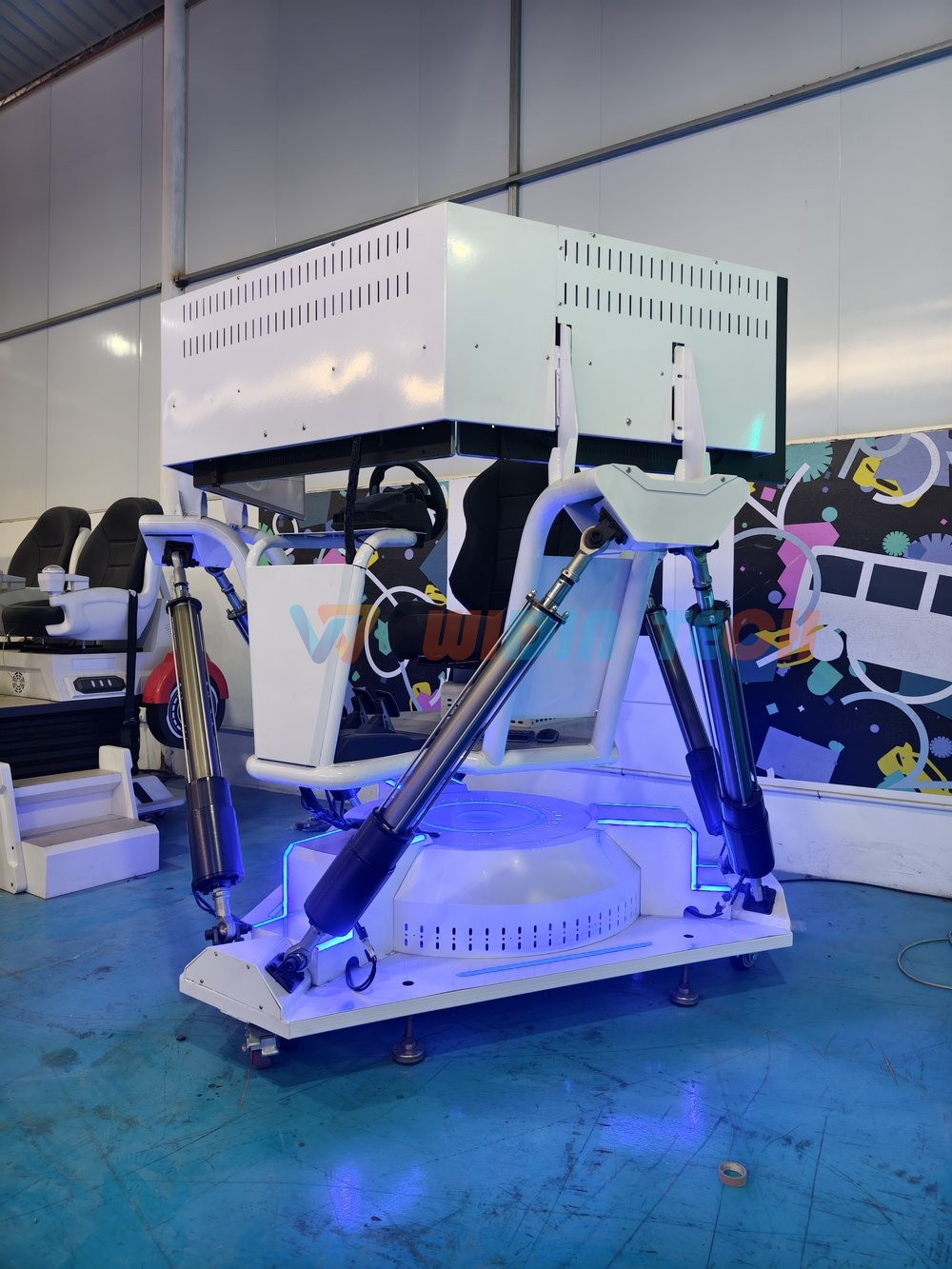
On a six-axis racer, the actuators are the component that decides whether the machine earns or sits idle. Everything else on the cabinet — screens, PC, wheel, lighting — is a part you can replace from stock; a hydraulic-electrical leg is not. Three things belong in the purchase conversation.
The service interval. Six legs, twelve pivots, and their fasteners need a documented check at a defined interval. Ask the factory for the maintenance schedule in writing and for the greasing or inspection points, and put the interval in your venue's own maintenance calendar rather than leaving it to whoever notices a rattle.
The access direction. Ask which face of the machine opens for maintenance and how much clearance that side needs. On a machine with a 4.27 m² base, that answer decides which side of the bay has to stay clear for the life of the installation — and it is the sort of thing venues discover after they have built the surrounding layout, when clearing a metre means moving something else.
The spare-parts position. Ask what the factory holds in stock and what the lead time is for one actuator, one screen and one wheel. A single actuator failure takes the whole machine out of service, so this is the number that turns a warranty conversation into a business-continuity plan. Put the answer in the same email as the price and keep it in your maintenance file.
One operational note that saves money later: riders should not be able to reach the actuator area, and the base plate should be visible enough that a loose fastener is noticed on a walk-round rather than by a rider. That is a five-second check an attendant can do at opening, and on a machine of this class it is worth writing into the daily routine.
Build Quality and Service Life
This machine is built under the same process the factory publishes across its range, and those process figures are the verifiable part. Every machine runs a 72-hour continuous aging test at full load before shipment, with no exceptions in the factory's process — on a motion platform that tests where an actuator that was going to fail early fails in Guangzhou rather than in your venue. Cabinet steel is 1.2 mm reinforced against the 0.6–0.8 mm common in the category, and powder-coated surfaces take about 8 additional hours of manual finishing per machine. WIDIN rates the stable service life of this build class at 4–6 years against 2–3 years for conventional workshop cabinets — a manufacturer's rating, stated so you can hold it against other suppliers' claims rather than take "commercial grade" on faith, and the reason the rating changes the ownership arithmetic is argued in our piece on how long commercial arcade machines last.
For a machine of this class, add one more line to the warranty conversation: ask whether the actuators carry their own warranty term separately from the cabinet, and what the exclusions are. A cabinet warranty that quietly excludes the single most expensive component is worth knowing about before the invoice rather than after a failure.
Custom Builds and OEM Orders
OEM and ODM customization covers cabinet artwork, brand logos, the game list, game language, and the payment system — coin, bill, card, or cashless, matched to what your venue already runs. On a three-screen machine, the two customizations worth planning are the screen content and the title list: the screens carry game output and the touch panel carries a menu, so if you intend to brand the selection screen or add your own titles, that conversation has to happen before production rather than on delivery. Confirm the 11-title list by name and language, and if your venue runs an existing cashless system, send the reader specification with the enquiry so the factory wires for it rather than supplying a generic coin door.
Shipping, Packing and Installation
The dimensions of the wooden crate packaging are 2.17 m long × 2.17 m wide × 1.98 m high. At about 2,500 kg, this is heavy machinery rather than arcade equipment: expect crane or forklift handling at both ends, a crate rather than a carton, and a delivery slot with equipment and people on site. The height is not the constraint — 1.78 m clears a standard doorway — but mass on ramps, lifts and thresholds is, so the route check is about what can carry 2.5 t and what the floor at the destination is rated for. Site requirements before delivery: a receiving path rated for the weight with a level run to the bay, a floor-loading answer from the building, load-spreading plates if the answer is marginal, and the dedicated circuit from the checklist with the starting current in hand. If the machine ships in sections, agree the assembly scope with the factory in the same email as the quote so the on-site work is priced rather than discovered.
Frequently Asked Questions
How much does a 6DOF racing simulator cost?
This is the most expensive single-seat machine in the WIDIN VR range, and the honest reason is in the bill of materials: six actuators, three screens and a 2.5 t structure. Quotes move on quantity, destination port, and configuration. For orientation, WIDIN publishes USD pricing on its on-screen twin racing set — a plainer machine, so treat that figure as a floor reference rather than a comparison.
How much floor space does a 6DOF racing simulator need?
The cabinet plan area is 4.27 m² at 2.07 × 2.07 m at rest, excluding rider access and queue space. A moving platform reserves more floor at the extreme of its travel than at rest, so measure the base plate the factory supplies plus the platform's travel envelope, then add the rider approach and the queue. This is the machine in the range that most rewards giving it a clear bay rather than a corner.
How heavy is it, and where can it be installed?
About 2,500 kg. Spread over the 4.27 m² base that averages roughly 585 kg per square metre, above the design live load of many upper-floor retail slabs, and concentrated on the base plates rather than applied evenly. Ask the building to confirm the floor rating, ask the factory for the base-plate dimensions and point loads, and plan load-spreading plates if the answer is marginal. A ground-floor slab is normally the simple answer.
Can it be moved into an upper-floor unit?
Height is not the obstacle — 1.78 m clears a standard doorway of roughly 200–210 cm. Mass and the route are: 2.5 t needs lifting equipment rated for the job, a run that supports it, and a floor at the destination rated for the installed load. Whether the platform ships in sections is Integrated transportation; if it does, section weights decide what equipment the route needs. Settle this with the building before you place the order.
What is the difference between a 6DOF platform and a three-axis one?
Three axes give orientation — the seat tips and tilts. Six actuators give orientation plus translation, so the platform can heave, yaw, and shift sideways as well as pitch and roll, which is what makes braking and long corners register physically. Six legs are the standard count for that reason: the geometry of a Stewart platform needs six to produce both rotation and translation. The trade-off is weight and actuator maintenance.
Does it need a VR headset?
No. This machine uses three large HD screens around the seat, so there is no headset to wipe between riders and no hygiene routine for staff — one of the differences that matters most in a busy venue with no attendant permanently at the bay. In exchange, a screen machine needs more floor space in front of the seat than a headset machine, because the screens have to sit at a workable viewing distance.
How many titles does it come with, and can I change them?
11 titles as quoted. Languages are Chinese and English. If you want your own titles, branded selection screens, or a different mix for your market, say so before production — the title list and the screen content are part of the order specification, not a setting you change afterwards.
What maintenance does the motion platform need?
Put the interval in your maintenance calendar rather than relying on someone noticing a rattle. Also ask the factory which face of the machine opens for service and how much clearance it needs, because that decides which side of the bay stays clear for the life of the installation.
Can I put my own branding on it?
Yes — OEM/ODM covers cabinet artwork, brand logos, the game list, game language, and the payment system. If you want the selection screen branded or your own title artwork on the three screens, that is part of the production specification, so raise it with the artwork files rather than after delivery.
What are the MOQ, lead time, and warranty?
All three for this model are: MOQ: 1 unit, lead time: 7 days, warranty: 1 year. Ask for the warranty in writing per component and specifically ask whether the actuators carry their own term: a cabinet warranty that excludes the most expensive part of the machine is the one exclusion worth knowing about in advance. Also request the spare-parts lead time for one actuator, one screen and one wheel, because a single actuator failure takes the whole machine out of service.
Request a Quote
A quotation for this machine needs three inputs: the quantity, the destination country or port — it sets voltage, plug standard and freight — and the configuration, meaning payment system, artwork language and the game list. Three more are specific to a 6DOF platform: the floor you intend to install on and its load rating, the route and handling equipment available at your end, and whether you need the machine in sections. Send all of it through the contact page, and the quote comes back with freight itemised rather than guessed — and on a machine of this weight, the freight answer is a large part of the total, so it is worth getting it in writing early.
— Chen, Founder & CEO at Guangzhou WIDIN Tech. Every installer who has moved a six-axis platform remembers the day. It is the only machine in our range where the site visit should happen before the order, not after — the floor rating decides whether the sale makes sense at all.