

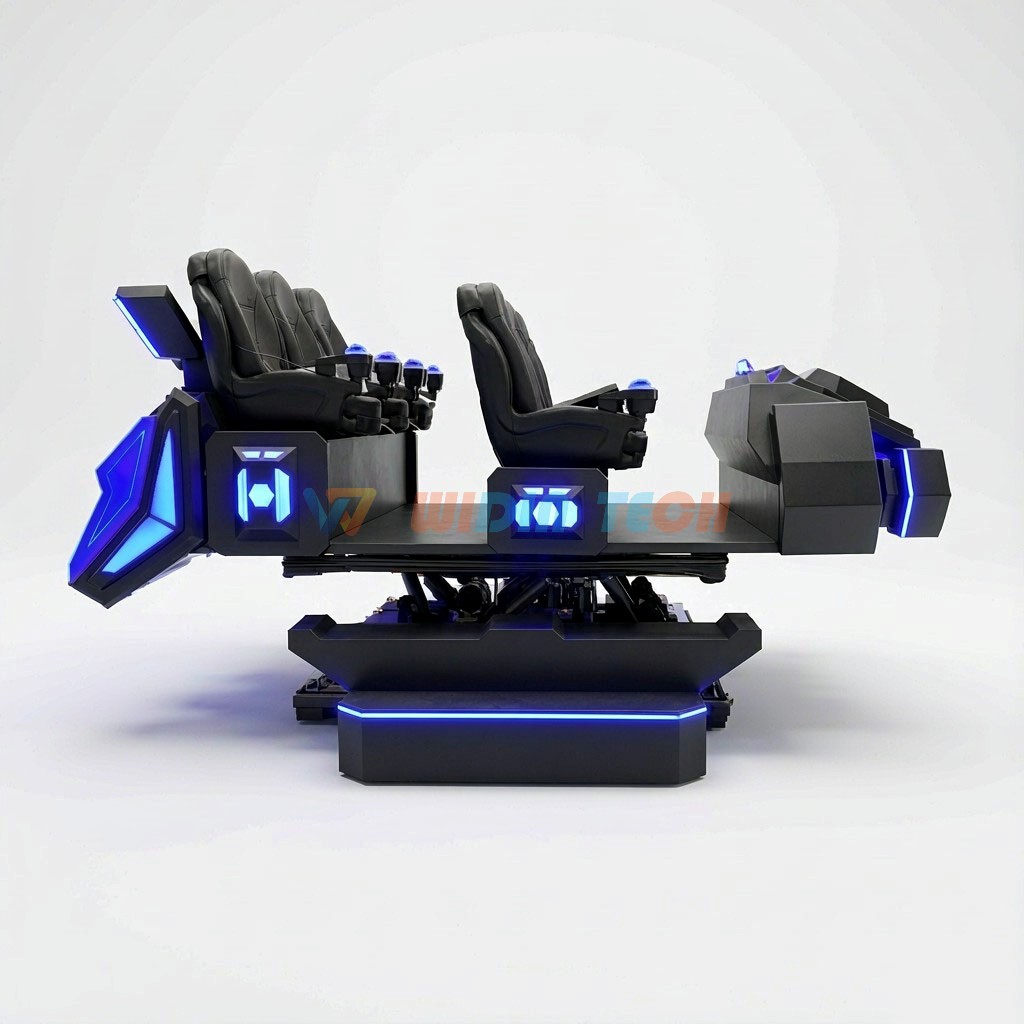
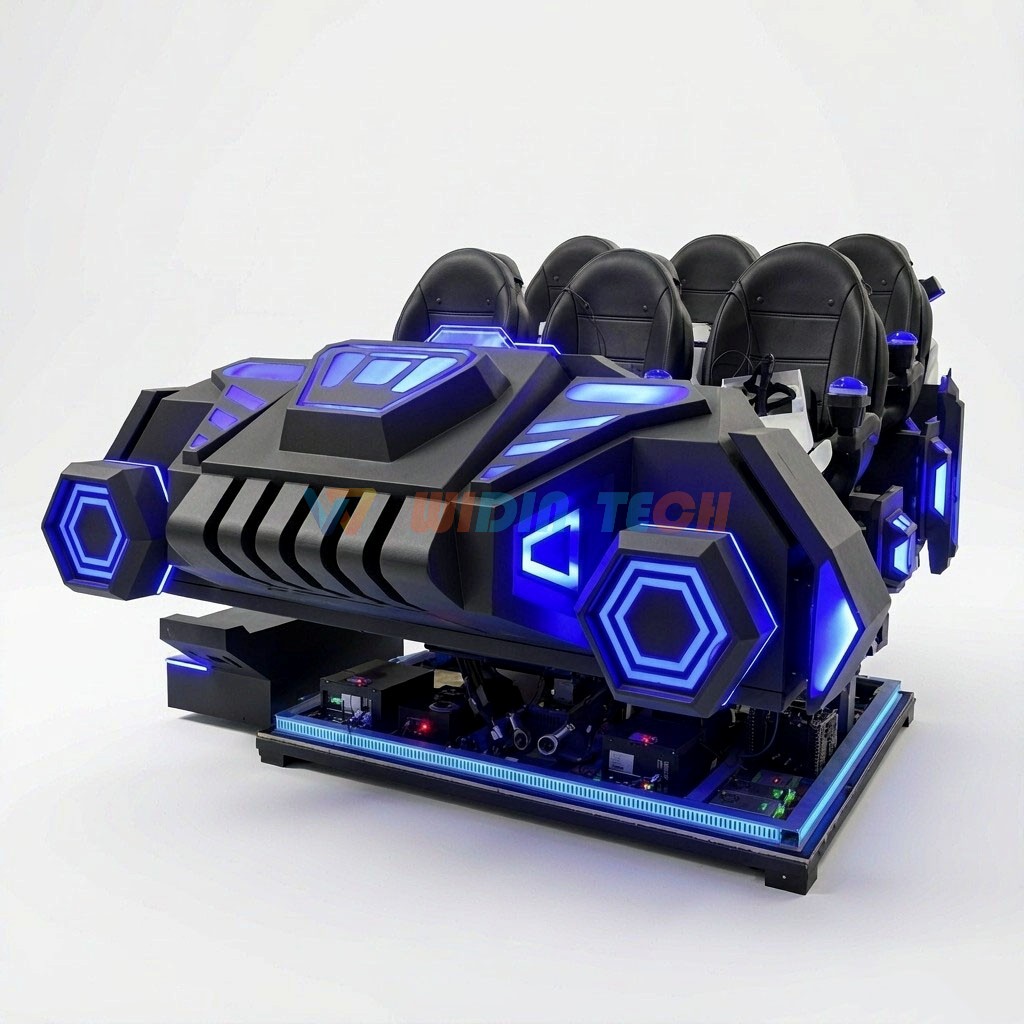
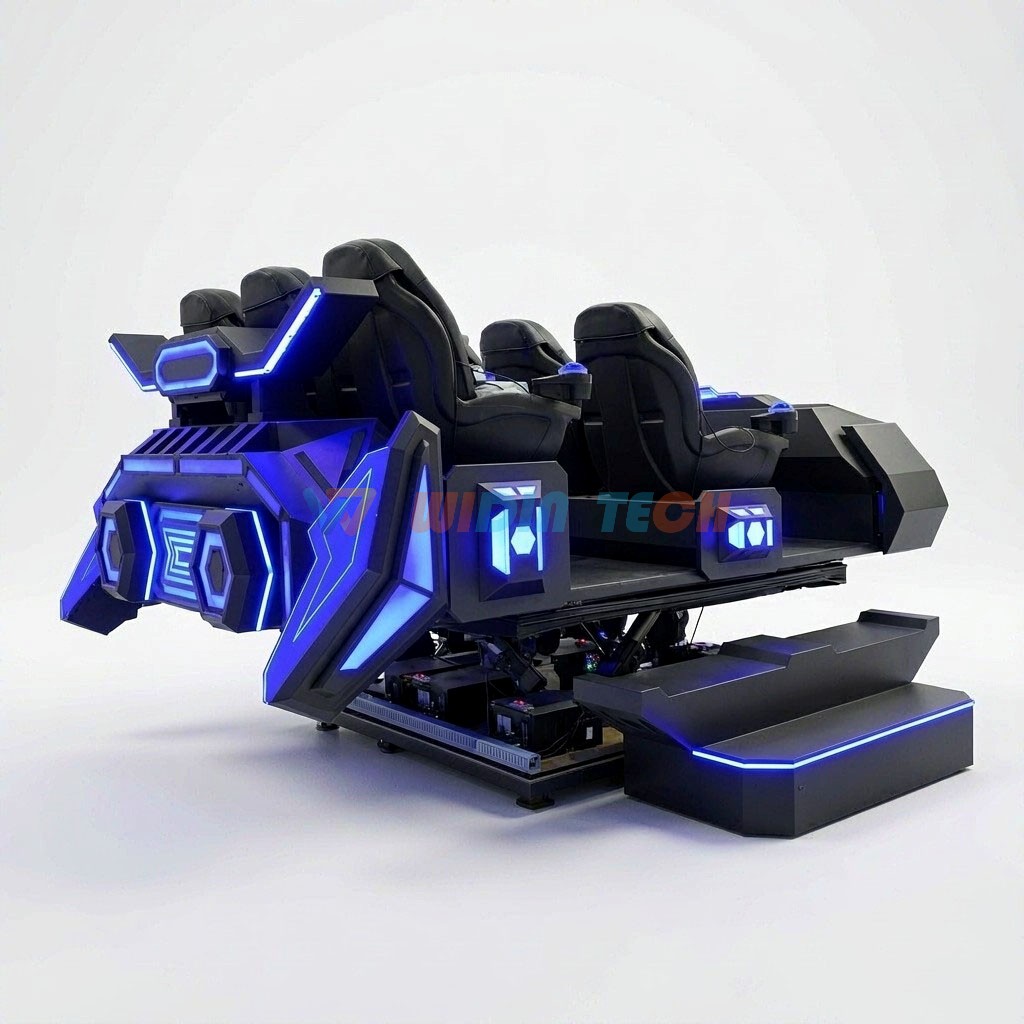
6-Player VR Battle Machine
- Product name: 6-Player VR Battle Machine
- Format: Six-seat multiplayer VR attraction on a shared motion platform
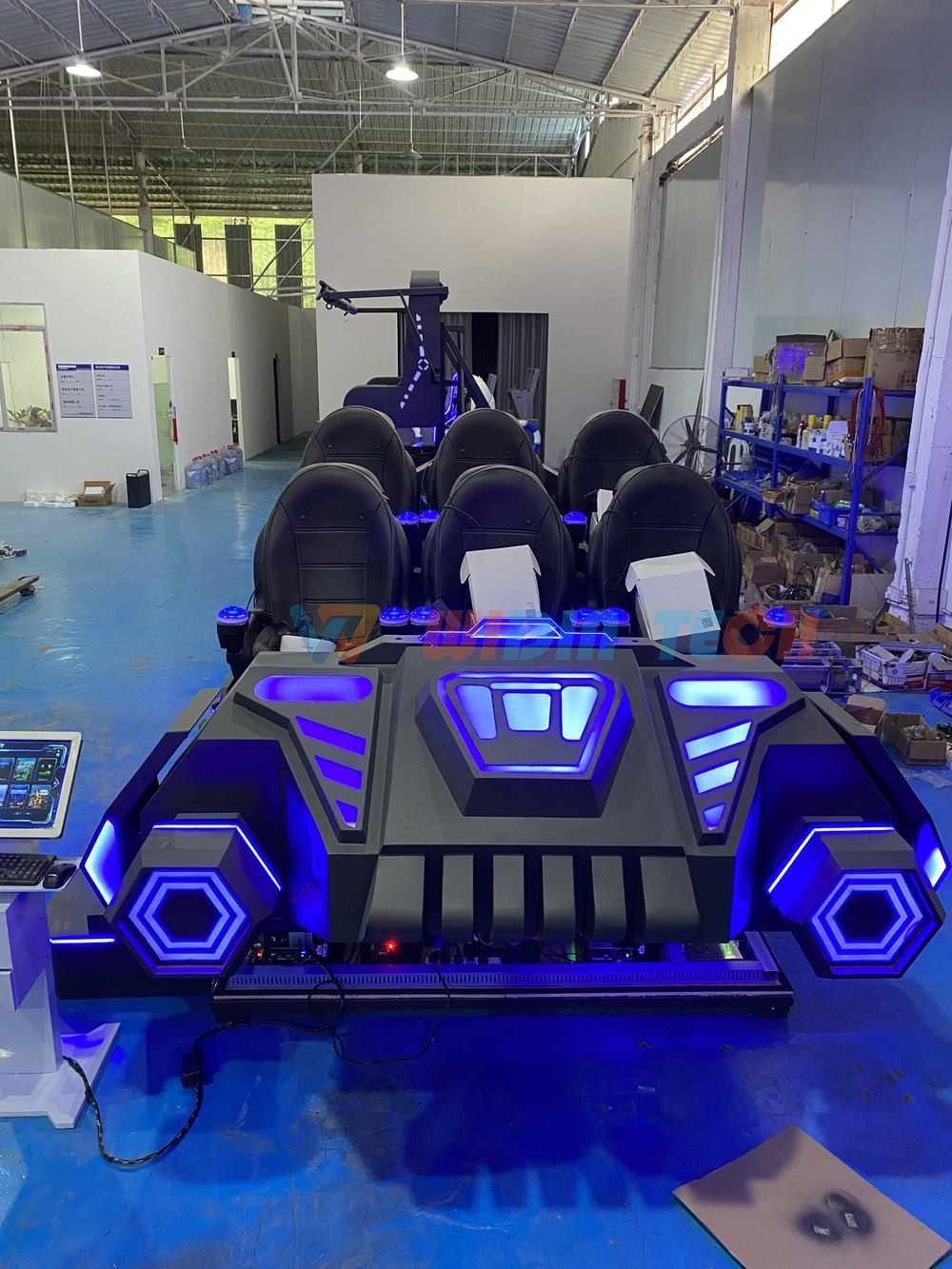
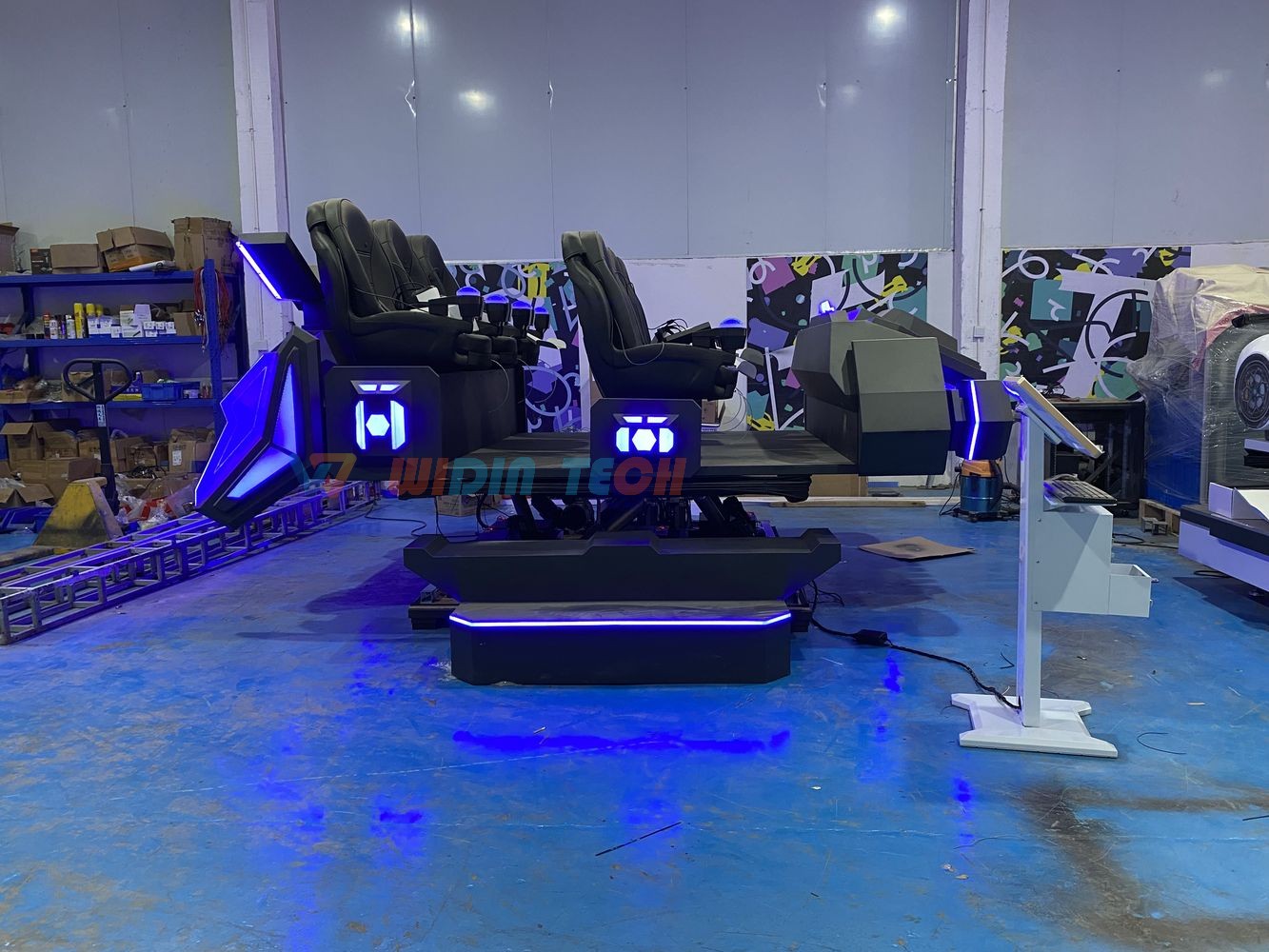
- Players: 6 per session (seats banked on one platform; headset holder at every seat — visible in photographs)
- Audio: Four surround speakers as quoted
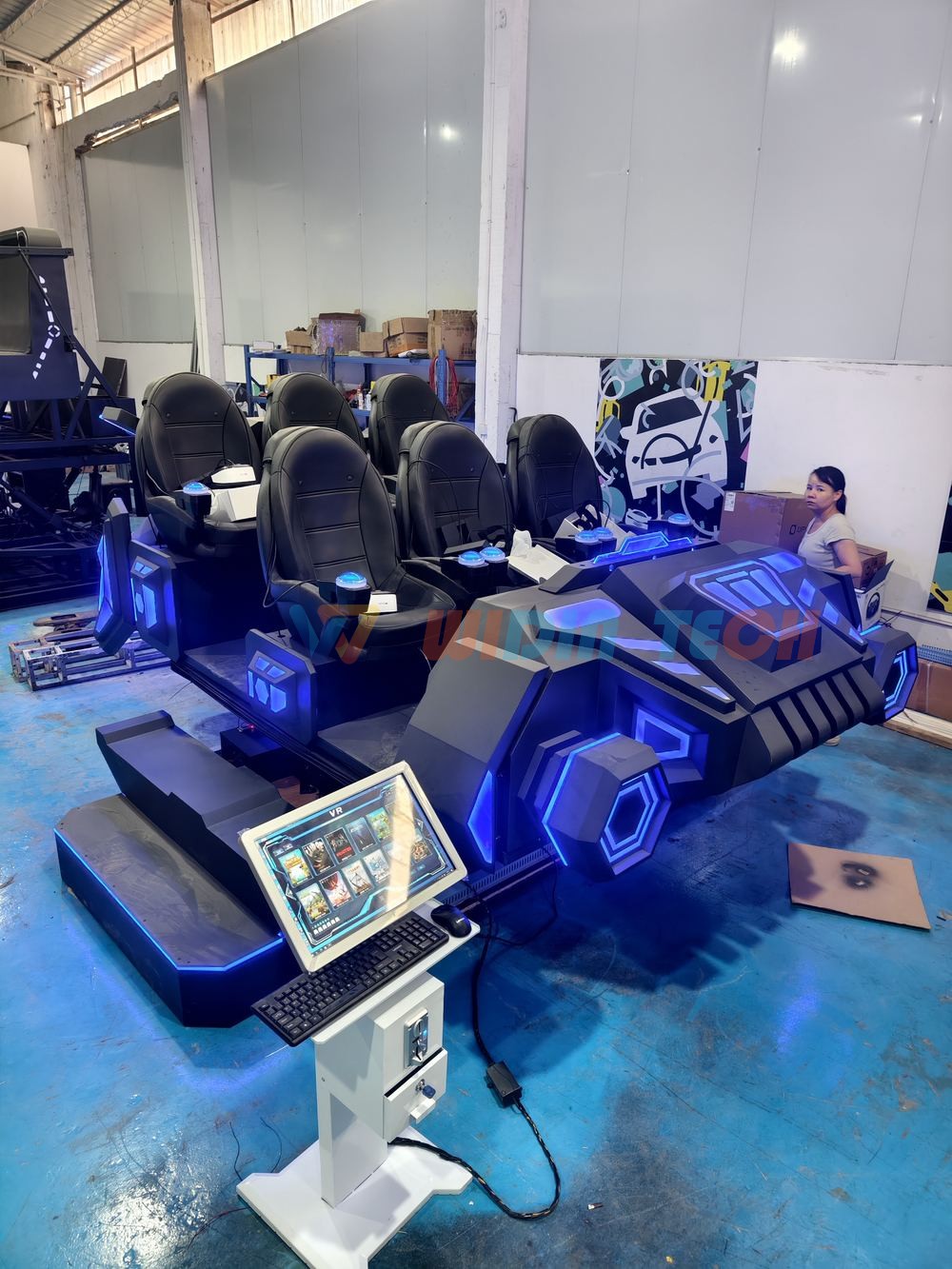
- Display: VR headset per seat; a touch panel on a stand handles title selection
- Cabinet size: 2.47 m long × 2.84 m wide × 1.68 m high (axis order as quoted: L × W × H)
- Cabinet plan area: 7.02 m² = 1.17 m² per play position
- Weight: ≈1,500 kg
- Power supply: AC 220 V, 4,500 W rated (as quoted — confirm the 110 V option for your market)
- Gaming PC: Gigabyte H310M motherboard, Intel i5-6500, GTX 1060 3 GB graphics, 8 GB DDR4, 240 GB SSD (standard build as quoted; confirm one PC or one per seat)
- Titles 100+ titles as quoted; languages Chinese, English
- Payment system: Each seat is charged separately, coin-operated; optional: bill acceptor/card swiping / QR code scan payment.
- OEM / ODM: Supported — artwork, branding, game list, language, and payment system are configurable
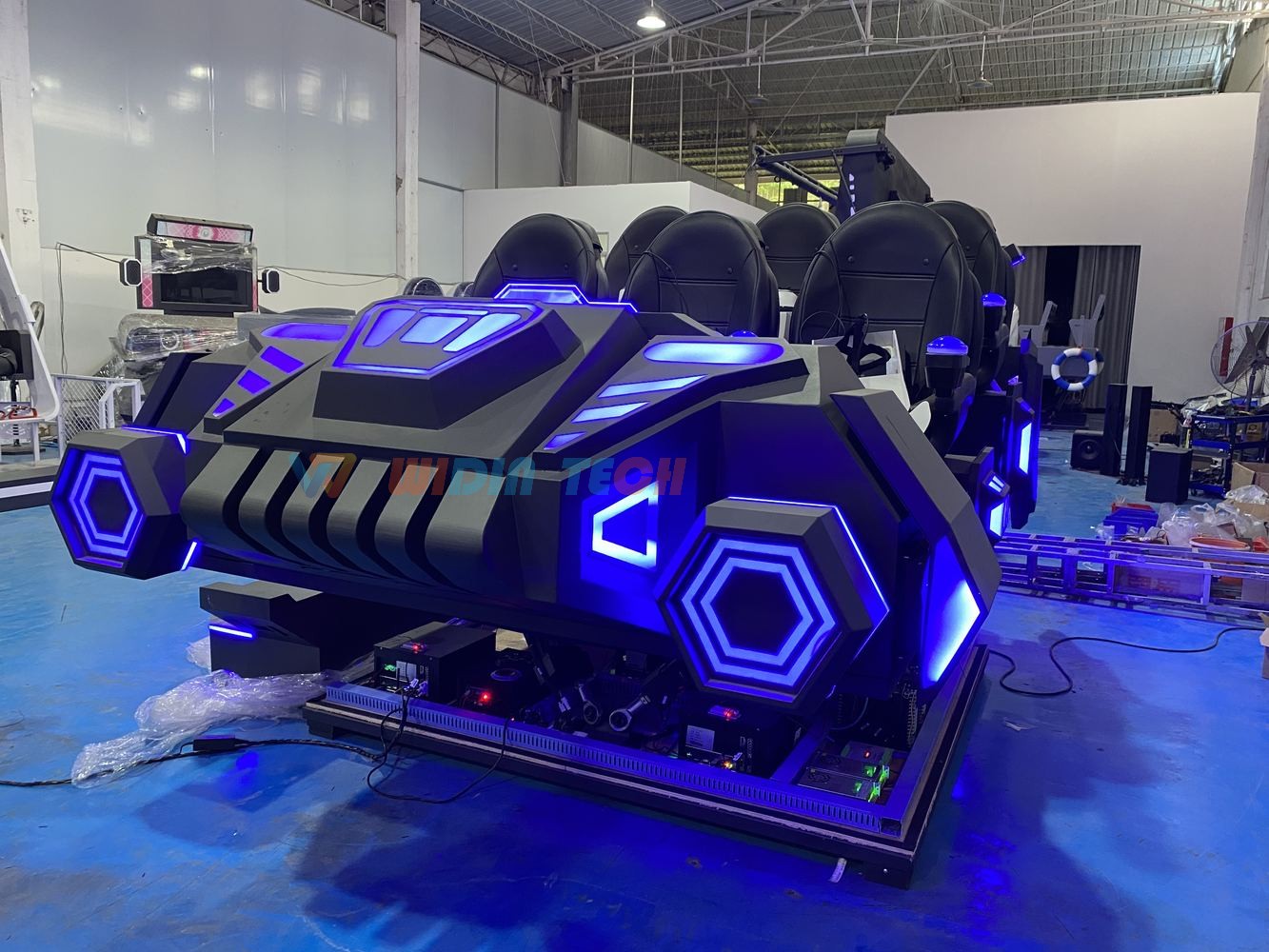
The 6-player VR battle machine is a multiplayer VR attraction for six riders at once: a bank of six seats on a shared motion platform inside a low, LED-lit battle-machine body, with each position holding a VR headset and its own armrest controller. The cabinet measures 2.47 m long, 2.84 m wide and 1.68 m high, with 7.02 m² of plan area, a quoted weight of about 1,500 kg, a rated power of 4,500 W at AC 220 V, and a library of more than 100 VR titles played through four surround speakers. Three numbers decide most purchase conversations about this machine. The first is 1.17 m² per play position — a sixth of what a single-seat VR racer costs you in floor — which is the whole case for buying one cabinet instead of six. The second is six riders per cycle on one payment path, which changes your hourly revenue arithmetic because a full machine earns six times what a single-seat machine does for the same session length. The third is weight: at 1,500 kg, it is heavy enough to need a forklift but nowhere near the 2,500 kg of the six-axis platform, so it installs on floors that a 6DOF racer cannot touch.
What to Check Before You Order
Floor space and the group it was bought for
Seven square metres is a real bay, and the machine is worth planning around rather than squeezing in, because its income depends on groups arriving together. Six seats pay off when a party of six, a family or a group of teenagers walks up, and the whole set fills in one cycle; they pay off much less when they sit half empty all evening. Two practical consequences. Put the machine where six people can see it and gather without blocking an aisle, which usually means a bay at the end of a run of cabinets or against a wall with open floor in front. And size the queuing area for groups rather than for individuals: a six-seat machine with a two-deep queue is a small crowd, not a queue. The per-square-metre cost model for a zone like this is worked through in our arcade startup cost breakdown.
Access route and ceiling height
At 1.68 m, the cabinet is the lowest machine in WIDIN's VR range and clears a standard interior doorway with room to spare — a standard doorway is roughly 200–210 cm, so roughly 30–40 cm of margin. The dimensions that matter on this machine are the plan ones: 2.84 m of width and 2.47 m of length are the two figures to run against your route, since a 2.84 m-wide piece needs either a straight run or a doorway wide enough to take it at an angle. On containers, the standard ISO internal width is about 2.34 m and a high-cube door is about 2.58 m, so a 2.84 m width travels as a section rather than in one piece — the split is integrated transportation. Measure the route to the lowest obstruction — lights, sprinklers, ducts, signage — before booking delivery.
Power and electrical
The model is quoted at AC 220 V, 4,500 W rated, the highest draw in the WIDIN VR range — six VR headsets, six seats, a motion platform and four surround speakers in one cabinet. Rated watts over 1,000 gives hours per kilowatt-hour, so 4,500 W is about 0.22 h per kWh: a 12-hour trading day draws roughly 54 kWh at the rated figure, which is three times a single-seat VR machine running the same hours for the same number of riders. That is the honest trade for six play positions in one footprint, and it is a number worth putting into your operating cost model rather than discovering on a bill. Give the machine a dedicated circuit — and because the motion platform starts under load, confirm the starting current with the factory rather than sizing the breaker on the rated figure alone. Confirm the 110 V option for your market in the quote.
Six Seats, One Cabinet: The Floor Efficiency Case
This is the machine in the WIDIN VR range built for density. Six riders on 7.02 m² is 1.17 m² per play position; buying the same six positions as single-seat VR racers would take 22.98 m² of floor — roughly 3.3 times the space — and would draw 9,000 W instead of 4,500 W, because six machines each carry their own motion base, PC and lighting. On top of that, one cabinet means one delivery, one circuit, one maintenance visit and one four-metre frontage instead of six.
| Model | Play positions | Cabinet plan area | Area per position | Rated power | Weight |
|---|---|---|---|---|---|
| 6-player VR battle machine (this page) | 6 | 7.02 m² (2.47 × 2.84 m) | 1.17 m² | 4,500 W | ≈1,500 kg |
| Six F1 VR racing machines | 6 | 22.98 m² (6 × 3.83 m²) | 3.83 m² | 9,000 W | ≈1,800 kg total |
| 6DOF three-screen racer | 1 | 4.27 m² (2.07 × 2.07 m) | 4.27 m² | 1,500 W | ≈2,500 kg |
| 8-player fishing table (on-screen) | 8 | 3.60 m² (2.25 × 1.60 m) | 0.45 m² | 1000 W | 300 kg (as published) |
Plan areas exclude rider access, staff access, and queue space; the six F1 racers would also need access aisles between every machine, which this single cabinet does not have. Power figures are rated rather than measured values.
The honest comparison is with the last row. WIDIN's eight-player fishing table publishes 0.45 m² per player — better than half of this machine's 1.17 m² — at a fraction of the weight and power. If your goal is maximum plays per square metre and your audience is happy with a screen game, that machine wins on the numbers, and there is no point pretending otherwise. This machine is the choice when the attraction has to be VR: six headsets, a shared motion platform and a body that reads across a hall as a ride rather than a table. Multiplayer VR is the product, and the floor efficiency is what makes it affordable.
Running Six Headsets: Grouping, Hygiene and the Changeover
A six-seat machine has a different operating rhythm from a single-seat one, and the rhythm is where the money is.
Each cycle needs six riders to be worth what it costs. One session delivers six plays, so throughput is 360 ÷ (T + R) plays per hour, where T is the session in minutes, and R is the changeover — a 6-minute session with a 4-minute changeover is 36 plays an hour, and the same session with a 6-minute changeover is 30. Session length for this model is 10 minutes. The changeover is the part you control, and on a six-seat machine it is a production line: six headsets off, six wiped, six riders out, six in. Rehearse it as a pair of attendants rather than one, because at six seats one person becomes the bottleneck.
Whether you charge per machine or per seat is a pricing decision, not a technical one. Each seat is charged separately. Both models exist in this category. A single price for a full session fills the machine but leaves you earning nothing from a machine that runs with four riders; per-seat pricing protects your revenue on a partial machine but means the machine can start with one rider and the other five seats are dead for that cycle. Ask the factory whether the payment system can be configured either way — it is a wiring and software question, and it is much cheaper to settle before production than after.
Six headsets is six times the hygiene routine. Facial-contact padding touches one face after another all day, and this machine puts six of them in play at once. Stock the wipes where the attendants stand, wipe every headset every cycle, and ask the factory what the padding material is and whether replaceable hygienic covers are available. If your venue runs a themed or family audience, also ask whether headset sizes or adjustable straps are offered, because a headset that does not sit properly on a child is a headset that gets taken off halfway through a session.
The group sight line. Six riders are moving together on one platform, and an attendant has to be able to see all six at once. That is a siting decision rather than a specification one: put the machine where one person standing at the payment point can see the whole bank, and not where a column splits the view. On a ride of this class, IAAPA, the Global Attractions Industry Association, publishes safety resources covering restraint use, rider eligibility signage and attendant practice — industry guidance rather than a specification of this machine, and the right frame for the operating rules you write.
Build Quality and Service Life
This machine is built under the same process the factory publishes across its range, and those process figures are the verifiable part. Every machine runs a 72-hour continuous aging test at full load before shipment, with no exceptions in the factory's process — on a six-seat machine with a shared motion platform, that test is what catches a platform that tracks badly under a full load before it reaches your floor. Cabinet steel is 1.2 mm reinforced against the 0.6–0.8 mm common in the category, and powder-coated surfaces take about 8 additional hours of manual finishing per machine. WIDIN rates the stable service life of this build class at 4–6 years against 2–3 years for conventional workshop cabinets — a manufacturer's rating, stated so you can hold it against other suppliers' claims rather than take "commercial grade" on faith, and the argument for why that rating changes the ownership arithmetic is set out in our piece on how long commercial arcade machines last.
Two maintenance lines specific to this machine. The headset inventory is your consumable: ask what a spare headset costs and keep at least one spare on site, because a single dead headset turns a six-seat machine into a five-seat machine for however long the replacement takes to arrive. And the seats: six riders climbing in and out of a stepped bank wear the seat facings and the armrest holders faster than one rider wears a single seat, so ask what the seat covering is and whether replacement covers are stocked. Both questions belong in the same email as the price.
Custom Builds and OEM Orders
OEM and ODM customization covers cabinet artwork, brand logos, the game list, game language, and the payment system — coin, bill, card or cashless, matched to what your venue already runs. On this machine, the artwork does more work than on a single-seat unit: a six-seat battle machine is a four-metre frontage, and its LED-lit body is the largest flat graphic surface in the range apart from the plane fuselage. If you are buying for a themed venue or a licensed property, send the brand guidelines with the enquiry and the factory will confirm which panels can carry supplied artwork. Confirm the title list by name and language before production — with 100+ titles quoted, the set you actually receive should be agreed rather than assumed — and if you need per-seat pricing or your own cashless reader, raise both before the order.
Shipping, Packing and Installation
The dimensions of the wooden crate packaging are 2.57 m long × 2.94 m wide × 1.88 m high. At about 1,500 kg, the machine is heavy cargo: it needs a forklift or a rated pallet truck at both ends and a delivery slot when somebody is on site. Compared with the 2,500 kg six-axis platform, it is a straightforward install — 1,500 kg spread over 7.02 m² averages roughly 214 kg per square metre, comfortably inside the design live load of most commercial floors, so an upper-floor unit is a question for the building rather than an obvious problem. The route is the part to check: 2.84 m of width means the machine travels in sections through any normal doorway, and the section list decides what equipment your end needs. Site requirements before delivery: a receiving path sized for the largest section with a route to the bay, a level floor, a seating area laid out for groups rather than individuals, and the dedicated circuit from the checklist. Agree the section list and assembly scope in the same email as the quote.
Frequently Asked Questions
How much does a 6-player VR battle machine cost?
It is quoted on quantity, destination port, and configuration, and the options that move the number most are the payment system, the title list, and the headset specification that ships with it. One thing worth comparing before you buy: the delivered cost of one six-seat cabinet against six single-seat VR machines, including six freight consignments, six circuits and six machines' worth of maintenance visits. Send quantity, port, and configuration, and the factory answers with an itemised figure.
How much floor space does it need?
The cabinet plan area is 7.02 m² at 2.47 × 2.84 m, which is 1.17 m² per play position — a sixth of what a single-seat VR racer costs in floor. That excludes rider access, attendant space, and queue, and because the machine earns from groups, plan the gathering and queue area for a party of six rather than for a single player.
How many players can ride at once, and how are they seated?
Six, on a bank of seats on a shared motion platform, with a VR headset and an armrest-mounted controller at each position and four surround speakers carrying the audio. Six riders per cycle on one payment path is the core of the machine's economics: the same session length that earns one play on a single-seat machine earns six here.
How heavy is it, and will my floor take it?
About 1,500 kg. Spread over the 7.02 m² base that averages roughly 214 kg per square metre, comfortably inside the design live load of most commercial floors — so unlike the six-axis platform in the same range, this machine is normally an upper-floor-safe installation. Confirm the floor rating with the building if the machine is going above ground level or over a basement, and ask the factory for the base-plate dimensions.
What power supply does it need?
The model is quoted at AC 220 V with a rated power of 4,500 W, the highest in WIDIN's VR range — six headsets, a shared motion platform, four speakers and the cabinet lighting in one machine. That is about 0.22 hours per kilowatt-hour, roughly 54 kWh over a 12-hour trading day at the rated figure. Give it a dedicated circuit, and confirm the starting current and the 110 V option with the factory.
Is it one price for the machine or one price per seat?
That is a configuration and pricing decision you make, not a fixed property of the machine: Each seat is charged separately. A single price for a full session fills the cabinet; per-seat pricing protects revenue when the machine runs partially full. Ask the factory whether the payment system can be set up either way before production, because it is much cheaper to settle then than to change later.
How many titles does it come with, and in which languages?
More than 100 VR titles as quoted, the largest library in the WIDIN VR range. Language support is Chinese and English. With a library that large, ask for the title list by name and confirm which titles carry your market's language before production — and if you want a themed or branded selection for your venue, agree it with the order rather than after delivery.
How many plays per hour can it deliver?
Six per session at 360 ÷ (T + R) plays per hour, where T is the session length and R is the changeover. A 6-minute session with a 4-minute changeover is 36 plays an hour; the same session with a 6-minute changeover is 30. Session length is 10 minutes. Rehearse the changeover as a two-attendant routine — at six seats, one person wiping six headsets is the bottleneck.
How do you manage hygiene with six headsets?
With a routine rather than a feature: every headset wiped between sessions, wipes stocked where the attendants stand, and replaceable hygienic covers if the factory offers them. Six headsets multiply the routine by six, so ask what the padding material is and what a spare headset costs — a single dead headset turns a six-seat machine into a five-seat machine until the replacement arrives.
Can I put my own artwork, games and payment system on it?
Yes — OEM/ODM covers cabinet artwork, brand logos, game list, game language and payment configuration, including cashless readers matched to your existing system. A six-seat cabinet is a large graphic surface, so supplied artwork reads well; send brand guidelines and the reader specification with the enquiry. Final specifications are confirmed before production starts.
What are the MOQ, lead time, and warranty?
All three for this model are: MOQ: 1 unit, lead time: 7 days, warranty: 1 year. Ask for the warranty scope per component — the shared motion platform, the PC, the headsets, and the seat coverings wear at different rates — and get the spare-parts lead time for a headset, an actuator, and a seat covering in writing, because those are the three parts that decide how long the machine earns or sits idle.
Request a Quote
A quotation for this machine needs three inputs: the quantity, the destination country or port — it sets voltage, plug standard and freight — and the configuration, meaning payment system, artwork language and the game list. Three more matter on a six-seat machine: whether you will charge per machine or per seat, how many spare headsets you want in the first order, and your floor and route, so the section list and the handling equipment are agreed before the crate is built. Send all of it through the contact page, and the quote comes back with freight itemised rather than guessed — on a machine this size the freight is a large share of the total, so it is worth getting in writing.
— Chen, Founder & CEO at Guangzhou WIDIN Tech. Six seats on one cabinet is not only a floor-space saving. It is the only way to sell VR to a group of friends, and a group of friends is what walks past a VR machine and decides in five seconds whether they are doing it. One seat sells a ride; six seats sell an evening.