

5 Arcade Games That Can Attract Teenagers and Young Adults
Quick answer: Racing, basketball, shooting, boxing and multiplayer cabinets are the five categories that hold teenagers and young adults. Across WIDIN's published specs, floor space per player ranges from 0.45 m² (8-player fishing cabinet) to 3.69 m² (twin racing simulator) — an eight-fold difference, and the reason footprint, not game popularity, should drive the order. The most common installation blocker is a 235 cm cabinet meeting a 200–210 cm doorway.
Teenagers and young adults buy competition, physical challenge, and social play — and they decide in seconds whether a cabinet is worth a coin. For an operator, distributor, or FEC owner, that translates into a shortlist of five categories that consistently work: racing simulators, basketball machines, shooting games, boxing punch testers, and multiplayer cabinets. Each earns its floor differently, and each fails differently when the wrong unit is bought. This guide compares all five on published WIDIN specifications, then covers the checks that decide whether a machine keeps earning after installation: build quality, spare parts, electrical configuration, and supplier support.
Which Arcade Games Actually Hold Teenagers and Young Adults?
The five categories below share one property: the gameplay is legible without instructions. A visitor watches for ten seconds and knows what a punch, a lap, a shot, or a fish hunt is worth. That is what separates machines that hold this age group from machines that only photograph well — comprehension speed, not graphics, drives the first coin.
| Category | WIDIN reference model | Cabinet (W × D × H) | Floor area | Players | Floor per player | Rated power |
|---|---|---|---|---|---|---|
| Racing | Twin racing simulator | 288 × 256 × 290 cm | 7.37 m² | 2 | 3.69 m² | 300 W |
| Basketball | 2-player folding basketball | 100 × 245 × 240 cm | 2.45 m² | 2 | 1.23 m² | 200 W |
| Shooting | 2-player shooting cabinet | 185 × 96 × 160 cm | 1.78 m² | 2 | 0.89 m² | 250 W |
| Boxing | Punch strength tester | 140 × 80 × 235 cm | 1.12 m² | 1 | 1.12 m² | 200 W |
| Multiplayer | 8-player fishing table | 225 × 160 × 85 cm | 3.60 m² | 8 | 0.45 m² | 250 W |
Figures are taken from the published specification of each WIDIN model. Floor area is the cabinet outline only — it excludes the space players stand in, queue in, and the technician needs for service access. Power figures are rated values, not measured draw. Price bands per category are available with the quotation.
1. Racing Simulators: The Biggest Commitment in Floor and in Price
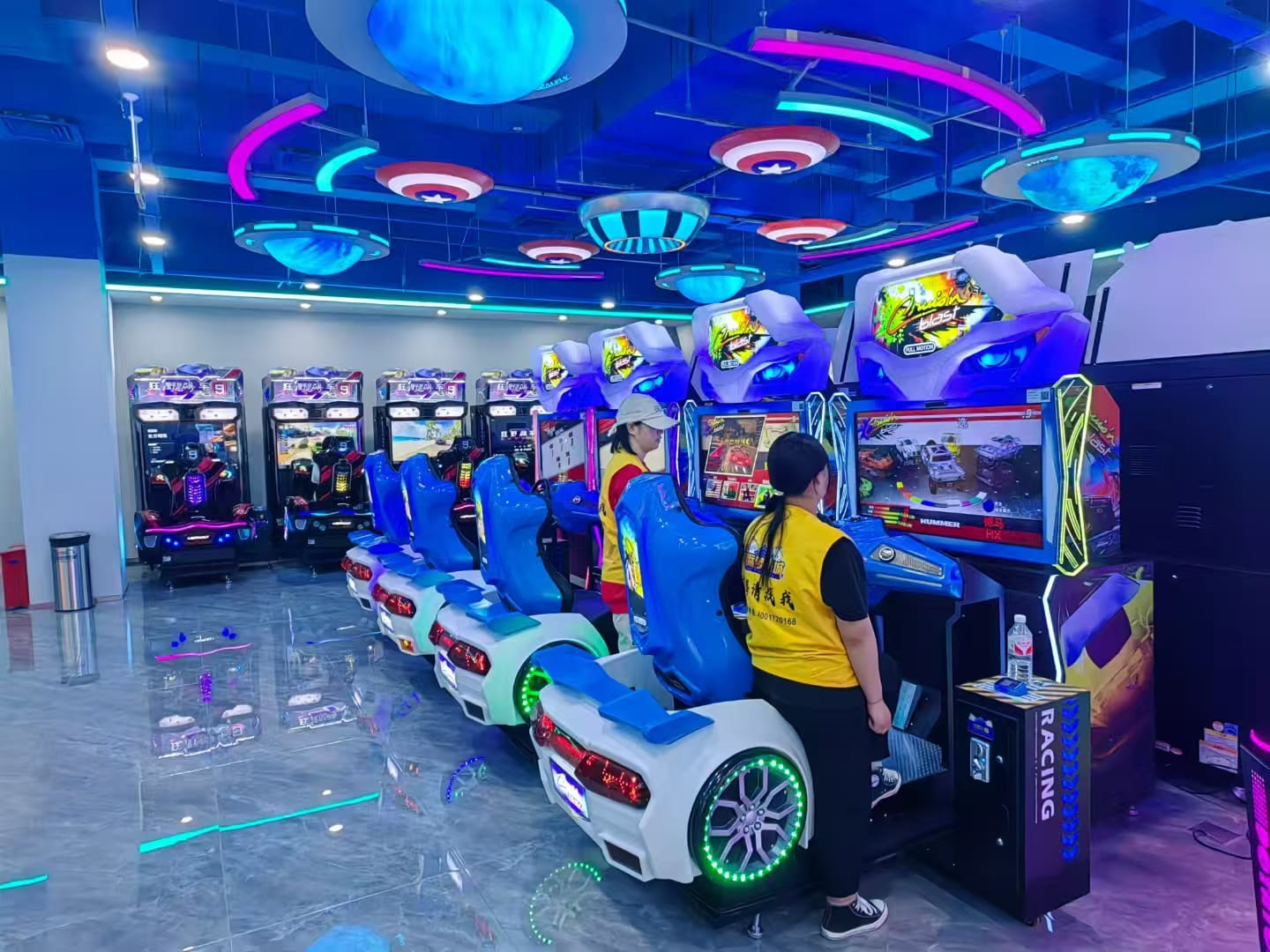
The twin racing simulator is the largest item on this list — 288 × 256 × 290 cm, 7.37 m² of cabinet, 3.69 m² per player. Racing earns that footprint through session length: a player occupies the seat for minutes rather than seconds, and linked cabinets turn one play into a head-to-head that spectators stop to watch. For teenagers and young adults, the appeal is direct — lap times are comparable between strangers, which manufactures competition without staff involvement.
What to Check on a Racing Cabinet
Seat, pedal, and wheel durability — these absorb the most physical abuse of any controls on the floor.
Display size and mounting — the twin model runs a 55-inch HD LCD; confirm the panel brand and replacement cost.
Link configuration — how many cabinets link, wired or wireless, and what the network requires.
Cooling and ventilation — enclosed PC-driven cabinets in a warm hall run hot.
Service access — how the steering assembly, pedals, PC, and wiring are reached for replacement.
Voltage and plug standard — configured per destination market.
The honest trade-off: at 3.69 m² per player, racing is the wrong first purchase for a small floor. A venue under roughly 100 m² gets more revenue per square metre from basketball or boxing, and adds racing once the traffic justifies it. If the floor cannot give a simulator both its 7.37 m² and its spectator standing room, the machine underperforms regardless of how good the game is.
2. Basketball Machines: The Fastest Cycle per Square Metre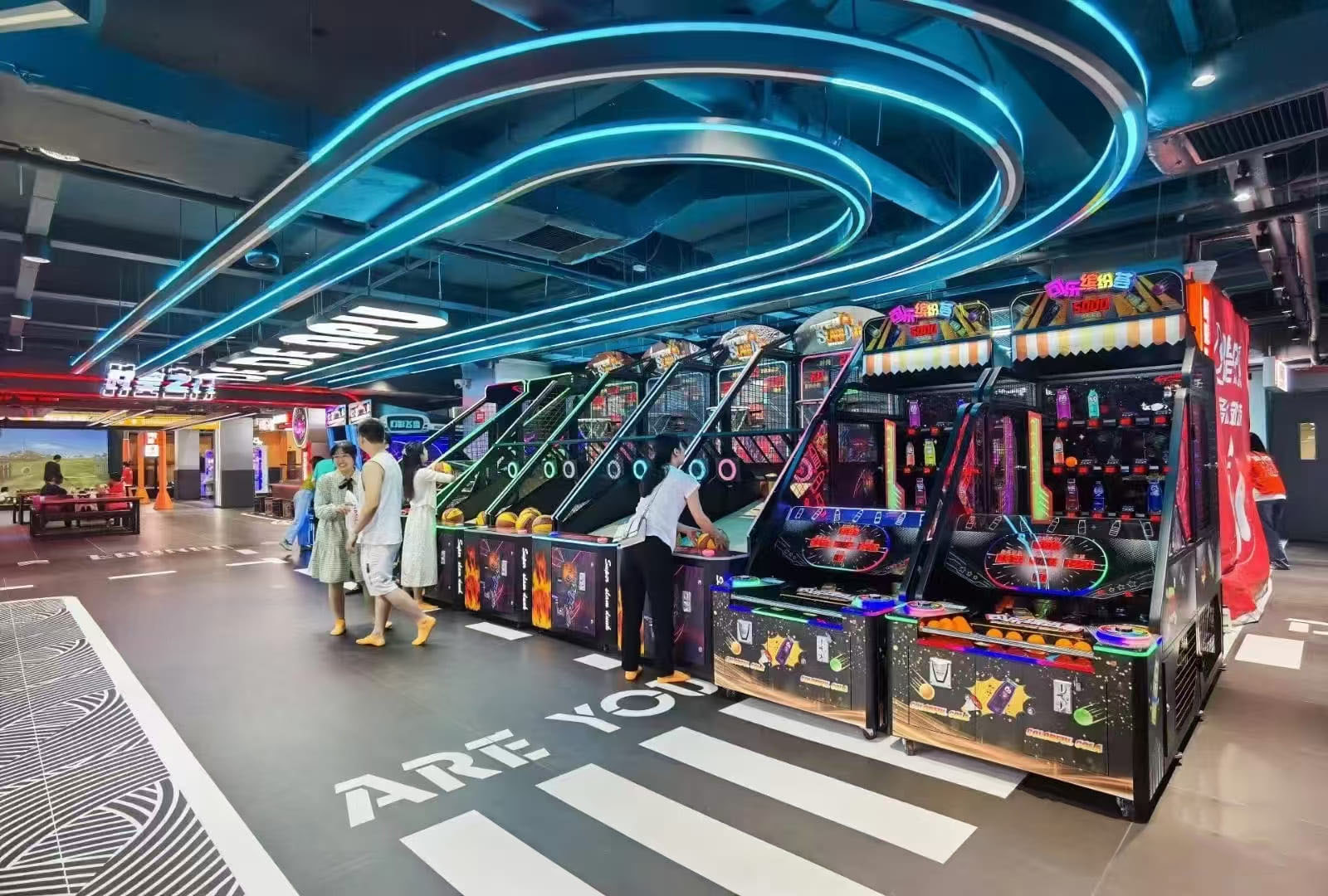
Basketball holds this age group because the loop is seconds long and self-explanatory: shoot, score, beat your own last score or the person next to you. The 2-player folding model runs 100 × 245 × 240 cm — 2.45 m² of cabinet, 1.23 m² per player — and is rated at 200 W, which works out to five hours of play per kWh, roughly 2.4 kWh across a 12-hour trading day. Folded, the same unit is 130 × 130 × 120 cm, small enough to store or relocate without a rigging crew.
What to Check Before Ordering a Basketball Machine
Frame and ball-return mechanism — the return rail takes continuous impact and is the first thing to fail on thin builds.
Scoring sensors — confirm the sensor type and what a replacement costs.
Ball specification and spares — balls wear and migrate; ask what a set costs.
Shooting lane clearance — the published footprint is not the working area: add roughly 2 m of clear floor in front of the hoop plus 1–1.5 m behind each player. A 2.45 m² cabinet effectively occupies 6–7 m² of floor.
Height — 240 cm clears a standard doorway only if the route is unobstructed; measure to the lowest obstruction, not the ceiling slab.
3. Shooting Games: Modular Internals Decide Downtime
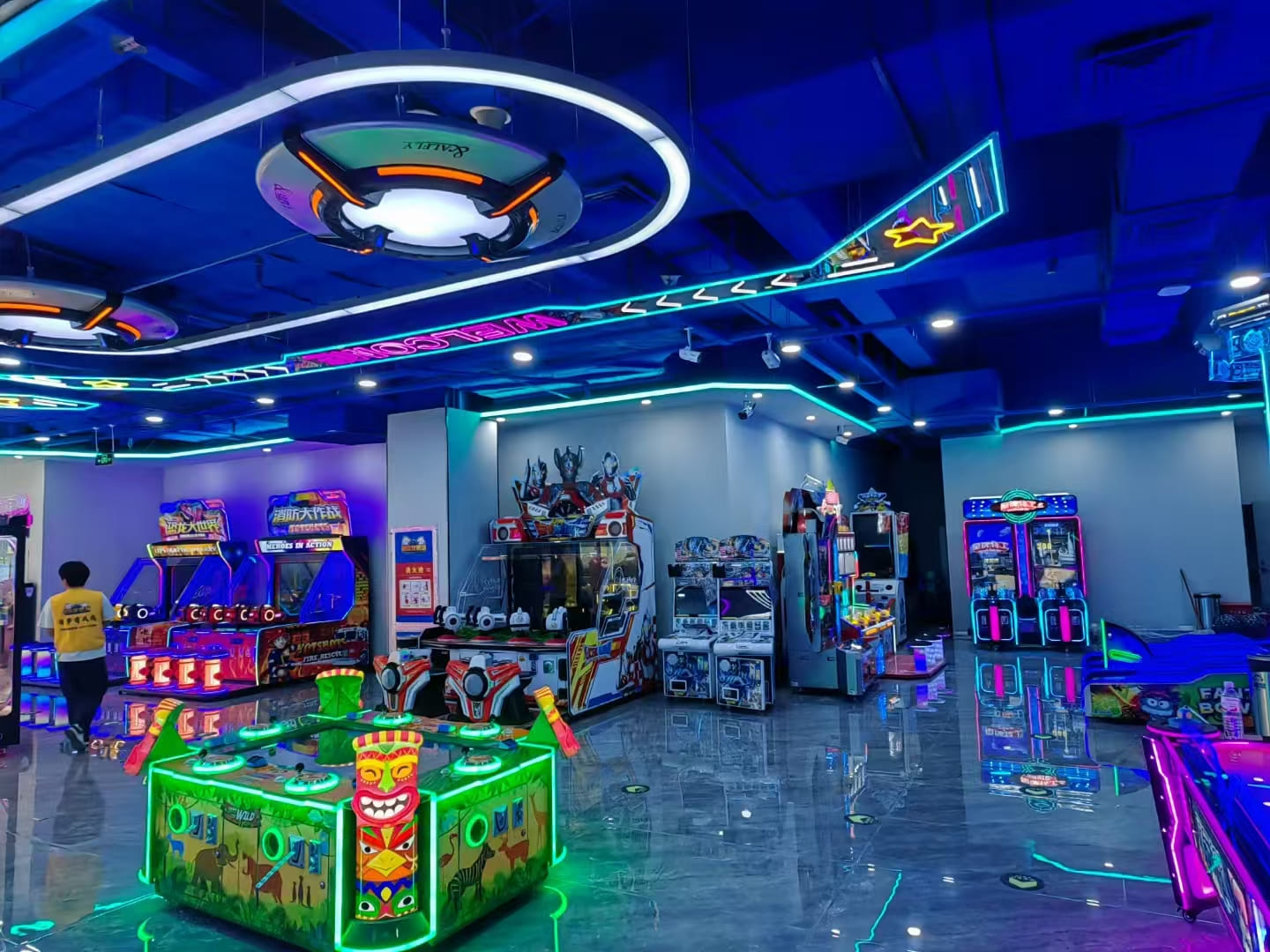
Shooting games hold teenagers through reaction feedback: aim, fire, hit, score, repeat. WIDIN's 2-player shooting cabinet runs 185 × 96 × 160 cm — 1.78 m², 0.89 m² per player, 150 kg — and its internals are built modular: screen, shooting-track motors, ticket mainboard and joysticks are each replaceable without pulling the machine off the floor. On a machine whose whole appeal is rapid repetitive input, that modularity is the difference between a one-hour repair and a one-week one.
Payment compatibility is the other commercial-critical check: the standard build takes coins, with multi-country QR modules optional — confirm which your market needs before production, because retrofitting payment hardware later costs more than ordering it right. For distributors, cabinet artwork, language, branding, and colour scheme are produced per order.
4. Boxing Machines: The Height, Not the Footprint, Is the Constraint
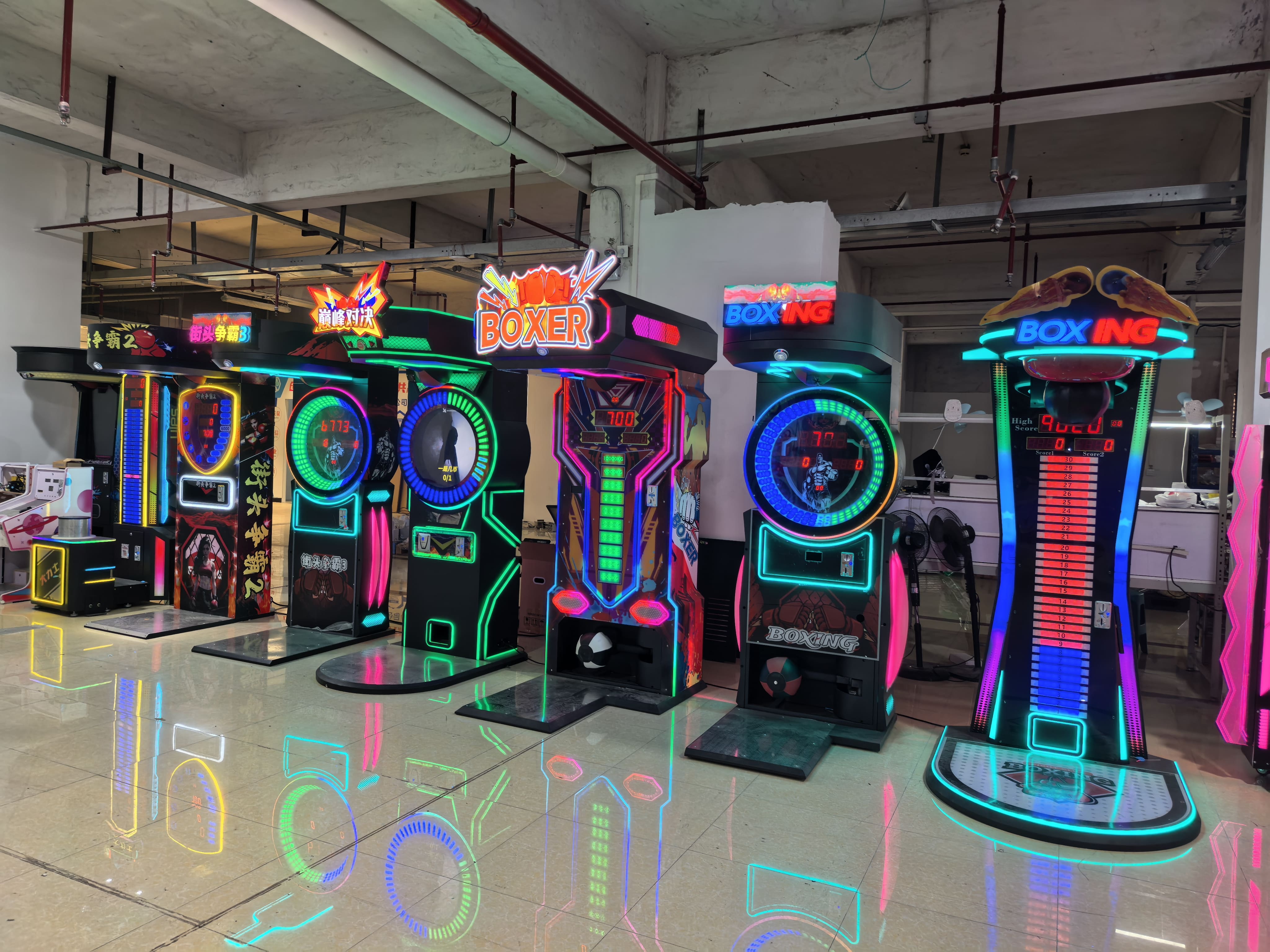
The punch tester needs 1.12 m² of cabinet — the smallest floor claim of the five — and one punch produces one number that friends immediately compare. But its 235 cm height is the catch: a standard interior doorway is roughly 200–210 cm high, so this cabinet does not pass upright through a normal door. It needs a goods entrance, a loading dock, or to travel on its end — plan that route before ordering, not when the truck arrives.
What to Check on a Punch Tester
Punch sensor and target assembly — the parts that absorb every play; ask how they are mounted and what replacement costs.
Frame structure — repeated full-force impact is the operating condition; thin-gauge frames fatigue.
Clearance — the player's swing needs clear floor around the machine; keep it out of tight corners and away from neighbouring cabinets.
Delivery route — 235 cm height plus the weight class of a steel-frame cabinet makes this a two-person, planned-route installation.
One caution about revenue claims on this category: any earnings figure a supplier quotes is venue-specific. Actual performance depends on location, pricing, traffic and the surrounding attraction mix — treat supplier numbers as illustrations, not forecasts.
5. Multiplayer Cabinets: Eight Positions on 3.6 Square Metres
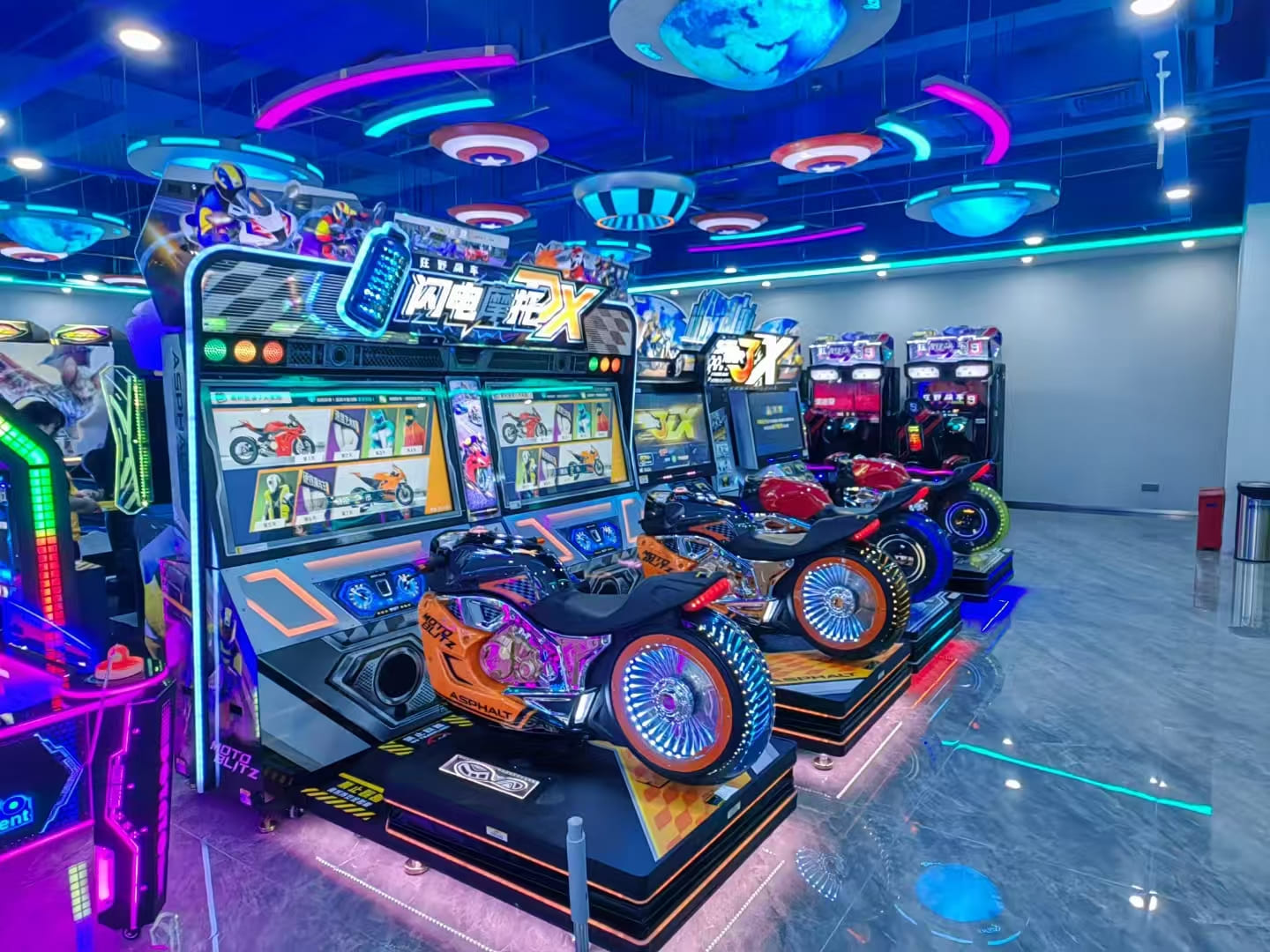
The multiplayer category is where floor efficiency flips. WIDIN's 8-player fishing table measures 225 × 160 × 85 cm — 3.60 m² of cabinet carrying eight play positions, 0.45 m² per player, the best ratio of anything on this list. The cabinet weighs 300 kg, which is what keeps it stable under eight players leaning on it at once. Every station has its own coin and QR payment slot and its own ticket output, so one seat fault does not idle the other seven.
Multiplayer also changes the social math: eight friends ride one machine together, and the group — not the individual — is the unit that arrives and pays. Before ordering, confirm how the multiplayer system actually works: number of positions, local versus networked play, ranking functions, software update method, and backend revenue reporting per station. The fishing table ships from workshop stock within 7 working days when ordered without customisation.
How Much Floor Space per Player Does Each Category Need?
Ranked by floor space per player, from the published specs above: the 8-player fishing table at 0.45 m², the shooting cabinet at 0.89 m², the punch tester at 1.12 m², the folding basketball at 1.23 m², and the twin racing simulator at 3.69 m². The spread is roughly eight-fold, and it is the single most useful number in arcade layout planning: the question is not "which game is popular" but "which popular game fits the square metres this venue can give it".
Two limits on these figures matter. First, cabinet area excludes player standing and queueing space — basketball's working area is roughly three times its footprint. Second, power figures are rated rather than measured values, so treat the comparisons as planning ratios, not operating bills.
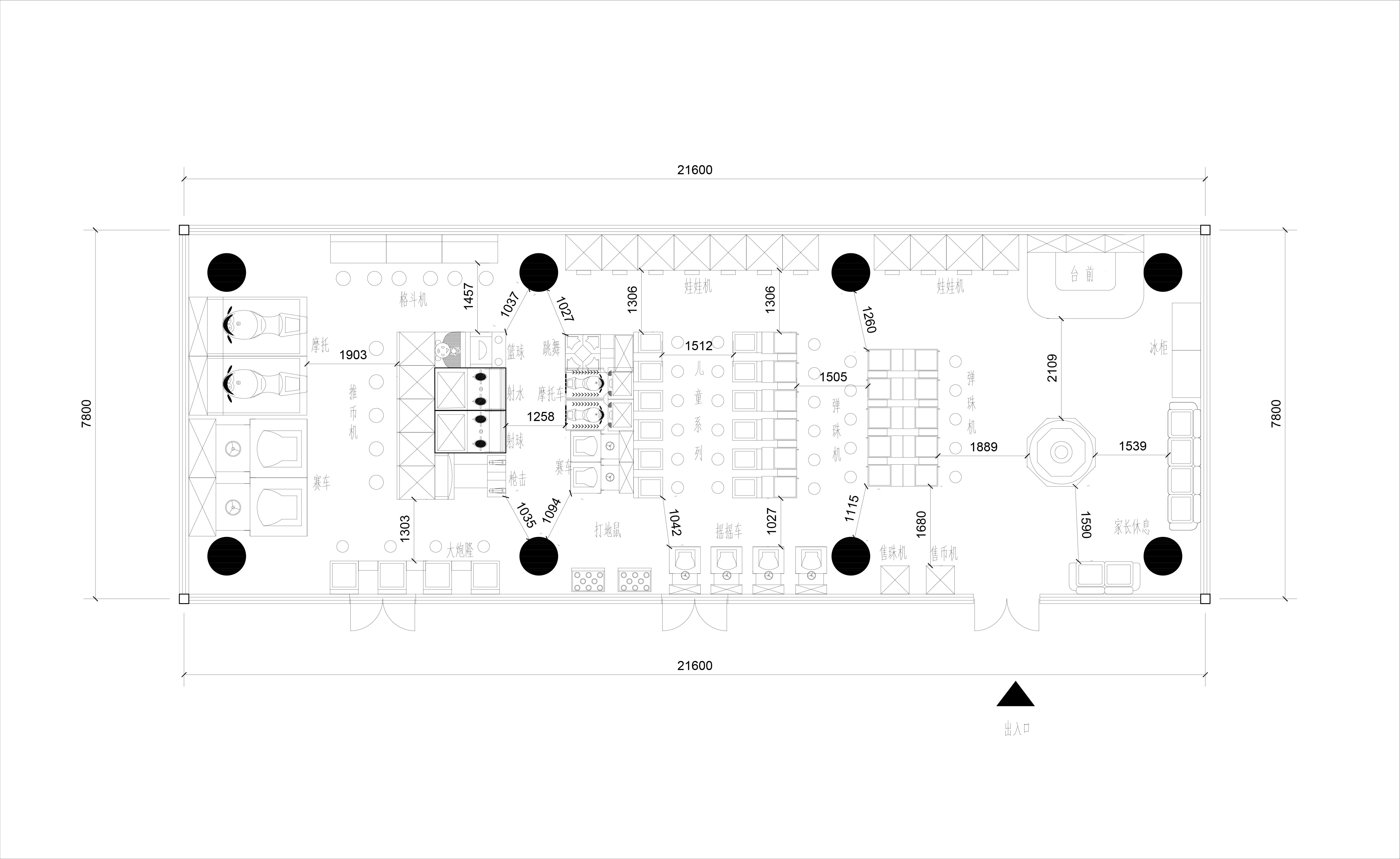
The way to use these numbers is on a plan, not in a spreadsheet. Mark each cabinet's footprint, its player clearance and its service-access side, then draw the circulation paths — the layout below is the version of that exercise done before ordering rather than after delivery, when moving a 300 kg cabinet is no longer a planning decision.
Which Machines Fit Through a Standard Doorway?
A standard interior doorway is roughly 200–210 cm high — an architecture standard, not a factory figure. Against that: the fishing table at 85 cm, the shooting cabinet at 160 cm, and most claw machines at about 190 cm pass upright. The punch tester at 235 cm and the racing simulator at 290 cm do not — they need a goods entrance, a loading dock, or to be transported on their end. The basketball machine at 240 cm is marginal: it fits only where the route is clear.
Measure the whole route, not just the door: to the lowest obstruction along it — lighting track, sprinkler heads, ductwork, signage. Weight is the second constraint: at 300 kg (fishing) and 180 kg (basketball), these are heavy cargo requiring pallet trucks or a planned carry, not parcel deliveries.
What to Confirm in Writing Before Production
The most expensive purchasing mistakes in this category are configuration mistakes, and they are avoidable with a written specification. Before production starts, confirm: final dimensions, voltage, frequency, plug type, payment system, cabinet language, branding, game version, accessories, and export packaging. For OEM and custom projects, an approved specification sheet or prototype before mass production is what turns a quotation into a deliverable.
Spare parts deserve the same written treatment as the machine itself. Buttons, joysticks, sensors, power supplies, ticket motors, and LED components are normal wear items — ask which are stocked, at what price, and how they ship after installation. A machine with an attractive purchase price can still cost more across three years if its parts are slow to arrive; the purchase price is one line of the landed cost, and the full cost model is where that comparison belongs.
How Do You Evaluate an Arcade Machine Supplier?
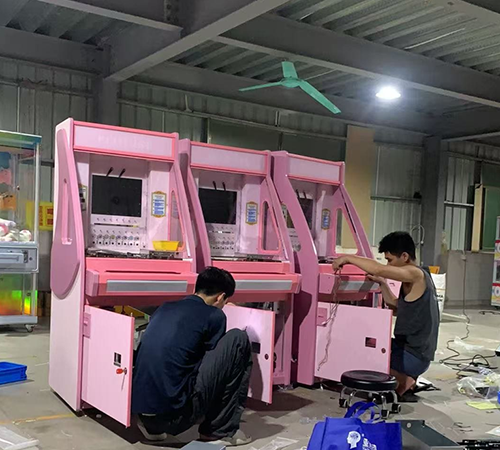
For overseas buyers, supplier evaluation comes down to four verifiable things: production capability, pre-shipment testing, spare-parts policy, and export experience. Product photos and a quotation demonstrate none of them — ask for evidence instead.
On build quality, the numbers worth asking any supplier for are specific. WIDIN runs a 72-hour continuous aging test on every machine before shipment, builds cabinets in 1.2 mm reinforced steel against a 0.6–0.8 mm industry norm, and rates the stable service life of the build at 4–6 years against 2–3 for conventional workshop cabinets. These are the manufacturer's ratings, quoted as such — and they are the difference between buying a cabinet once and buying it twice: a 2–3 year machine must be replaced within a six-year operating period, which means paying the lower purchase price a second time plus freight, downtime and changeover labour.
Before shipment, request inspection photos, testing videos, quality records or third-party inspection for larger orders. After installation, what matters is the spare-parts channel and response time — ask the supplier to describe their troubleshooting process in one paragraph. If they cannot, that is the answer. WIDIN's factory and assembly process in Guangzhou is open to buyer review, and the same standard applies to any manufacturer being evaluated.
FAQ: Arcade Games for Teenagers and Young Adults
What are the best arcade games for teenagers?
Racing simulators, basketball machines, shooting games, boxing punch testers, and multiplayer cabinets are the five categories that consistently hold teenagers and young adults, because each offers competition, physical interaction, or social play that needs no instructions. The right pick for a specific venue depends on floor area, budget and the existing equipment mix — an 8-player fishing table at 0.45 m² per player and a twin racing simulator at 3.69 m² per player serve the same audience on very different floors.
Which arcade game earns the most per square metre?
No universal ranking exists — earnings are venue-specific and depend on traffic, pricing and position. What the published specs do show is the input side: per player, the 8-player fishing table occupies 0.45 m², the shooting cabinet 0.89 m², the punch tester 1.12 m², the basketball machine 1.23 m² and the twin racing simulator 3.69 m². The lower the floor per player, the more earning positions a venue fits — but session length and price per play move the result as much as footprint does.
How much floor space do these machines need?
Cabinet footprints range from 1.12 m² (punch tester) to 7.37 m² (twin racing simulator). Add player clearance on top: a basketball machine needs roughly 2 m of shooting lane in front plus 1–1.5 m behind each player, so its real working area is several times its footprint. Multiplayer tables concentrate the most play positions into the least cabinet area — 0.45 m² per player on the 8-player model.
Will a boxing machine fit through a standard door?
No. At 235 cm high, the punch tester does not pass upright through a standard 200–210 cm interior doorway. It needs a goods entrance, a loading dock, or transport on its end. Cabinets at or below about 190 cm — the fishing table at 85 cm, the shooting cabinet at 160 cm — pass upright. Measure the delivery route to its lowest obstruction before ordering any cabinet over 200 cm.
How much power does an arcade machine use?
The published rating for the 2-player basketball machine is 200 W — five hours of play per kWh, roughly 2.4 kWh across a 12-hour trading day. Rated values are manufacturer figures, not measured draw; actual consumption varies with game load, lighting and idle behaviour. Ask for the rated wattage of any model being compared and configure voltage and plug standard to the destination market.
Are arcade games suitable for FECs?
Yes — the five categories in this guide are staples of family entertainment centers, arcades and shopping centers. The checks that matter before purchase are durability under the venue's expected traffic, floor space with player clearance, payment compatibility, spare-parts availability, and destination-market certification.
What should I check before buying commercial arcade machines?
At minimum: construction quality and cabinet materials, final dimensions, rated power, voltage and plug standard, payment compatibility, warranty terms, spare-parts policy, certifications, and pre-shipment testing. Confirm all of it in writing before production begins — configuration changes after manufacturing cost far more than specification decisions before it.
How do I choose the right arcade game mix?
Start from the floor and the customer profile, not from a category ranking. A balanced mix combines short-cycle machines (basketball, boxing), medium attractions (shooting), session-length machines (racing) and social anchors (multiplayer tables), so the venue earns from visitors with different time budgets. The full buying guide walks through that selection process machine by machine.
How long do commercial arcade machines last?
WIDIN rates the stable service life of its builds at 4–6 years, against 2–3 years for conventional workshop cabinets — the difference traces to the 1.2 mm reinforced steel and the 72-hour pre-shipment aging test. The lifespan figure is also a cash-flow figure: a 2–3 year cabinet must be bought again within a six-year operating period, with freight and downtime on top, while a 4–6 year cabinet is bought once.
Can arcade machines be customized for different markets?
Yes. Cabinet artwork, branding, panel language, colours, voltage and plug standard, payment hardware and selected game configurations are produced per order; WIDIN archives OEM files so repeat orders ship to the same specification. Minimum order quantity and sampling time are confirmed with the quotation.
Build the Right Mix for Your Floor
The five categories in this guide serve the same audience on very different budgets for floor, money, and maintenance. Match the footprint to the venue first — 0.45 m² per player on a multiplayer table against 3.69 m² on a racing simulator is an eight-fold difference that no game design overcomes — then judge the machines on build quality, parts availability and written specifications.
For a new arcade, FEC or distribution project, WIDIN supplies all five categories from its Guangzhou factory, with OEM artwork and market-specific electrical configuration produced per order. Send the venue's floor plan and target market for a machine mix and quotation built around them.
Related reading: How to Choose the Right Arcade Machine for Your Business · How Much Does It Cost to Open an Arcade? · How Arcade Machines Are Tested Before Shipment