

How Much Does It Cost to Develop a Custom Arcade Machine?
A custom arcade machine project has two separate price tags: a one-time development cost (design, engineering, prototype, testing) and a per-unit production cost (materials, components, assembly, quality control, export packaging). Repainting an existing cabinet in your brand colors may need only a few days of engineering work. A new machine with its own structure, electronics, and control system is a full product development project. This guide explains what goes into each cost bucket, why the first unit is the most expensive machine you will ever buy, and what to put in your brief so a manufacturer can quote accurately.
| Cost bucket | What it covers | When you pay it |
|---|---|---|
| Development (one-time) | Concept design, engineering, prototype fabrication, testing | Mainly once, before mass production |
| Production (per unit) | Materials, components, assembly, quality control, packaging | Every unit, at the agreed unit price |
What Is Included in Custom Arcade Machine Development?
A custom project runs through four stages, and each one adds a different kind of cost.
1. Concept and Design
You bring the input — a sketch, reference photos, an existing machine, target dimensions, or just an idea. The manufacturer's job is to turn it into something that can actually be built: cabinet dimensions, screen position, control panel layout, player position, lighting, branding, service doors, and internal component arrangement. The more original the design, the more engineering work sits behind it.
2. Engineering
Engineering converts the concept into a buildable structure: 3D cabinet design, mechanical structure, electrical layout, wiring, component mounting, cooling, service access, and control interfaces. This is the main reason a custom prototype costs more than a standard machine. A standard cabinet amortizes its engineering across thousands of units; a custom one amortizes it across your order.
3. Prototype Manufacturing
The first physical unit shows what drawings cannot: a control panel that feels uncomfortable after ten minutes, a screen at the wrong viewing angle, components that need more internal space, a service door that is hard to reach, cooling that falls short. Every one of these is cheap to fix on a prototype and expensive to fix after tooling. Changes at this stage are a normal part of development, not a sign that something went wrong.
4. Testing and Adjustment
A commercial machine has to survive repeated operation, not just look finished. Testing covers controls, display, speakers, lighting, sensors, power supply, cooling, the payment system, game communication, and mechanical parts. Ask what the factory's production testing routine includes — WIDIN runs a 72-hour aging test on machines before they leave the production line, so a prototype that passes the same routine has already been through what a production unit goes through.
What Determines the Cost of a Custom Arcade Machine?
1. How Much of the Machine Is New?
This is the biggest single factor, and it is worth ranking explicitly. From least to most engineering:
| Customization level | Typical engineering workload |
|---|---|
| Artwork, colors, logo on an existing cabinet | Graphics only — days |
| Different controls or payment system on an existing cabinet | Control interface and wiring changes |
| Modified cabinet dimensions or structure | New mechanical design, new sheet-metal and panel parts |
| Completely new machine: structure, electronics, controls | Full development: design, engineering, prototype, testing, possibly tooling |
An existing platform with your branding is a limited engineering job. A completely new cabinet with unique dimensions, structure, electronics, and controls is a substantially larger project — and the quotation should say so.
2. Cabinet Design and Size
Cabinet size drives material consumption, structural design, transportation, packaging, and component layout. A compact countertop unit and a large racing simulator are different engineering projects in kind, not just in price. Custom dimensions can also force new sheet-metal parts, acrylic panels, wood components, brackets, molds and packaging materials — which is why buyers should lock down accurate dimensions as early as possible.
3. Screen and Display Requirements
The display is its own cost decision: standard LCD, large-format, touchscreen, curved, multiple screens, special mounting angles. The screen itself is only part of it — the cabinet has to be designed around the display's dimensions, weight, ventilation, viewing angle, mounting structure, and service access.
4. Control Panel and Physical Controls
Joysticks, buttons, steering wheels, pedals, keyboards, touchscreens, sensors or a fully custom panel. One recent example from our own order book: a custom commercial machine that needed a physical keyboard with specific keys, dedicated START / CLEAR buttons, USB connectivity, and a custom mounting structure. The more specialized the controls, the more compatibility engineering sits between the idea and a working machine.
5. Tooling: the Cost That Appears Only When the Cabinet Changes
If your design needs new molds, dies, or fixtures, tooling is a one-time cost that can exceed the prototype itself. Three questions to ask before signing: Is tooling quoted separately or buried in the unit price? Who owns the tooling once it is paid for? Can it be reused for future variants? A supplier who answers all three in writing is easier to scale with than one who quotes a single number.
Why Is a Prototype More Expensive Than a Production Machine?
The first unit carries costs that later units never see: engineering, design modifications, one-off fabrication, prototype assembly, testing, custom components, and special packaging. When the project moves to mass production, these costs spread across the run. The arithmetic is unforgiving and simple — if development costs D and you build N units, each unit carries D/N of the development cost:
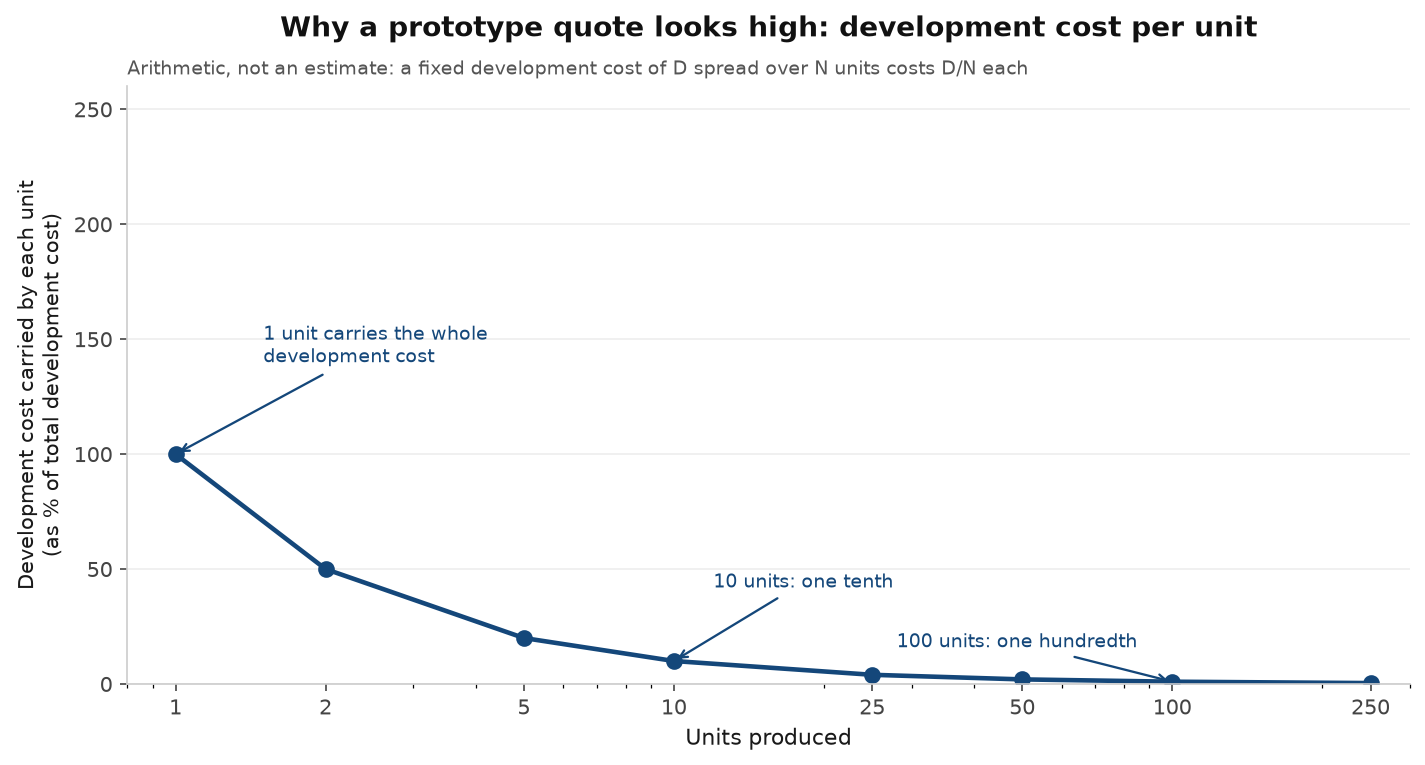 Line chart showing development cost per unit falling from 100 percent at one unit to about 10 percent at ten units and 1 percent at one hundred units
A practical way to read two quotations: judge the prototype quote by what it includes, and judge the production quote by what quantity it assumes. A prototype price that covers full engineering and testing is not comparable to one that covers assembly only.
How Much Should a Custom Arcade Prototype Cost?
No reliable universal range exists, because "custom" spans everything from an artwork change to a new machine. The question that produces a usable comparison is more specific: what does the prototype quotation include, and which of those costs disappear or decrease during mass production? A professional quotation separates the major cost categories instead of providing one unexplained number — the table below shows what to expect.
What Should Be Included in a Custom Arcade Machine Quote?
| Cost area | What to confirm | Why it matters |
|---|---|---|
| Engineering | Which design and technical development work is included | Under-quoting here means the work still happens — you pay for it later as change requests |
| Prototype | What the first physical machine includes | Defines what you can test before committing to tooling |
| Components | Screen, PC, controls, speakers, lighting | Brand and grade of components drive both price and service life |
| Tooling | Whether new molds or fixtures are required, and who owns them | Can be the largest hidden line in the project |
| Testing | Functional and reliability testing included | Skipped testing migrates failures to your floor after delivery |
| Packaging | Export-grade packaging and protection | Sea freight punishes weak packaging |
| Production | Unit price at different quantities (e.g. 10 / 50 / 100) | Tiered pricing shows how development cost actually amortizes |
| Spare parts | Recommended spare components | Determines your downtime risk in year two |
| Shipping | Delivery terms and logistics costs | Incoterms decide who pays for what between factory and floor |
What Should B2B Buyers Prepare Before Requesting a Quote?
Quotation quality tracks brief quality. Before contacting a manufacturer, prepare:
Product Concept
Reference images, sketches, drawings, or an existing machine you want modified.
Dimensions
Approximate or final Width × Depth × Height, and the door and elevator sizes on the delivery route.
Display
Preferred screen size, and whether touch is required.
Operating System and Hardware
If the machine runs a PC, state the platform (Windows or Linux) and requirements for CPU, RAM, storage, graphics, Wi-Fi, Ethernet, and USB ports.
Controls
Buttons, joysticks, steering systems, keyboards, pedals, sensors — whatever the player actually touches.
Payment System
Coins, tokens, cards, NFC, QR, cashless systems, or hardware you already operate.
Target Market
Country or region, because voltage, plugs, certifications, and payment habits differ. A complete specification shrinks the uncertainty in the quotation — and the gap between the quotation and the final invoice.
How Does MOQ Affect Custom Arcade Machine Cost?
Directly. If one machine is built, that machine carries the entire development cost. At 50 or 100 units, the same development investment spreads across the run. This is why buyers planning future production should state the expected volume from the start, even when the first order is a single prototype: the prototype can then be engineered for repeatable manufacturing — standard parts, producible panels, testable assemblies — instead of being a one-off that cannot be scaled.
Which Certifications Does a Custom Arcade Machine Need?
It depends on the destination market. As a baseline: the EU requires CE marking under the Machinery Directive 2006/42/EC, Low Voltage Directive 2014/35/EU, EMC Directive 2014/30/EU and RoHS; the US requires FCC Part 15 for electronics, with UL or ETL listing commonly expected by venues and insurers; the UK requires UKCA; Australia and New Zealand require RCM. For a custom machine, certification belongs in the design discussion, not after the prototype — changing a power supply or adding a wireless module late in the project can force a redesign. Ask which certificates the manufacturer holds for the platform you are customizing, and request the Declaration of Conformity with the test reports behind it. [待填:WIDIN 实际持有的认证清单与编号]
How Can Buyers Reduce Custom Arcade Machine Development Cost?
Each of these reduces development work; each also has a trade-off worth knowing before you choose it.
Use a proven cabinet platform
The largest single saving. Standard commercial components and an existing platform reduce engineering risk — at the cost of a machine that looks less unique from the outside.
Customize only what touches the player or the business model
Branding, controls, screen content, and payment flow earn their customization. Internal brackets and fastener choices usually do not.
Freeze the specification before the prototype is built
Changing cabinet dimensions or major components after prototype production means new parts, new packaging, and a new round of testing. Late changes cost multiples of early ones.
Provide complete reference material
Drawings, photos, dimensions, and videos shorten the engineering evaluation. Engineers who can see the concept quote it faster and with fewer assumptions.
State future production volume upfront
A prototype designed with mass production in mind saves a second development round later.
One warning from the factory floor: cutting engineering or testing hours is the most expensive saving available. The work does not disappear — it reappears after delivery as failures, downtime, and warranty claims.
How Long Does Custom Arcade Machine Development Take?
A typical sequence runs: requirement confirmation → engineering evaluation → quotation → prototype → testing and feedback → design adjustment → final approval → mass production. The schedule is dominated by one variable: the number of revision rounds, which both sides control through how precisely the specification is written and how quickly feedback comes back.
What Should You Ask an Arcade Machine Manufacturer?
Before approving a custom project, get written answers to:
Is the design completely new or based on an existing cabinet?
What engineering work is included in the price?
What does the prototype price cover?
Are tooling costs included — and who owns the tooling?
Which components are standard, and which are customized?
What happens if the prototype requires changes?
Can the machine be produced in larger quantities, and at what unit prices?
What is the expected MOQ and production lead time?
How is the machine tested before shipping?
Which certifications are held, and is a Declaration of Conformity provided?
What spare parts are recommended?
What warranty and after-sales support are provided?
Frequently Asked Questions
How much does it cost to develop a custom arcade machine?
There is no fixed price. Cost depends on how much of the machine is new, cabinet complexity, engineering requirements, components, tooling, prototype quantity, testing, and future production volume. The most useful comparison between suppliers is not the total price but which cost categories each quotation separates and includes.
Why is a prototype more expensive than a production machine?
A prototype carries one-time engineering, design, fabrication, testing, and setup costs. When production begins, those costs spread across the run — the same logic that makes one unit carry 100% of development cost and one hundred units carry 1% each.
Can I customize an existing arcade machine?
Yes, depending on the machine. Cabinet artwork, dimensions, screens, controls, lighting, branding, and payment systems are the usual customization points. Artwork and branding involve the least engineering; structural changes involve the most.
Is a custom arcade machine more expensive than a standard machine?
The initial development cost is higher because engineering and prototype work are involved. The production unit price then becomes more competitive as order volume increases, since the development cost is spread across more machines.
What information should I send a manufacturer?
Concept images, dimensions, screen requirements, controls, hardware specifications, payment method, operating system, target market, branding requirements, and expected order quantity. Complete briefs produce narrower quotations — and fewer surprises at invoice time.
Should I build one prototype before mass production?
For a completely new machine, yes. A prototype surfaces design, usability, and technical problems while they are still cheap to fix, before tooling and volume production lock the design in.
How long does it take to develop a custom arcade machine?
It depends on how much of the machine is new and how many revision rounds the prototype needs. A typical cycle is 2–4 weeks for prototype work and 8–12 weeks for pre-production preparation. Stating expected volume and freezing the specification early are the two actions that most reliably shorten the schedule.
What is the MOQ for a custom arcade machine?
WIDIN’s MOQ for custom arcade machines is 1 unit for prototypes and 100 units for mass production. Development economics improve with volume — a single prototype carries the whole development cost, while a production run spreads it — so manufacturers will usually ask about your production plans before quoting.
Do I need new tooling or molds for a custom cabinet?
Only if the design changes parts that are produced with molds or dies — typically new cabinet dimensions or shapes. Standard-platform projects with artwork, control, or payment changes usually avoid tooling entirely. Ask whether tooling is quoted separately and who owns it.
Which certifications does a custom machine need for the EU or US?
For the EU: CE marking covering the Machinery Directive, Low Voltage Directive, EMC Directive, and RoHS. For the US: FCC Part 15, with UL or ETL listing commonly expected by operators. Discuss certification at the design stage — late changes to power supplies or wireless components can force a redesign.
Final Thoughts
The cost of a custom arcade machine is decided by more than the cabinet: how much of it is new, which components go inside, whether tooling is needed, how thoroughly it is tested, and how many units will eventually share the development bill. The single most useful habit when comparing manufacturers is to read what each quotation excludes — a prototype price that lists its exclusions is easier to judge than a cheaper one that does not.
If you are planning a custom machine, send your concept images, dimensions, screen requirements, control layout, hardware specifications, payment method, target market, and expected production quantity, and we will tell you which parts of the project can ride on an existing platform and which genuinely need new engineering.