

How Do Arcade Machines Work? A Complete Guide to Arcade Hardware and Software
How Do Arcade Machines Work?
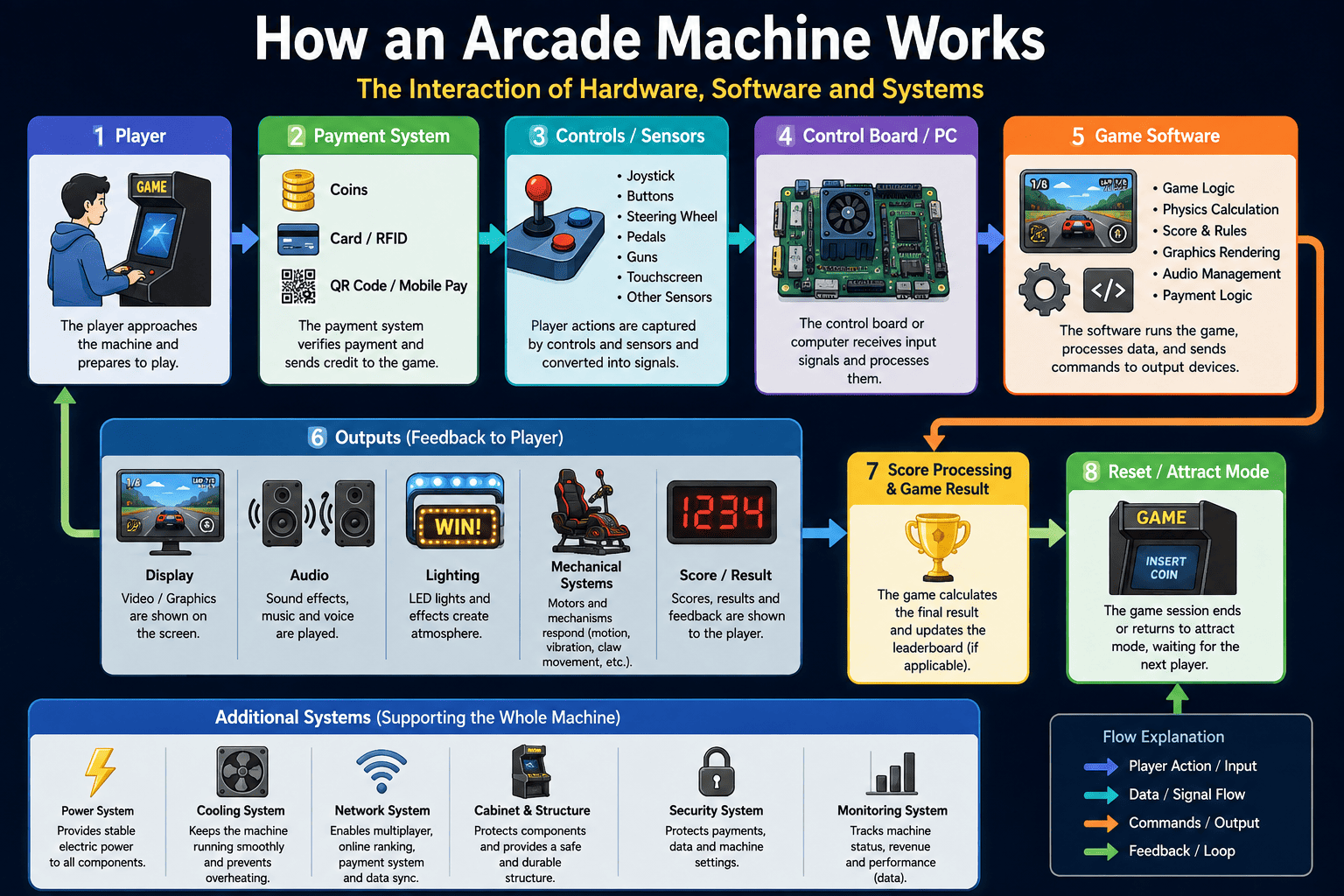
Arcade machines work by combining hardware, game software, player controls, display systems, audio, power management, and payment technology into one dedicated entertainment system.
When a player inserts a coin, taps a card, scans a QR code, or activates the machine through a venue payment system, the arcade system starts a game session. The player then interacts with physical controls such as joysticks, buttons, steering wheels, guns, basketballs, pedals, punching bags, or touchscreens.
The machine's software processes these inputs, calculates the game result, and sends information to the display, speakers, lighting system, motors, or other physical components.
A simplified arcade machine workflow is:
Payment → Game Start → Player Input → Software Processing → Game Output → Score / Result → Game Reset
Commercial arcade machines are more than ordinary computers inside cabinets. They are purpose-built systems designed for frequent public use, simple operation, fast game cycles, and reliable commercial operation.
What Are the Main Components of an Arcade Machine?
Although different arcade games use different technologies, most commercial arcade machines contain several fundamental systems.
The main components include:
Game computer or control board
Game software
Display
Player controls
Sensors
Audio system
Lighting system
Power supply
Payment system
Mechanical components
Network or communication system
Cabinet and structural components
The exact configuration depends on the type of machine.
A racing simulator, for example, requires a steering wheel, pedals, and possibly motion hardware, while a claw machine requires motors, sensors, and a mechanical claw.
1. Arcade Machine Hardware
Arcade hardware refers to the physical electronic and mechanical components that make the machine operate.
The hardware is responsible for receiving player input, processing information, displaying graphics, producing sound, controlling lighting, and operating mechanical components.
A commercial arcade machine may contain:
Motherboard or game board
CPU
GPU
RAM
Storage
Display
Speakers
Amplifier
Power supply
Input controllers
Sensors
Motors
LED lighting
Cooling fans
Wiring
Payment components
The hardware configuration should be matched to the game requirements.
A simple 2D arcade cabinet does not require the same computing performance as a high-end racing simulator with 3D graphics.
2. The Arcade Game Board or Computer
At the center of many modern arcade machines is a game computer or arcade control board.
Its primary job is to run the game software and coordinate communication between the different components.
Depending on the machine design, the system may use:
Dedicated arcade game boards
Industrial PCs
Android-based systems
Embedded computers
Custom control boards
The system processes information from the controls and sensors, runs the game logic, and generates the output shown on the screen.
For example, when a player presses a button:
Button → Input Controller → Game System → Game Software → Display / Audio
The entire process happens within a very short period, creating the feeling of real-time interaction.
3. Arcade Machine Software
Hardware alone cannot create a playable arcade experience.
The machine also requires software that controls:
Game rules
Player interaction
Graphics
Sound
Scoring
Levels
Timers
Game difficulty
Menus
Payment logic
Game sessions
Multiplayer functions
The software is essentially the operating logic of the arcade machine.
Different arcade machines may use completely different software architectures.
For example:
A boxing machine may calculate punch strength.
A basketball machine may calculate successful shots.
A racing simulator may process steering, acceleration, braking, lap time, and race position.
A claw machine may control motor movement, claw strength, timing, and prize positioning.
4. How Do Arcade Controls Work?
Arcade controls convert physical player actions into electronic signals.
The most common controls include:
Joysticks
Push buttons
Steering wheels
Pedals
Guns
Touchscreens
Trackballs
Basketball sensors
Punch sensors
Dance platforms
The process is generally:
Player Action → Sensor / Switch → Controller → Game Software → Response
For example, when a player moves a joystick to the left, the input controller detects the movement and sends the corresponding signal to the game system.
The software then moves the character or object to the left.
This simple principle applies to almost every interactive arcade machine.
5. How Do Arcade Machine Displays Work?
The display provides visual feedback to the player.
Commercial arcade machines commonly use LCD or LED displays.
The game system sends video information to the display through an appropriate video interface.
The basic process is:
Game Software → Graphics Processing → Video Signal → Display
Different arcade machines require different display configurations.
Standard Arcade Cabinets
Traditional cabinets may use a single medium-sized monitor.
Racing Machines
Racing simulators may use large displays or multiple screens to create a wider field of view.
Shooting Games
Shooting machines may use large displays to improve immersion.
Interactive Games
Interactive machines may use touchscreens or specialized display systems.
Screen brightness, viewing angle, resolution, durability, and size can all affect the player experience.
6. How Does the Arcade Sound System Work?
Sound is an important part of arcade game design.
A typical arcade audio system includes:
Speakers
Amplifier
Audio controller
Wiring
Game audio software
The game software generates audio signals for:
Music
Sound effects
Voice
Player feedback
Game instructions
For example, when a player scores in a basketball game, the software can simultaneously trigger:
Score Update + Sound Effect + LED Animation
This synchronized feedback makes the game feel more responsive.
7. How Do Arcade Machine Sensors Work?
Sensors allow an arcade machine to detect physical events.
Different machines use different sensor technologies.
Common examples include:
Optical sensors
Infrared sensors
Pressure sensors
Position sensors
Limit switches
Motion sensors
Proximity sensors
Accelerometers
Encoders
For example, a basketball machine may use sensors to determine whether the basketball has passed through the hoop.
A racing machine may use sensors or encoders to detect steering-wheel position.
A claw machine can use sensors to determine the position of the claw mechanism.
Sensors convert physical events into electronic information that the software can interpret.
8. How Do Boxing Arcade Machines Measure Punch Strength?
Boxing machines provide a good example of how hardware and software work together.
A typical boxing machine may contain:
Punching bag
Impact sensor
Mechanical structure
Control board
Display
Game software
Score algorithm
When the player hits the target:
Punch → Impact Sensor → Signal Processing → Software Algorithm → Score Display
The sensor detects the impact.
The control system converts the physical signal into electronic data.
The software then processes the data and produces a score.
Different machines may use different sensor technologies and scoring algorithms, so the displayed score should not automatically be interpreted as a standardized physical measurement such as an exact Newton or pound-force value.
9. How Do Racing Arcade Machines Work?
Racing simulators combine multiple hardware systems.
A typical commercial racing machine may include:
Steering wheel
Pedals
Gear shifter
Racing seat
Display
Speakers
Game computer
Vibration system
Lighting
Network connection
When the player turns the steering wheel:
Steering Wheel → Encoder / Sensor → Game System → Vehicle Direction
When the player presses the accelerator:
Pedal → Sensor → Game System → Vehicle Speed
The game software combines these inputs with the physics engine to calculate vehicle movement.
Some advanced racing machines also use motion platforms.
In that case:
Game Data → Motion Controller → Motors / Actuators → Physical Movement
This creates a more immersive driving experience.
10. How Do Arcade Shooting Games Work?
Shooting machines combine a display, game software, and shooting controller.
Depending on the technology, the gun may use:
Optical tracking
Infrared tracking
Position sensors
Motion detection
Other electronic tracking technologies
When the player pulls the trigger, the system determines the player's aiming position and sends that information to the game.
The game then calculates whether the target has been hit.
The basic process is:
Aim → Trigger → Tracking System → Game Software → Hit Detection → Score
Some multiplayer shooting machines also synchronize multiple players through a local network.
11. How Do Claw Machines Work?
Claw machines are different from traditional video arcade cabinets because they combine software with mechanical systems.
A typical claw machine contains:
Joystick
Control buttons
X/Y movement system
Claw motor
Vertical lifting mechanism
Sensors
Control board
Prize compartment
Payment system
The player controls the claw horizontally.
The machine then lowers the claw, closes the mechanism, and lifts the prize.
The process may look like:
Player Input → Control Board → Motor Movement → Position Detection → Claw Operation → Prize Result
The machine's software can control various operating parameters depending on the machine design.
For commercial operators, mechanical reliability is particularly important because repeated movement can create wear on motors, gears, belts, cables, and other components.
12. How Does the Arcade Payment System Work?
A commercial arcade machine normally needs a way to authorize a game session.
Traditional machines commonly use:
Coins
Tokens
Modern arcade businesses may also use:
RFID cards
Cashless cards
QR codes
Mobile payment systems
Centralized payment platforms
A typical payment sequence is:
Payment → Payment Verification → Credit Added → Game Activated → Credit Deducted
For a multi-machine arcade, the payment system may be connected to a central management platform.
This can allow operators to manage multiple machines through one system.
13. How Do Networked Arcade Machines Work?
Some commercial arcade machines operate independently.
Others are connected through a local network.
Networking can be used for:
Multiplayer gaming
Tournament systems
Player rankings
Centralized payment
Machine management
Game data
System monitoring
For example, two racing machines can be connected so that two players compete in the same race.
The basic architecture may be:
Machine A → Local Network → Game Server / Machine B
The machines exchange game information so that players can see synchronized race positions and results.
For larger entertainment centers, centralized systems can also help operators monitor machine status and operational data.
14. How Does the Arcade Machine Power System Work?
Commercial arcade machines need stable electrical power for their electronic and mechanical components.
A typical system may include:
AC power input
Main switch
Fuse or protection
Power supply
DC output
Distribution system
The power supply converts incoming electrical power into the voltages required by different components.
For example, one machine may need different power levels for:
Computer
Monitor
LED lighting
Speakers
Sensors
Motors
Electrical design is especially important for commercial machines because they may operate for many hours each day.
The power system should be designed according to the machine's electrical requirements and the regulations applicable to the destination market.
15. How Do Arcade Machine Lights Work?
Lighting is often used to increase visual attraction.
Commercial arcade machines may include:
LED strips
LED panels
RGB lighting
Marquee lighting
Button illumination
Decorative lighting
Lighting can be controlled by the game software or a separate lighting controller.
For example:
Game Event → Software Signal → Lighting Controller → LED Effect
The lights may change when:
The game starts
A player scores
A bonus is triggered
A player wins
The machine returns to attract mode
This creates visual feedback while also helping machines stand out in busy entertainment venues.
16. What Is Arcade Machine Attract Mode?
Many commercial arcade machines have an attract mode.
Attract mode is the demonstration sequence that runs when the machine is not being played.
It may display:
Game footage
Instructions
High scores
Animations
Product graphics
Promotional content
The purpose is simple:
Show people how the machine works and encourage them to play.
For commercial operators, attract mode can be especially useful in high-traffic locations because customers may not know how to operate a machine immediately.
17. How Does an Arcade Game Session Work?
A typical commercial arcade game follows a predictable sequence.
Step 1: Payment
The player pays using a coin, card, QR code, or other system.
Step 2: Game Activation
The payment system sends an activation signal to the machine.
Step 3: Game Initialization
The software starts a new game session.
Step 4: Player Input
The player interacts with the machine.
Step 5: Software Processing
The game processes the player's actions.
Step 6: Output
The machine produces:
Graphics
Sound
Lighting
Motion
Score
Step 7: Game Result
The game calculates the final result.
Step 8: Reset
The machine returns to its idle or attract mode.
The entire cycle is designed to repeat continuously during business hours.
Hardware vs. Software: What Is More Important?
Neither hardware nor software can work effectively without the other.
Hardware Provides:
Physical interaction
Computing power
Display
Sound
Sensors
Mechanical movement
Electrical power
Software Provides:
Game logic
Graphics
Rules
Scoring
User interface
Payment logic
Communication
Machine control
A useful way to understand this relationship is:
Hardware = Physical Platform
Software = Intelligence and Control
The quality of the final arcade machine depends on how well these two systems are integrated.
Why Is Hardware and Software Integration Important?
A commercial arcade machine can have good hardware and still provide a poor experience if the software is poorly integrated.
For example:
A high-resolution display is not useful if the game graphics are poorly optimized.
A high-quality steering wheel is less valuable if input latency is high.
A strong motor is not enough if the control software is inaccurate.
A reliable payment system is not useful if it frequently fails to activate games.
Commercial arcade equipment should therefore be evaluated as a complete system, not simply as a collection of individual components.
How Are Commercial Arcade Machines Tested?
Before commercial arcade machines are shipped, manufacturers should conduct functional and quality testing.
A typical testing process may include:
Electrical Testing
Check:
Power input
Voltage
Wiring
Protection components
Power distribution
Hardware Testing
Check:
Display
Game computer
Buttons
Joysticks
Speakers
Sensors
Motors
Software Testing
Check:
Game startup
Game controls
Scoring
Menus
Language
Payment logic
Multiplayer functions
Mechanical Testing
For machines with moving parts, manufacturers may test:
Motors
Gear systems
Belts
Claws
Pedals
Steering mechanisms
Motion systems
Final Inspection
The final inspection may include:
Appearance
Cabinet structure
Artwork
Lighting
Accessories
Packaging
Machine configuration
Testing before shipment can help reduce installation problems and unnecessary downtime after delivery.
What Happens When an Arcade Machine Breaks?
Like any commercial electronic equipment, arcade machines may eventually require maintenance.
Common problems include:
Screen failure
Button failure
Joystick wear
Sensor problems
Power supply issues
Game software errors
Motor failure
Wiring problems
Payment-system problems
Cooling issues
A commercial machine should ideally be designed for serviceability.
Important replacement components may include:
Power supplies
Buttons
Joysticks
Sensors
Motors
Game boards
Cables
Displays
For B2B buyers, it is worth discussing spare parts availability and technical support before placing an order.
How Can Arcade Machine Downtime Be Reduced?
For commercial operators, machine downtime can directly affect revenue and customer experience.
Several practices can help reduce downtime:
Choose Commercial-Grade Equipment
Machines should be designed for frequent public use.
Maintain Spare Parts
Keep commonly replaced components available.
Train Staff
Employees should understand basic troubleshooting procedures.
Monitor Machine Performance
For connected systems, operators may be able to monitor machine status and usage.
Choose a Manufacturer With Technical Support
A responsive supplier can make troubleshooting and replacement easier.
How Arcade Machine Technology Is Evolving
Arcade machines continue to develop as technology changes.
Modern commercial arcade equipment increasingly combines:
High-resolution displays
3D graphics
Motion simulation
Cashless payments
Networked multiplayer
Interactive sensors
Touchscreens
VR technology
LED lighting
Centralized management systems
Customized software
The modern arcade is therefore becoming less about a single cabinet and more about integrated entertainment systems.
For operators, this creates opportunities to build more immersive and connected entertainment environments.
What Should B2B Buyers Ask About Arcade Hardware and Software?
Before purchasing commercial arcade machines, buyers should ask manufacturers:
Hardware
What game system is used?
What display is included?
What materials are used for the cabinet?
What sensors are installed?
What is the power requirement?
Which components are easy to replace?
Software
What games are included?
Can the software be customized?
Is multilingual support available?
Is multiplayer supported?
Can the game software be updated?
Payment
Does the machine support coins?
Can it support cashless payment?
Can it integrate with an existing arcade payment system?
Maintenance
What spare parts are available?
What is the warranty?
Is remote technical support available?
Are maintenance instructions provided?
Commercial Project
Can the manufacturer provide multiple machine types?
Can machines be customized?
Can the supplier provide layout recommendations?
What is the production lead time?
What export packaging is used?
These questions help buyers evaluate the complete ownership experience, rather than comparing machines only by purchase price.
Arcade Machine Hardware and Software: The Complete System
The easiest way to understand how an arcade machine works is to look at the complete system:
Player
↓
Controls / Sensors
↓
Input Controller
↓
Game Computer / Control Board
↓
Arcade Game Software
↓
Graphics / Audio / Game Logic
↓
Display + Speakers + Lighting + Mechanical Systems
↓
Player Feedback
↓
Score / Result
↓
Game Reset
At the same time, the payment system determines whether a player is authorized to start a new session.
This integration of hardware and software is what turns individual electronic components into a complete commercial arcade game.
Frequently Asked Questions
Do arcade machines use computers?
Many modern arcade machines use computers or dedicated game boards to run their software. The exact hardware depends on the type and technical requirements of the machine.
Do arcade machines need internet?
Not necessarily. Many arcade machines can operate without an internet connection. Internet or local networking may be required for features such as online services, centralized management, multiplayer networking, software updates, or cloud-based systems.
How does an arcade machine know when someone has paid?
The payment system sends a credit or activation signal to the machine. The machine then allows a game session to begin according to its configured settings.
How do arcade machines detect player actions?
They use physical controls, switches, sensors, encoders, cameras, touchscreens, or other input technologies to convert player actions into electronic signals.
Can arcade machines be connected together?
Yes. Certain commercial arcade games can be connected through a local network for multiplayer gaming, tournaments, rankings, or centralized management.
Can arcade machine software be customized?
Depending on the machine and manufacturer, software may be configurable or customized for languages, interfaces, payment systems, game settings, multiplayer functions, or specific commercial projects.
What is the difference between an arcade game board and a PC?
An arcade game board is typically designed for a specific gaming application, while a PC is a more general-purpose computing platform. Modern commercial machines may use either approach depending on the game requirements.
Why do commercial arcade machines need stronger hardware?
Commercial machines may operate for many hours per day and experience repeated physical interaction. Their hardware and mechanical systems therefore need to be selected and designed for the intended operating environment.
Conclusion: Arcade Machines Are Integrated Entertainment Systems
So, how do arcade machines work?
The answer is that they combine multiple technologies into one commercial entertainment system.
The basic architecture is:
Hardware + Software + Controls + Sensors + Display + Audio + Payment + Mechanical Systems
The hardware provides the physical platform. Software controls the game logic. Sensors and controls capture player actions. The computer processes the information, while displays, speakers, lighting, and mechanical systems provide feedback.
For commercial arcade operators, understanding these systems is important when choosing equipment because reliability, maintainability, software compatibility, payment integration, and hardware quality can all affect long-term operating performance.
For B2B buyers planning an arcade, family entertainment center, shopping mall project, or amusement venue, the right approach is to evaluate the complete system rather than focusing only on the cabinet appearance or factory price.
An experienced arcade machine manufacturer should be able to explain the machine's hardware configuration, software system, payment options, customization capability, testing process, spare parts, warranty, and technical support before the order is confirmed.