

How to Start an Arcade Business: A Complete Guide for First-Time Operators
How to Start an Arcade Business
Starting an arcade business involves much more than buying a group of arcade machines and placing them in an empty room.
A successful arcade needs the right combination of location, customer demand, floor space, equipment, pricing, payment systems, operating costs, and customer experience.
The basic business model is straightforward:
Attract Customers → Sell Game Plays → Create Repeat Visits → Control Operating Costs → Generate Profit
The difficult part is making those five steps work together.
For first-time operators, the biggest mistake is often starting with the machines instead of starting with the business model. A better approach is to determine who you want to serve, where they will play, how much they are likely to spend, and what type of entertainment experience you can provide before finalizing your equipment list.
This guide explains the process step by step.
1. Decide What Type of Arcade You Want to Open
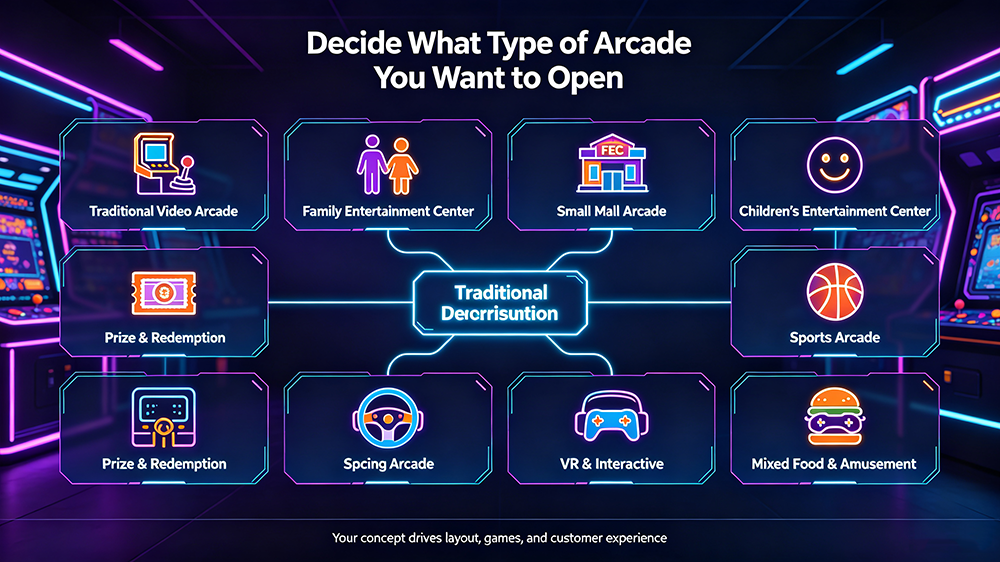 There is no single format for an arcade business.
Your concept could be:
Traditional video arcade
Family entertainment center (FEC)
Small mall arcade
Children's entertainment center
Prize and redemption arcade
Sports arcade
Racing-focused arcade
VR and interactive entertainment center
Mixed arcade and amusement venue
Arcade area inside a restaurant, hotel, or shopping center
Your concept determines nearly every later decision.
For example, a children's venue may require more rides, redemption games, claw machines, and easy-to-operate equipment.
A teenage and young-adult arcade may benefit more from racing simulators, shooting games, competitive sports games, rhythm games, and multiplayer attractions.
A family-oriented venue usually needs a broader equipment mix, so parents and children can find something to play together.
Start with the customer, not the machine.
2. Identify Your Target Customers
Before signing a lease, define your primary customer group.
Consider:
Children
Important factors include:
Simple gameplay
Bright colors
Safety
Prize appeal
Short game cycles
Easy controls
Families
Families usually need a mixture of games that can accommodate different ages.
Examples include:
Basketball games
Racing games
Claw machines
Redemption games
Children's rides
Interactive games
Teenagers
Teenagers may respond more strongly to:
Competitive games
Racing simulators
Shooting games
Multiplayer games
Skill-based challenges
Young Adults
For this group, immersive experiences and competitive gameplay can become important attractions.
The goal is not to predict what everyone will like.
The goal is to determine which customer group is most likely to visit your specific location repeatedly.
3. Research the Local Market Before Spending Money
A good arcade concept can still fail in the wrong location.
Before purchasing equipment, investigate the surrounding market.
Look at:
Population
Age distribution
Household income
Foot traffic
Nearby schools
Shopping centers
Restaurants
Cinemas
Bowling centers
Existing arcades
Family entertainment venues
Competitor pricing
Parking availability
Visit competing entertainment venues in person if possible.
Do not only count how many machines they have.
Observe:
Which machines are being played
Which machines are empty
How long customers stay
What age groups are present
How customers pay
Which areas attract the most attention
Whether families or individual players dominate
This information can be more useful than simply copying another arcade's equipment list.
4. Choose the Right Location
Location is one of the most important decisions in an arcade project.
A good location should provide a reasonable combination of:
Visibility + Accessibility + Customer Traffic + Suitable Rent + Parking
Potential locations include:
Shopping malls
Retail centers
Tourist destinations
Entertainment complexes
Restaurants
Hotels
Bowling centers
Indoor playgrounds
Mixed-use commercial buildings
However, high foot traffic does not automatically mean high revenue.
You need relevant traffic.
A location full of office workers may have excellent weekday traffic but weak family traffic.
A suburban shopping center may have lower overall pedestrian traffic but strong weekend family demand.
Therefore, evaluate the type of people passing your location rather than relying only on total traffic numbers.
5. Determine How Much Space You Need
There is no universal arcade size.
A small arcade area can operate with a relatively limited number of machines, while a full family entertainment center may require thousands of square feet.
Instead of asking:
"How many machines can I fit?"
Ask:
"How much usable customer space does each machine need?"
Your floor plan needs to accommodate:
Arcade machines
Player standing areas
Seats
Customer circulation
Prize counter
Reception
Payment stations
Staff areas
Storage
Maintenance access
Emergency exits
Restrooms where applicable
Large machines such as racing simulators and basketball games require considerably more operational space than compact arcade cabinets.
A crowded layout may allow you to install more equipment but can make the venue uncomfortable.
Machine density should be balanced against customer movement and playing space.
6. Create an Arcade Business Budget
Your startup budget should include much more than machine purchases.
A practical arcade startup budget may contain:
Initial Investment
Lease deposit
Interior renovation
Arcade machines
Payment system
Signage
Furniture
Lighting
Network infrastructure
Security equipment
POS system
Insurance
Permits and licenses
Shipping and import costs
Initial spare parts
Marketing
Ongoing Costs
Rent
Electricity
Staff wages
Internet
Maintenance
Machine repairs
Prize inventory
Cleaning
Insurance
Marketing
Payment processing fees
Software or system fees where applicable
A common planning mistake is spending nearly the entire budget on machines.
This leaves insufficient working capital for the first months of operation.
A better approach is to divide the available funds between equipment, venue preparation, launch costs, and operating reserves.
7. Calculate the Economics Before Buying Machines
You do not need a perfect financial forecast before opening, but you should understand the basic economics.
A simple revenue model is:
Number of Paid Plays × Average Price per Play × Average Plays per Day
For example, if a machine receives 30 paid plays per day at an average price of $1.50:
30 × $1.50 = $45 daily gross play revenue
Over 30 days:
$45 × 30 = $1,350 monthly gross play revenue
This is only a planning example, not a guaranteed result.
Actual performance can vary significantly based on:
Location
Customer traffic
Game popularity
Pricing
Operating hours
Seasonality
Competition
Machine uptime
Customer demographics
You should evaluate the whole venue, not assume every machine will produce identical revenue.
8. Choose the Right Arcade Machine Mix
One of the most important decisions is deciding what machines to purchase.
Avoid building your equipment list based entirely on what looks impressive in a manufacturer's catalog.
A balanced arcade might combine:
High-Attraction Machines
These are visually noticeable machines that help draw customers into the venue.
Examples:
Racing simulators
Large shooting games
Multiplayer attractions
Motion-based games
Skill-Based Games
These encourage repeat attempts because players want to improve their scores.
Examples:
Basketball
Boxing
Shooting
Sports games
Prize-Based Games
These create a different motivation for playing.
Examples:
Claw machines
Redemption games
Ticket games
Family and Children's Games
These broaden the age range of your customers.
The objective is to create a complementary machine mix, rather than simply purchasing as many different products as possible.
9. Use Different Machines for Different Customer Jobs
An effective arcade floor often works like a retail store.
Different machines perform different functions.
Attraction
Large, colorful machines catch attention from a distance.
Engagement
Skill and competitive games encourage players to spend more time playing.
Repeat Visits
Games with rankings, high scores, prizes, or multiplayer competition can give customers a reason to return.
Revenue Support
Compact machines can make productive use of smaller areas.
Family Experience
Games that parents and children can enjoy together increase the overall appeal of the venue.
Thinking about machines this way can make equipment selection much more strategic.
10. Plan the Arcade Layout Before Ordering Equipment
Do not wait until the machines arrive to discover that they do not fit your floor plan.
Create a 2D or 3D layout before placing the final equipment order.
The layout should show:
Machine dimensions
Customer circulation
Entrance
Reception
Payment area
Prize area
Seating
Electrical locations
Emergency routes
Maintenance access
Large machines should generally be positioned where they can attract attention without blocking traffic.
Smaller machines can be placed in areas where they efficiently use available floor space.
For international projects, providing the manufacturer with the floor dimensions can also make it easier to discuss a suitable equipment combination before production begins.
11. Choose the Right Payment System
Payment technology has become an important part of modern arcade operations.
Traditional options include:
Coins
Tokens
Modern systems may include:
Cashless cards
RFID cards
QR codes
Mobile payments
Centralized credit systems
The right system depends on your market and business model.
A centralized cashless system can potentially make it easier to:
Add credit
Track machine usage
Manage customer accounts
Reduce cash handling
Monitor revenue
Run promotions
Before ordering machines, confirm that the equipment can work with your preferred payment system.
Do not assume that every arcade machine uses the same payment interface.
12. Decide Whether You Need Custom Arcade Machines
Not every arcade project needs custom equipment.
Standard machines are often the better choice when:
You are starting with a limited budget
You want faster production
You do not need special branding
The standard product already fits your concept
Customization becomes more useful when:
You have a strong brand
You want a unique cabinet
You need a special game
You require a specific payment system
You are building a themed venue
You need machines designed around a particular space
Possible customization areas include:
Cabinet design
Artwork
Colors
Logo
Lighting
Screen configuration
Game software
Payment system
Control layout
Machine dimensions
For a first arcade, unnecessary customization can increase cost and development time.
13. Decide Between Standard Machines and OEM/ODM
For first-time operators, understanding the difference between standard products and custom manufacturing is useful.
Standard Arcade Machines
Advantages:
Faster ordering
Lower development cost
Established design
Easier replacement parts
Faster production
OEM
OEM projects typically involve customizing a manufacturer's existing product around your branding or specifications.
This may include:
Logo
Cabinet graphics
Colors
Configuration
Payment system
ODM
ODM projects involve deeper product development and can involve changes to the structure, hardware, software, or overall design.
ODM is more suitable for larger projects or buyers who want a differentiated product.
For a first project, standard equipment or light OEM customization is often easier to manage than developing a completely new machine.
14. Select a Reliable Arcade Machine Manufacturer
The cheapest quotation is not necessarily the best offer.
When comparing manufacturers, evaluate:
Product Quality
Ask about:
Cabinet materials
Hardware configuration
Component suppliers
Mechanical parts
Testing procedures
Production Capability
Check whether the supplier can handle:
Multiple machine types
Bulk orders
Customization
Packaging
Export production
Quality Control
Ask how machines are tested before shipment.
A manufacturer should be able to explain its inspection and testing process rather than simply saying that the machines are "high quality."
Spare Parts
Ask:
Which spare parts are included?
Can additional parts be purchased?
How are replacement parts shipped?
Is technical support available?
Warranty
Clarify:
Warranty period
Covered components
Exclusions
Replacement procedures
Technical support
A reliable supplier relationship can become increasingly important as the number of machines in your venue grows.
15. Understand International Shipping and Import Costs
If you are purchasing arcade machines internationally, the factory quotation is only part of your landed cost.
You may need to account for:
Machine Cost + Packaging + Freight + Insurance + Customs / Duties + Local Delivery
The final cost depends on:
Destination country
Shipment volume
Machine dimensions
Shipping method
Import regulations
Customs classification
Local delivery requirements
Ask the supplier for the machine's:
Packed dimensions
Gross weight
Packaging type
Number of cartons or crates
Shipping volume
These details are important when comparing international quotations.
16. Check Certifications and Local Requirements
Before purchasing commercial amusement equipment, determine which regulations and certifications apply to your market.
Requirements can vary by:
Country
State
City
Equipment type
Electrical configuration
Venue type
Potential considerations may include:
Electrical safety
EMC requirements
Local amusement regulations
Fire safety
Insurance requirements
Installation requirements
Do not assume that a certification used in one market automatically satisfies every requirement in another market.
For an international project, confirm the applicable requirements with the relevant local authorities, inspectors, or qualified compliance professionals.
17. Prepare for Installation
Installation planning is often overlooked by first-time operators.
Before the machines arrive, confirm:
Door dimensions
Elevator capacity
Loading access
Electrical outlets
Voltage
Floor conditions
Network connections
Machine positioning
Assembly requirements
Large arcade machines can be difficult to move after the venue is fully operational.
If a machine is too large to pass through the entrance, even a perfect floor plan will not solve the problem.
Measure access routes before ordering.
18. Prepare Spare Parts Before Opening
A machine that stops working during a busy weekend can affect both revenue and customer satisfaction.
Keep commonly needed spare parts available.
Depending on the equipment, these may include:
Buttons
Joysticks
Power supplies
Sensors
Fuses
Cables
Motors
Belts
Switches
Control boards
The exact spare-parts list should be based on your equipment mix.
For larger projects, asking the manufacturer to provide recommended spare parts together with the original shipment can reduce future downtime.
19. Test the Arcade Before the Grand Opening
Do not wait until opening day to discover problems.
Run a complete pre-opening test.
Check:
Every Machine
Game startup
Controls
Screen
Sound
Lighting
Payment
Sensors
Mechanical movement
Venue Systems
Internet
POS
Cashless payment
Security cameras
Lighting
Air conditioning
Staff access
Customer Experience
Ask staff or test players to use the venue as a normal customer would.
Look for:
Confusing instructions
Long queues
Poor machine placement
Blocked walkways
Difficult payment procedures
Machines that are too loud
Machines that are difficult for children to operate
A pre-opening test can reveal problems that are difficult to identify from a floor plan.
20. Set Your Arcade Pricing Strategy
There is no universal "correct" arcade price.
Pricing depends on:
Local purchasing power
Competition
Venue positioning
Machine type
Game duration
Customer demographics
You can use different pricing models.
Pay Per Play
Customers pay for each game.
This is the simplest model.
Prepaid Credit
Customers purchase credits and spend them across different machines.
Promotional Packages
Examples include:
Buy more credits, receive a bonus
Family packages
Off-peak promotions
Weekend packages
Memberships
For high-frequency customers, membership programs can encourage repeat visits.
The key is to make the payment structure easy to understand.
21. Make the Arcade Easy to Understand
A first-time visitor should quickly understand:
What can I play?
How much does it cost?
How do I start?
What can I win?
If customers have to ask staff how every machine works, the venue may have unnecessary friction.
Use:
Clear instructions
Visible pricing
Simple payment procedures
Easy-to-read signs
Demonstration screens
Staff assistance
Good arcade design reduces the amount of explanation required.
22. Build Reasons for Customers to Come Back
A profitable arcade cannot depend entirely on first-time visitors.
Repeat visits are important.
Potential strategies include:
High-Score Rankings
Players return to beat previous scores.
Tournaments
Competitive events can generate additional traffic.
Rewards
Loyalty programs encourage customers to accumulate credits or prizes.
New Games
Rotating or adding attractions can create renewed interest.
Seasonal Promotions
Special events can create reasons to visit during holidays and school breaks.
The goal is to turn:
"That looks fun."
into:
"Let's come back next weekend."
23. Monitor Machine Performance After Opening
Do not assume that your original equipment plan will remain perfect forever.
After opening, track:
Plays per machine
Revenue per machine
Downtime
Maintenance frequency
Customer feedback
Prize consumption
Peak operating hours
Underperforming machines
You may discover that some games are much more popular than expected.
If one machine consistently performs poorly, investigate why.
Possible reasons include:
Poor location
Difficult controls
Weak visual attraction
Pricing
Game difficulty
Customer mismatch
Mechanical problems
Data from your own venue should eventually become more valuable than assumptions made before opening.
24. Common Mistakes First-Time Arcade Operators Make
Mistake 1: Buying Machines Before Choosing the Location
The equipment mix should be designed around the venue.
Mistake 2: Spending the Entire Budget on Equipment
Leave enough capital for rent, renovation, marketing, repairs, and working expenses.
Mistake 3: Choosing Machines Only by Appearance
A visually impressive machine is not automatically a profitable machine.
Mistake 4: Ignoring Maintenance
Every commercial machine eventually needs service.
Mistake 5: Overloading the Floor
More machines do not always mean more revenue.
Mistake 6: Ignoring Customer Circulation
Customers need enough room to move and play comfortably.
Mistake 7: Buying Without Checking Replacement Parts
A low purchase price can become expensive if parts are difficult to obtain.
Mistake 8: Not Testing the Payment System
Payment problems can prevent otherwise functional machines from generating revenue.
Mistake 9: Failing to Monitor Performance
The equipment mix should evolve according to real customer behavior.
25. A Practical Arcade Business Launch Sequence
For first-time operators, the following sequence can reduce unnecessary decisions:
Phase 1 — Business Planning
Define:
Target customers
Business concept
Budget
Revenue model
Location requirements
Phase 2 — Location
Evaluate:
Traffic
Competition
Rent
Accessibility
Parking
Floor area
Phase 3 — Equipment Planning
Create:
Equipment list
Machine mix
Floor plan
Payment strategy
Budget allocation
Phase 4 — Supplier Selection
Compare:
Product quality
Price
Customization
Production capability
Warranty
Spare parts
Technical support
Phase 5 — Production and Shipping
Confirm:
Final specifications
Packaging
Testing
Shipping documents
Delivery schedule
Phase 6 — Installation
Complete:
Machine placement
Electrical connection
Network setup
Payment configuration
Safety inspection
Phase 7 — Opening
Run:
Machine testing
Staff training
Soft opening
Customer feedback
Pricing adjustments
Phase 8 — Optimization
Monitor:
Revenue
Machine utilization
Downtime
Customer behavior
Repeat visits
Then adjust the equipment mix and operating strategy based on actual data.
26. How Much Money Do You Need to Start an Arcade?
There is no universal startup budget because arcade projects vary dramatically in size.
A small arcade corner inside an existing business may require a relatively modest investment.
A dedicated family entertainment center can require a much larger budget covering:
Property
Renovation
Arcade equipment
Rides
Payment systems
Staff
Marketing
Working capital
The most useful approach is to create your budget from the bottom up.
Start with:
Venue Cost
Renovation
Equipment
Payment System
Shipping / Installation
Licensing / Compliance
Marketing
Working Capital
=
Estimated Startup Investment
This method is more reliable than using a generic "average arcade startup cost" because local real estate and equipment requirements can differ significantly.
27. Is an Arcade Business Profitable?
An arcade business can be profitable, but profitability depends heavily on execution.
The major variables are:
Customer Traffic
How many potential customers enter or pass the venue?
Average Spend
How much does each customer spend?
Visit Frequency
How often do customers return?
Machine Utilization
How frequently are individual machines actually being played?
Operating Costs
How much does it cost to keep the venue open?
Equipment Reliability
How much revenue is lost when machines are unavailable?
A simple way to think about the business is:
Revenue − Operating Costs = Operating Profit
But the real objective is to improve the variables that influence both sides of the equation.
More customers are helpful, but so are better machine utilization, efficient staffing, appropriate pricing, and controlled operating costs.
28. Should You Buy Arcade Machines Directly From a Factory?
For a small number of standard machines, buying through a local distributor may be convenient.
For larger commercial projects, purchasing directly from a manufacturer can offer additional advantages.
Potential benefits include:
Factory pricing
Product customization
Direct technical communication
OEM/ODM support
Spare parts
Bulk-order coordination
Packaging options
Project-based equipment planning
The most important factor is not simply whether the supplier is a factory.
The supplier should be able to support the entire project, including product configuration, production, testing, packaging, shipping coordination, and after-sales communication.
29. Questions to Ask an Arcade Machine Manufacturer
Before placing an order, prepare a detailed list of questions.
Product
What are the machine dimensions?
What is the power consumption?
What hardware is included?
What games are installed?
What payment methods are supported?
Production
What is the MOQ?
What is the production lead time?
How are machines tested?
What packaging is used?
Customization
Can the cabinet be customized?
Can the artwork be changed?
Can the logo be added?
Can software or payment systems be customized?
After-Sales
What is the warranty period?
Which spare parts are recommended?
Is technical support available?
How are replacement parts handled?
Shipping
What are the packed dimensions?
What is the gross weight?
What shipping options are available?
Can the supplier provide export packaging?
Getting these answers before ordering can significantly reduce uncertainty during the project.
30. Final Checklist for First-Time Arcade Operators
Before opening your arcade, make sure you have considered:
Target customers defined
Business model selected
Location evaluated
Competitors researched
Floor space measured
Budget calculated
Working capital reserved
Equipment mix planned
2D/3D layout prepared
Payment system selected
Manufacturer evaluated
Warranty confirmed
Spare parts prepared
Shipping plan confirmed
Local requirements checked
Electrical requirements confirmed
Machines tested
Staff trained
Pricing established
Marketing prepared
Performance tracking system established
Conclusion: Build the Business Before You Build the Arcade
Starting an arcade business is ultimately a business planning problem, not simply an equipment purchasing problem.
The strongest projects usually begin with a clear understanding of:
Who will visit → Why they will visit → What they will play → How much they will spend → Why they will return
Only after these questions are answered should you finalize the equipment list.
For first-time operators, a practical strategy is to start with a manageable concept, select machines that match the target audience, leave enough working capital for daily operations, and work with a manufacturer that can support the project beyond the initial sale.
Your first equipment order does not need to contain every type of arcade machine available.
It needs to contain the right machines for your customers, your space, and your business model.
Once the arcade is operating, real customer behavior becomes the most valuable source of information. Track which machines attract players, which ones generate repeat plays, which equipment requires frequent maintenance, and where customers spend the most time.
Then improve the venue based on evidence.
That is the difference between simply opening an arcade and building an arcade business that can grow.