

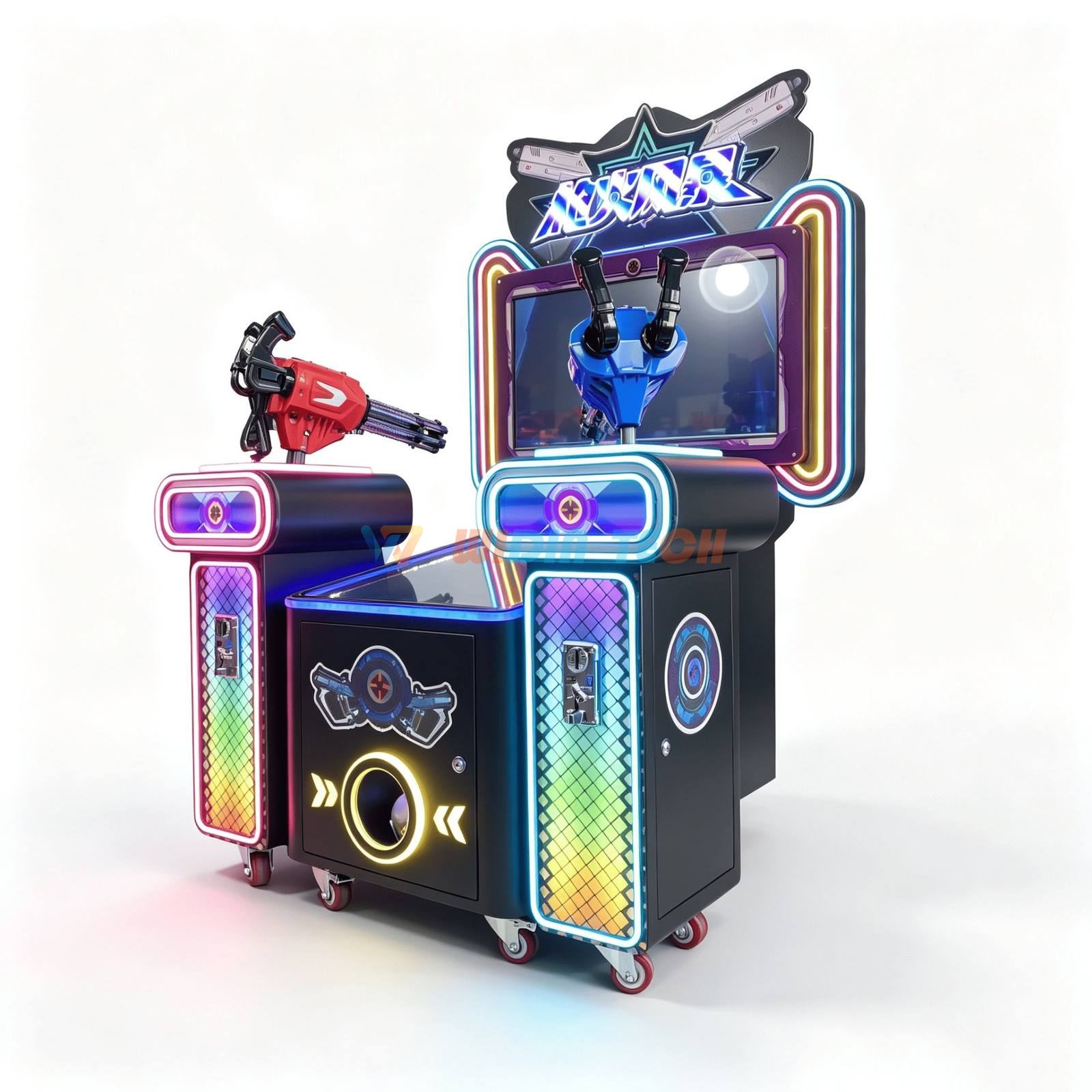
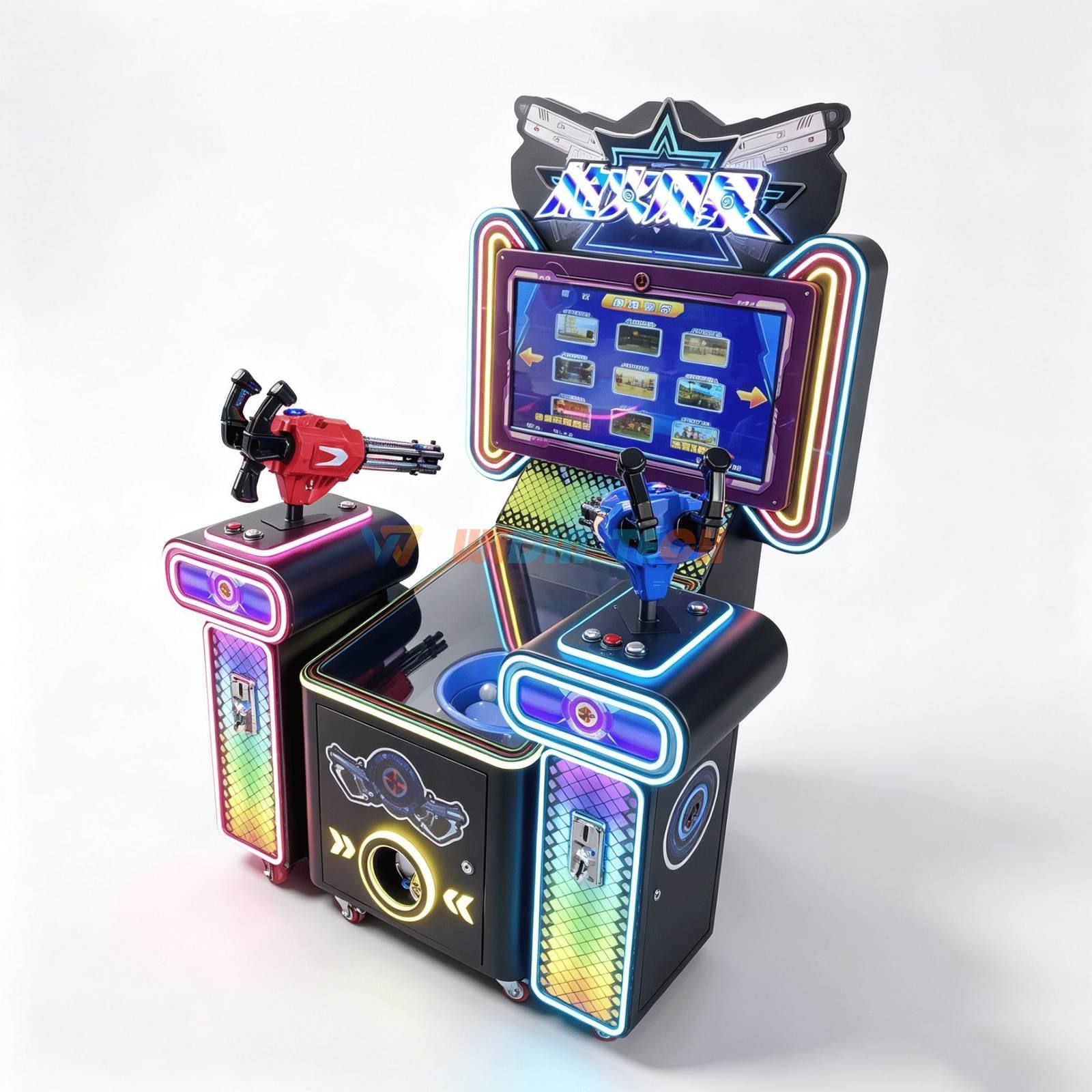
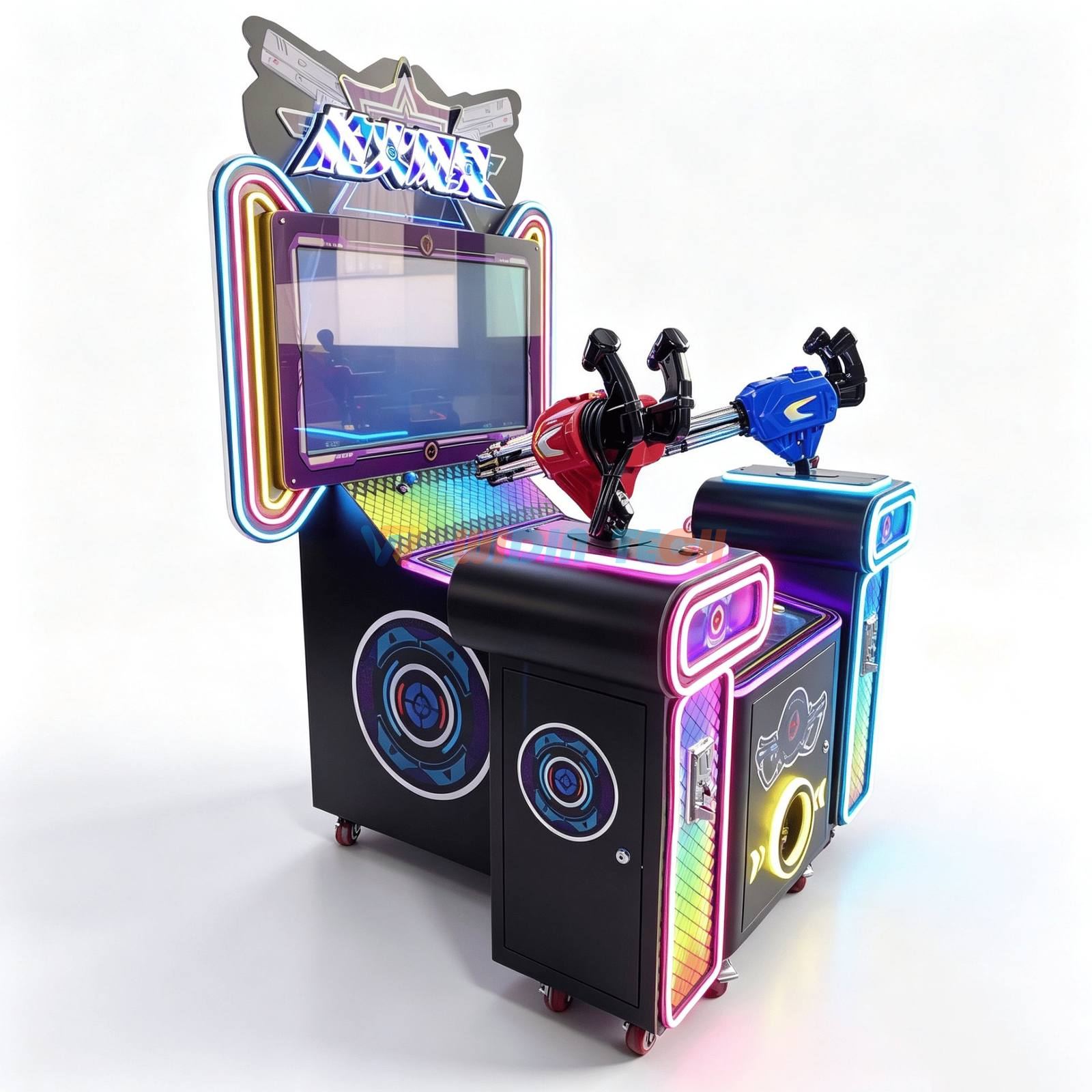
2-Player Shooting Prize Game Machine | 100mm Capsule Gun Game
- Players: 2, head-to-head on the same screen
- Cabinet size (L × W × H):102 × 124 × 166 cm
- Footprint:1.26 m² (cabinet plan area, excluding player standing space)
- Voltage:AC 110 V / 220 V, configured per destination market
- Rated power:150W Prize output: 100 mm capsule, dispensed through front prize window
- Screen: 32-inch
- Control:2 × mounted gun controllers + joystick/button panel
- Payment:Coin-operated as standard; Optional bill / QR scan /card reader interfaces
- Cabinet material:metal + acrylic
- Net weight:100 kg
Two players pick up the guns, face the same screen, and the round winner's capsule drops into the prize window before the next game starts. This is a two-player head-to-head shooting prize machine: a 102 × 124 × 166 cm cabinet that runs on 110 V or 220 V and pays out 100 mm capsule prizes instead of tickets. It is built for family entertainment centers, shopping malls, and arcade operators who want the pull of a prize payout without the ticket paper, dispensers, and counting work that ticket redemption adds to the daily routine.
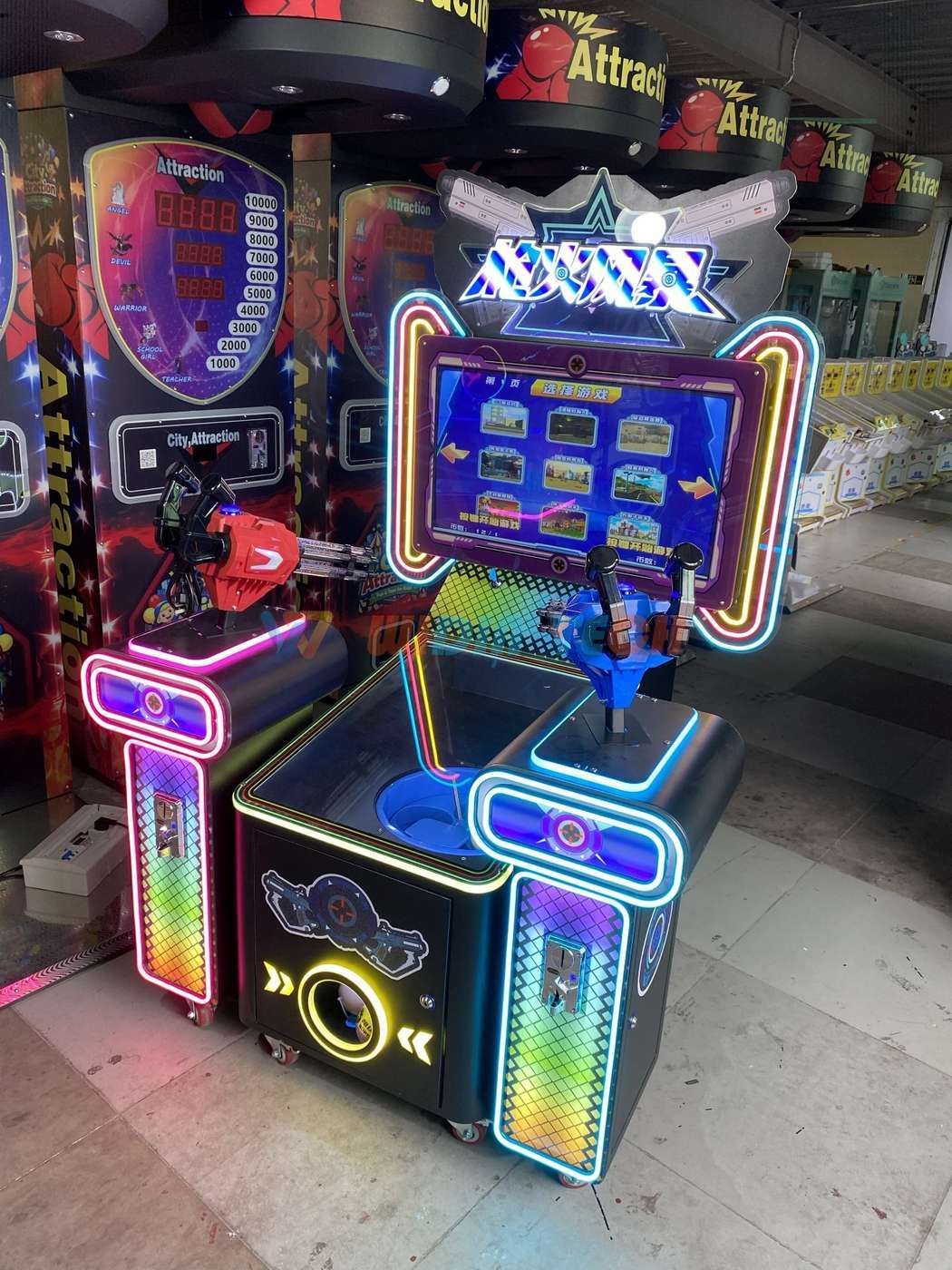
How the Two-Player Battle and the Capsule Payout Work
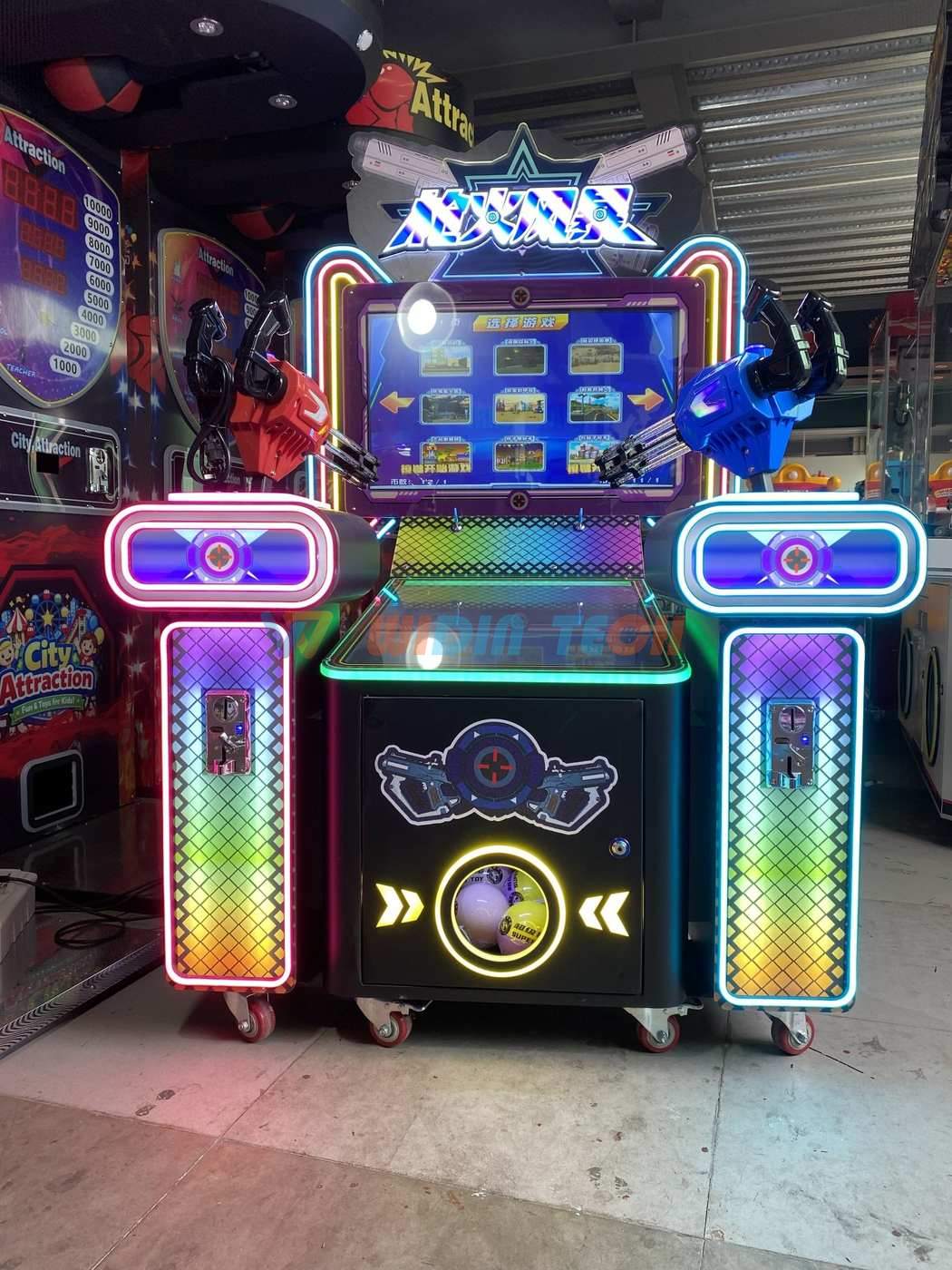
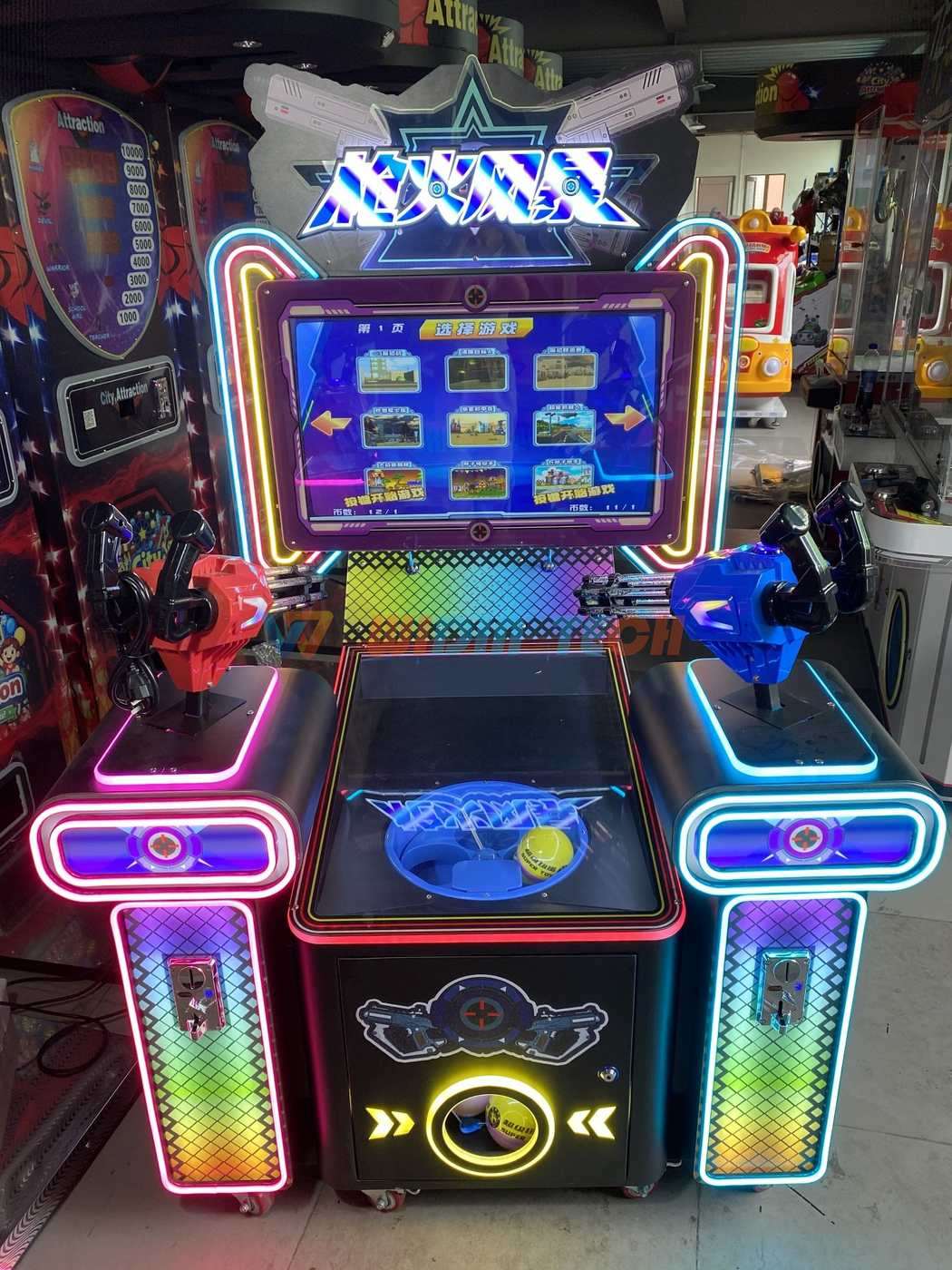
Each player takes one of the mounted gun controllers — red on one side, blue on the other — and both play on the same screen at the same time. The cabinet runs head-to-head shooting rounds: hit the targets, score more than your opponent, and the machine pays the winner a single 100 mm capsule through the prize window at the front of the cabinet. On the standard setting, each player pays one credit, and only the winner's capsule is dispensed, so one round takes two credits and pays out one prize. Game difficulty and payout rate are set by the operator.
The capsule size is the part that changes the economics. Common prize capsules run 60–75 mm, which limits what fits inside to small toys. A 100 mm capsule holds larger items — bigger plush, packaged accessories, higher-value novelty prizes — so the operator decides what a win is worth instead of accepting whatever fits a 65 mm shell. Bigger perceived prize value supports a higher per-play price without changing the hardware.
There is no ticket line in this machine at all. No ticket paper to reorder, no ticket dispenser to jam, no tickets to count at closing time, and no redemption counter to stock. The prize loop is: you fill the hopper with capsules, players win them, you refill. That is the entire maintenance routine on the prize side.
What to Check Before You Order
Floor space
The cabinet covers 1.26 m² of floor. What it actually occupies on your plan is cabinet area, plus standing room for two players side by side, plus a clear face for the prize window. A bay of roughly 2.5–3 m² is the working planning figure — an estimate, not a factory measurement, and tighter layouts work when the machine faces an open walkway.
Doorway and access route
At 166 cm high, the cabinet passes a standard 200–210 cm interior doorway upright with room to spare. Width is the dimension to measure for: at 124 cm it does not pass a single standard door leaf of 80–90 cm, so the delivery route needs a double door, a goods entrance or removal of a door from its hinges. Check the route once before ordering rather than on delivery day.
Power and electrical
The cabinet is configured for 110 V or 220 V before it ships — state your market's supply at quotation, and the voltage, plug standard, and certification are set per destination. Rated power draw is 150 W; the figure will be confirmed on the quotation together with the electrical requirements for your market.
How Much Floor and Revenue Does One Position Produce?
Floor efficiency is where this cabinet earns its place in the lineup. One cabinet carries two play positions on 1.26 m², which is 0.63 m² per player. Against WIDIN's own double-player kids shooting machine (185 × 96 cm, 1.78 m², 0.89 m² per player), this cabinet takes about 29% less floor per position. Neither figure includes the space players need to stand in front of the cabinet — the ratio compares cabinets, not bays.
Set against single-player cabinets, the picture is the same. Two standard single-player claw cabinets occupy about 1.34 m² for two positions; this machine's two positions fit in 1.26 m². One cabinet also means one delivery, one power point, and one machine to service instead of two.
The prize mechanic changes the cost side as well. A single-player prize machine pays up to one capsule per credit. On this cabinet's standard versus setting, a round takes two credits and pays one capsule, so the capsule cost per unit of gross revenue is roughly half — assuming both players pay per round and only the winner is paid, which is the shipped configuration and can be adjusted by the operator.
Revenue arithmetic, as a planning example rather than a forecast: at an operator-set price of $1 per credit, 20 rounds per trading day and 30 trading days, the machine grosses $1,200 a month. From that, subtract your local capsule-and-toy cost at one capsule per round — roughly $0.50–1.00 per capsule at typical wholesale, a market-dependent estimate you should price locally before setting your per-play rate. The two numbers that actually decide payback are your per-credit price and your capsule cost; both are set by you, not by the machine.
Where Does This Machine Earn Best?
Family entertainment centers use it as a versus anchor — two players at once draws the second player from the crowd, and the loser immediately wants a rematch. Shopping malls and cinema lobbies use it as a compact prize machine where a ticket redemption wall does not fit: 1.26 m² of floor and no redemption counter behind it. Arcade operators running mixed floors use it where a 100 mm prize is the hook — the visible capsule window does the advertising on its own.
It is also a distributor-friendly cabinet: dual voltage, a 166 cm build that ships upright through standard goods access, and artwork that can be re-skinned per market. For a container plan, it mixes cleanly with claw machines and basketball cabinets — [待填:每 20GP / 40HQ 装柜数量] once packing data is confirmed.
Build Quality and Service Life
Every finished unit runs a 72-hour continuous full-load aging test before shipment, which is what catches the thermal and fatigue faults a short power-on check misses. Load-bearing frames are 1.2 mm reinforced steel rather than the 0.6–0.8 mm common in the trade, so vibration cannot work internal connectors loose. WIDIN rates the stable service life of this build at 4–6 years, against 2–3 years for conventional workshop cabinets — a manufacturer's rating, not a measured guarantee. The powder-coating finish takes eight hours of manual work per cabinet.
Spare parts stay available after the catalogue moves on: the factory produces its own PCBs, fabricates its own steel and writes its own firmware, so a matching part can still be built years after a model leaves production. Remote video technical support is provided so venue staff resolve most faults themselves.
Custom Builds and OEM Orders
Artwork, cabinet colors, lighting effects, and game content can be customized under OEM/ODM. Every custom order's engineering files are cloud-archived permanently, which is what makes a repeat order produce the identical cabinet instead of a near-match. The unit in the photographs shows WIDIN standard branding; buyer-brand artwork is applied at the OEM order stage. Send your branding requirements with the quantity and destination port, and the quotation reflects both.
Shipping and Packing
Machines ship from Guangzhou by sea freight for container orders, with air or courier available for samples and spare parts. Packing is specified for sea freight rather than adapted from domestic practice, with fixation around the electronics and the guns detached and packed to a labelled scheme so your team reassembles the cabinet the way the line that built it did. Outer crate dimensions and units per container are confirmed on the quotation. Voltage, plug standard and certification are set per destination market before production.
Frequently Asked Questions
What size capsules does the machine take, and what prize comes out?
It takes 100 mm capsules, dispensed through the front prize window when a round ends. You source and fill the capsules yourself, so you decide the prize valueis your decision —100 mm fits larger plush and packaged items that the common 60–75 mm capsules cannot hold.
How much floor space do I need for one machine?
The cabinet covers 1.26 m² (102 × 124 cm). Add standing space for two players and a clear prize window face; a 2.5–3 m² bay is a working planning figure.
Will it fit through a standard doorway?
Height is not a problem — 166 cm passes a 200–210 cm doorway upright. Width is the check: at 124 cm it will not pass a single standard door leaf, so plan delivery through a double door or goods entrance.
Does it run on 110 V or 220 V?
Both. The cabinet is configured for your destination market's supply before it ships — state the voltage at quotation, and it arrives set up for your power standard.
Do I need a ticket redemption system with it?
No. The prize is inside the capsule, so there is no ticket paper, no ticket dispenser, and no counting at closing time. The prize routine is refilling the hopper.
What happens when the capsule hopper runs out?
You refill it through the front of the cabinet; a top-up takes a few minutes and is typically done during a shift change. Hopper capacity is confirmed on the quotation.
What payment systems does it accept?
Coin-operated as standard, with coin mechanisms on both side towers. Bill acceptor, card reader, or QR-code payment interfaces can be quoted for your market — tell us what your venue already runs.
Can the cabinet artwork be customized?
Yes. Cabinet colors, artwork, lighting, and game content are customizable under OEM/ODM, and we permanently archive engineering files for every custom order so repeat orders match exactly.
What certificates and documents ship with it?
Each shipment carries export documentation matching the configuration that actually shipped. Ask for the certificate list for your market at the quotation stage, before you ask for the price.
What spare-parts support comes after the sale?
The factory builds its own PCBs, steel, and firmware, so matching parts stay in production after a model ages out of the catalogue. Remote video support helps your venue staff resolve most faults on the spot, and bulk clients receive spare-parts stocking suggestions for their region and usage.
Request a Quote
To quote this machine properly, we need three things: your order quantity, the destination country and port, and the prize plan — what you intend to put in the 100 mm capsules and at what local cost. Add your branding requirements if this is an OEM order. Send those with the enquiry, and the quotation that comes back will already fit your market: contact WIDIN.
Founder & CEO at Guangzhou WIDIN Tech,Chen: "The capsule size is the whole business model. A 65 mm shell decides the prize for you; a 100 mm shell lets the operator decide it — and the operator who decides the prize value also decides the per-play price."