

Commercial Motorcycle Racing Arcade Machine | 2-Rider Motion
- Product Type: Motorcycle Racing Arcade Game
- Players:2 Players
- Game Mode: Racing Competition / Ranking
- Display: Dual HD Displays
- Lighting: LED Lighting System
- Power: 1000W
- Machine Size: 2470 × 2980 × 2350 mm
- Product Weight: Approx. 500 kg / Set
- Main Material: Steel + Acrylic
- Payment System: Coin / Bill / Card System Optional
- OEM / ODM: Available
- Application: Commercial Entertainment Venues
The Commercial 2-Player Motorcycle Racing Arcade Machine is a two-station motion racing set: each rider sits on a motorcycle controller in front of a dedicated HD screen, and the two stations race head-to-head on the same track. As published, the set measures 2,470 × 2,980 × 2,350 mm — 7.36 m² of floor space, 3.68 m² per rider — weighs about 500 kg per set and carries a rated power of 1,000 W. It is built for arcades, family entertainment centers, shopping malls, and gaming venues, and it ships as OEM/ODM: cabinet artwork, logo, game language, and payment system are all configurable. Three numbers decide most purchase conversations about this machine — the 7.36 m² floor plan, the 2.35 m height against your doorways, and the 1,000 W rating against your power budget. This page walks through each one.
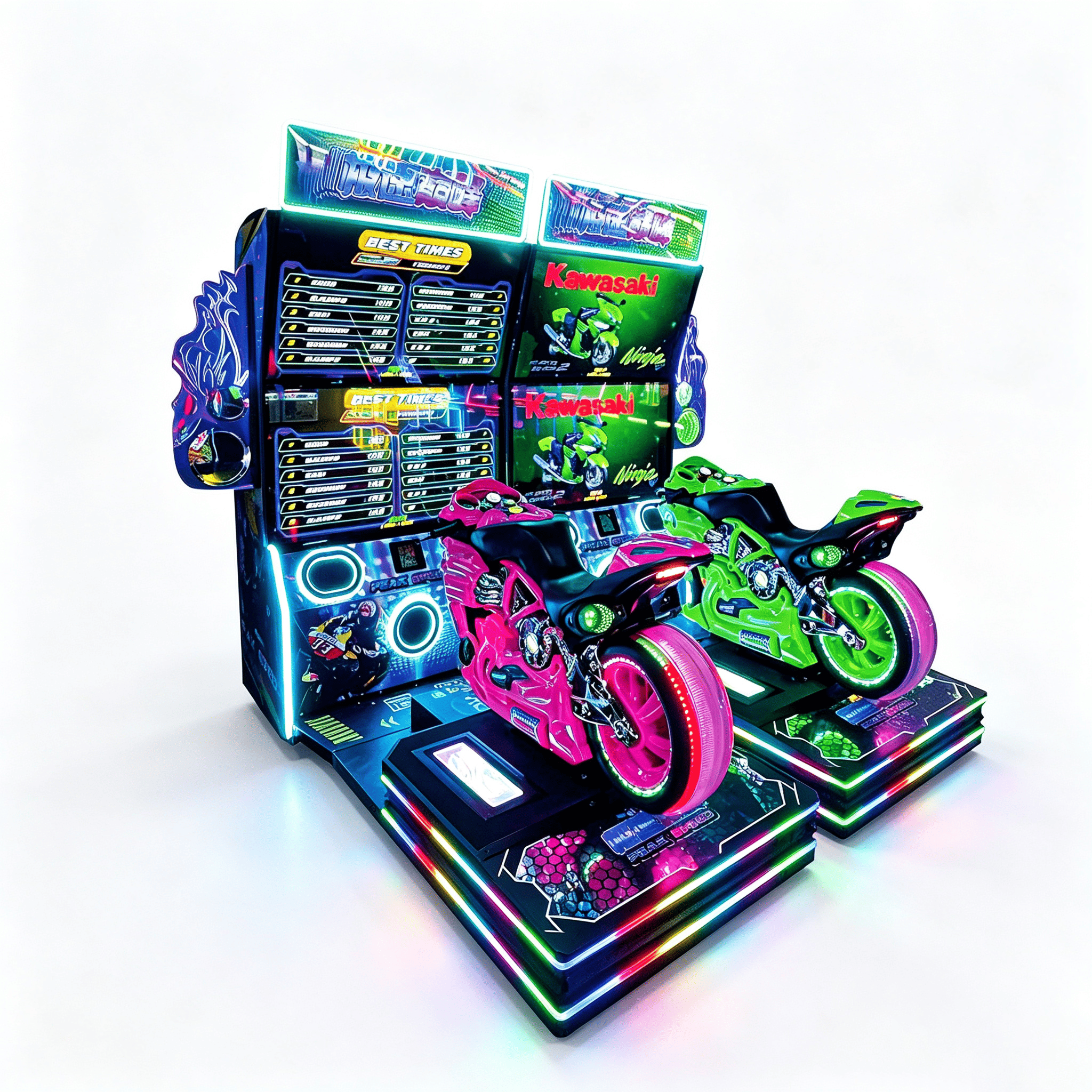
What to Check Before You Order
Floor space
The published footprint is 2.47 × 2.98 m = 7.36 m², or 3.68 m² per rider. Neither figure includes the space players need to mount the bike, stand alongside it, or queue, so plan for roughly 9–10 m² of dedicated zone once clearance is added. For scale: 7.36 m² is the same floor area as about eleven standard single-player claw cabinets at 0.67 m² each. This is a centerpiece machine, not an infill unit.
Access route and ceiling height
At 2,350 mm tall, the assembled set does not pass through a standard interior doorway, which is roughly 200–210 cm high in most commercial buildings. It needs a goods entrance, a roll-up shutter, or delivery in sections and assembly on site. Measure the route to the lowest obstruction — lighting track, sprinkler heads, ductwork, signage — not to the ceiling slab. Width matters too: at 2,470 mm, the set is wider than a standard forklift aisle, so confirm the receiving path with the venue before booking the truck.
Power and electrical
The set is rated at 1,000 W. The destination-market voltage for this model is 220v; on comparable WIDIN racing cabinets, the supply is AC 110 V / 220 V selectable, but confirm the value for this model before an order, because the motion hardware is the part that cannot be changed after shipment. One dedicated circuit per set is the safe planning assumption, since the rated figure covers both displays, the LED system, and the motion hardware running together.
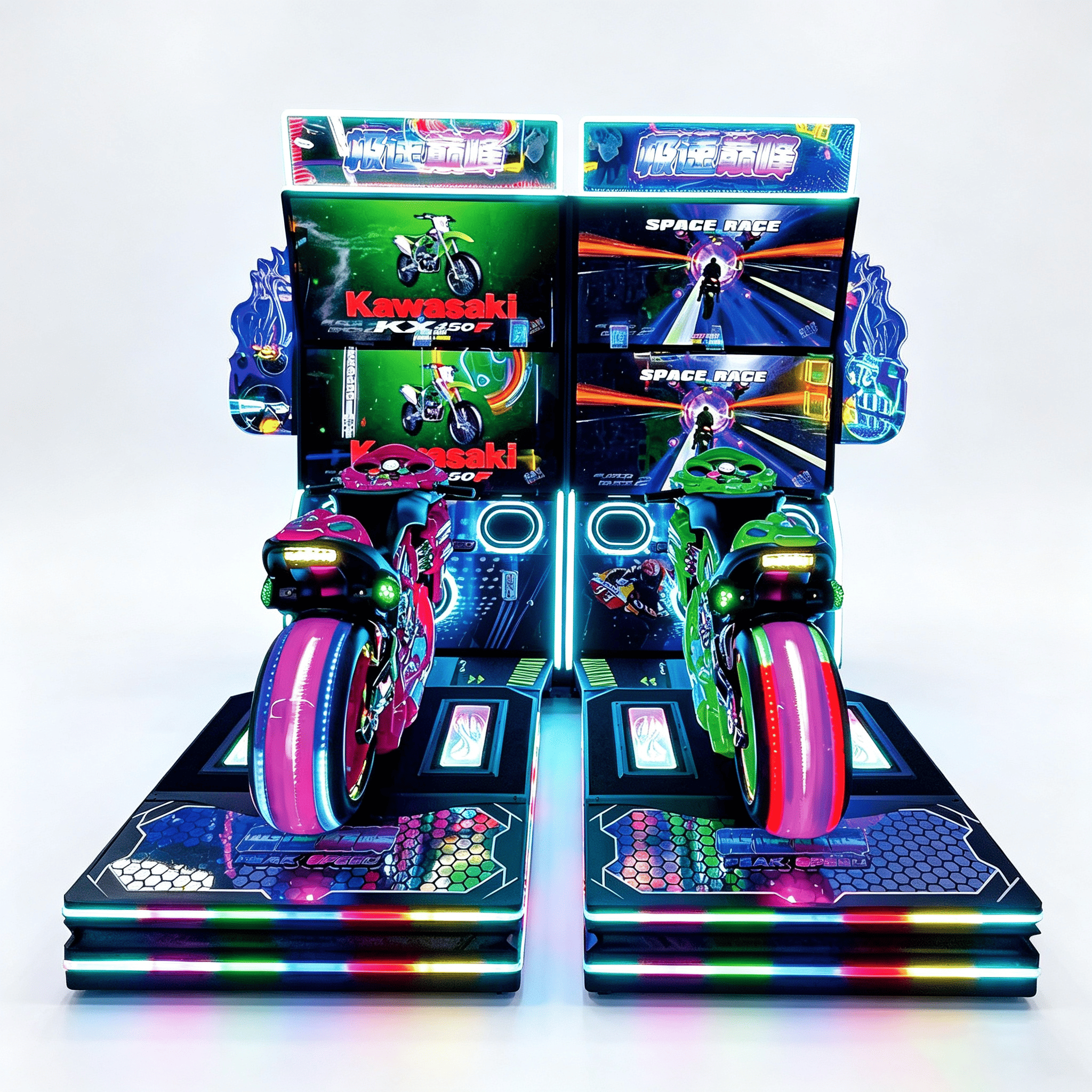
What the Floor Space Buys You
Three two-station racing sets appear in the WIDIN catalogue. The plan area per rider is computed from the published cabinet dimensions; power is the published rating.
| Model | Cabinet (mm) | Footprint | Per rider | Rated power | Weight |
|---|---|---|---|---|---|
| Commercial motorcycle set (this page) | 2,470 × 2,980 × 2,350 | 7.36 m² | 3.68 m² | 1,000 W | ≈500 kg |
| Twin motorcycle set (smaller sibling) | 2,100 × 2,700 × 2,400 | 5.67 m² | 2.84 m² | 300 W | ≈300 kg |
| Twin car racing simulator (55-inch screens) | 2,880 × 2,560 × 2,900 | 7.37 m² | 3.69 m² | not published | not published |
Cabinet plan area excludes player standing space, and power figures are rated rather than measured values, so treat them as a planning ratio rather than a bill.
The trade-off is worth stating plainly. Against the smaller twin-motorcycle sibling, this set takes about 30% more floor, 3.3 times the rated power and 200 kg more weight — in exchange for the dual-screen leaderboard configuration and the larger scale of the attraction. If your floor is under about 40 m² or your venue sits on a constrained power feed, the smaller sibling is the better buy, and we will say so in a quote. If the motorcycle set is your anchor attraction and the floor is there, the extra 1.7 m² is what buys the leaderboard tower that keeps players walking back for a ranking run.
Motorcycle or Car Racing Simulator — Which One Fits Your Venue?
Both large racing sets occupy almost identical floor (7.36 vs 7.37 m²), so the choice is about gameplay format, not space. The motorcycle set puts players in a riding position with handlebar-style lean and throttle control — a lower entry barrier for casual visitors, because everyone understands how to sit on a bike. The car simulator uses motion racing seats and a 55-inch shared display, which suits players who want longer, more technical racing sessions. Venues that serve families and footfall traffic tend to get more plays per day from the motorcycle format; dedicated racing zones and esports-leaning venues get more session depth from the seated simulator. Running one of each is a common configuration, because the two attract different players rather than competing for the same one.
Where This Machine Earns Best
| Venue | Why it works here |
|---|---|
| Shopping malls and FECs | The leaderboard tower and LED platforms pull footfall; two-rider format doubles revenue per race cycle. |
| Arcades and game centers | Ranking mode drives repeat play; pairs naturally with car simulators and redemption rows. |
| Gaming lounges and esports venues | Head-to-head format supports tournaments and event nights. |
| Cinema and bowling lobbies | High visual presence fills dead lobby time; coin/bill/card payment matches short visits. |
| Resorts and tourist attractions | Strong photo point; English-language game interface configurable for international guests. |
The typical buyer is an arcade or FEC operator, a mall entertainment-zone manager, a family entertainment center investor planning a racing zone, or a distributor supplying these venues. What they share is the need for one machine that justifies several square metres of prime floor — which is exactly what the 3.68 m² per rider figure is for calculating.
Build Quality and Service Life
The cabinet structure is steel with acrylic panels. WIDIN rates the stable service life of this build at 4–6 years, against 2–3 years for conventional workshop cabinets. Before shipment, every set runs a 72-hour continuous aging test at full load — the same test applies to this model as to every WIDIN cabinet, with no exceptions in the factory's process. Cabinet steel is 1.2 mm reinforced, against the 0.6–0.8 mm common in the category, and powder-coated surfaces take about 8 additional hours of manual finishing work per machine. These are the manufacturer's own ratings and process figures, published so buyers can compare them against other suppliers' claims rather than take "commercial grade" on faith.
Custom Builds and OEM Orders
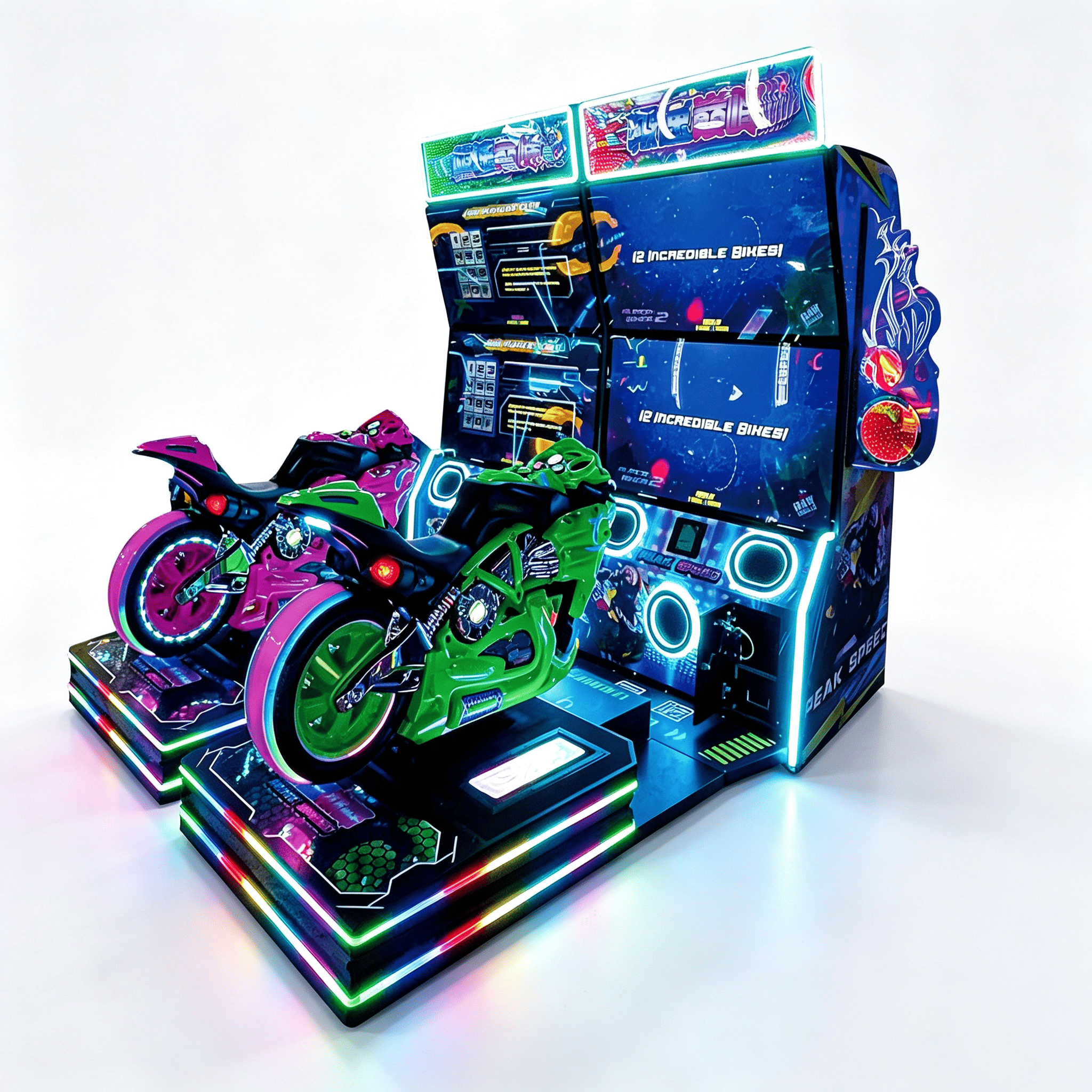
OEM and ODM customization covers cabinet artwork, brand logo, game language, exterior color, payment system, and software configuration. For export orders, the two customizations that matter most are artwork language — the unit shown in the photographs carries its domestic-market marquee, and export cabinets are produced with the buyer's target-market artwork — and payment hardware, which should match what your venue already runs (coin, bill acceptor, or card reader). Customized projects confirm final specifications before production, so cabinet design and electronic configuration are prepared to the agreed requirement. OEM files are archived in the cloud permanently, which is what makes a repeat order of the same build a specification match rather than a rebuild.
Shipping, Packing and Installation
A set weighs about 500 kg, so plan on freight handling rather than parcel delivery. This model is packed with a wooden frame; the packed volume with the wooden frame is 9.3 CBM. One arithmetic point shapes the whole shipment: a standard ISO container is about 2.34 m wide internally, and this set is 2.47 m wide as assembled — so the set cannot travel fully built, and ships broken down into sections for on-site assembly. Confirm the breakdown scope and the assembly labour it implies at quotation stage. By floor area alone, a 40 ft container holds at most three assembled-set equivalents; the real figure depends on how the sections stack. Site requirements before the truck arrives: a receiving path wide enough for the largest section, a level floor, and the dedicated power circuit from the checklist above.
After-Sales Support
Support after delivery covers installation guidance, remote technical support and troubleshooting, spare-parts supply for the motion hardware, screens and payment system, and operation and maintenance support for the running life of the machine. OEM/ODM project support continues after the first order, using the archived build files. The practical contact route for overseas buyers is written message first — factory hours are China Standard Time, and remote diagnosis with photos or video resolves most issues without a service visit.
Frequently Asked Questions
How much does a commercial motorcycle racing arcade machine cost?
The FOB price range for this model is USD 5,200 – 6,700. The price moves mainly with the payment system (coin, bill, card), the game software package, and the level of OEM artwork customization. Ask for a quote with your quantity, destination country, and configuration, because the freight component alone varies more between a mall in the Gulf and an arcade in South America than the option list does.
How much floor space does it need?
The published cabinet footprint is 2.47 × 2.98 m = 7.36 m², which is 3.68 m² per rider. That figure excludes player standing and mounting space, so budget roughly 9–10 m² of venue floor for the zone. For comparison, 7.36 m² equals about eleven standard claw cabinets.
Will it fit through a standard doorway?
No. At 2,350 mm tall and 2,470 mm wide, the assembled set does not pass a standard 200–210 cm doorway. It needs a goods entrance or roll-up shutter, or delivery in sections with on-site assembly. Measure the route to the lowest obstruction — lights, sprinklers, ducts, signs — before confirming delivery.
What power supply does it need — 110 V or 220 V?
The set is rated at 1,000 W. The voltage configuration for this model is 220v; WIDIN racing cabinets in this category are typically available in AC 110 V / 220 V versions matched to the destination market. Confirm the voltage in the quotation, because the motion hardware cannot be changed after shipment.
What does it cost to run per month?
At the rated 1,000 W, one hour of operation uses 1 kWh. A 12-hour trading day uses about 12 kWh, roughly 360 kWh over a 30-day month — about US$54 per month at US$0.15/kWh, or around US$650 per year. These figures are derived from the rated maximum, not measured consumption: real draw is lower because the motion hardware only works at full load during play, and your tariff may differ. Treat it as a planning ceiling, not a bill.
How heavy is it — does my floor need reinforcing?
About 500 kg per set. Spread over the 7.36 m² footprint, that is roughly 68 kg/m² average, well under the 250–500 kg/m² live load most retail and assembly floors are designed for, so upper-level mall installations are usually feasible without structural work. The average is not the whole story — the load concentrates at the levelling feet, so if the venue's own structural data is tight, ask for the feet layout and use spreader plates. The venue's structural rating governs, not this arithmetic.
What maintenance does a motion motorcycle simulator need?
The routine is the same class as any commercial cabinet: daily wipe-down of the bike, seat, and screens, weekly check of fasteners and the payment path, and periodic inspection of the motion hardware and cable routing. Spare parts for the motion hardware, screens, and payment system are supplied from the factory, and remote video support covers most diagnosis. The model-specific maintenance schedule is 2 weeks — ask for it with the quote.
How is it shipped, and how many fit in a container?
Because the set is 2.47 m wide, it cannot travel assembled in a standard container (about 2.34 m internal width) and ships broken down into sections. By floor area, a 40 ft container holds at most three assembled-set equivalents; the exact loading plan depends on the section stacking and the crate dimensions. One set includes four wooden cases: 2 pcs: 128(L) × 85(W) × 224(H) cm; 2 pcs: 156(L) × 110 × 124(H) cm. Volume per set: 9.13 CBM. Estimated loading quantity for 40HQ container: 7 sets (subject to actual loading arrangement).
Can I customize the artwork, branding, and payment system?
Yes. OEM/ODM covers cabinet artwork and color, brand logo, game language, lighting configuration, payment system, and software setup. Export cabinets are produced with the buyer's target-market artwork — the unit in the photographs shows the domestic-market version. Customized projects confirm final specifications before production starts.
What is the MOQ and lead time?
MOQ and production lead time for this model are 1 set. Single-set orders are typically accepted for this factory's commercial cabinets, but confirm both values in the quotation — lead time moves with OEM artwork and payment-system configuration, not just quantity.
Does it come with a warranty?
The warranty terms for this model are a 1-year warranty for the whole unit. For reference, the twin car racing simulator in the same category carries a 12-month warranty covering the display, mainboard and key components, with spare-parts supply and remote support — expect comparable terms, but get this model's in writing with the quote.
Request a Quote
A quotation for this set needs three inputs: quantity, destination country or port, and configuration — payment system, artwork language, and any OEM branding. Add your venue type and floor dimensions if you want the delivery-route and floor-loading checks done against real numbers rather than the planning figures on this page.
— Chen, Founder & CEO at Guangzhou WIDIN Tech. On this machine, the honest advice is the same for every buyer: measure the doorway before you measure the budget. The 2.35 m height is the one spec that no amount of money changes after the crate is opened.