

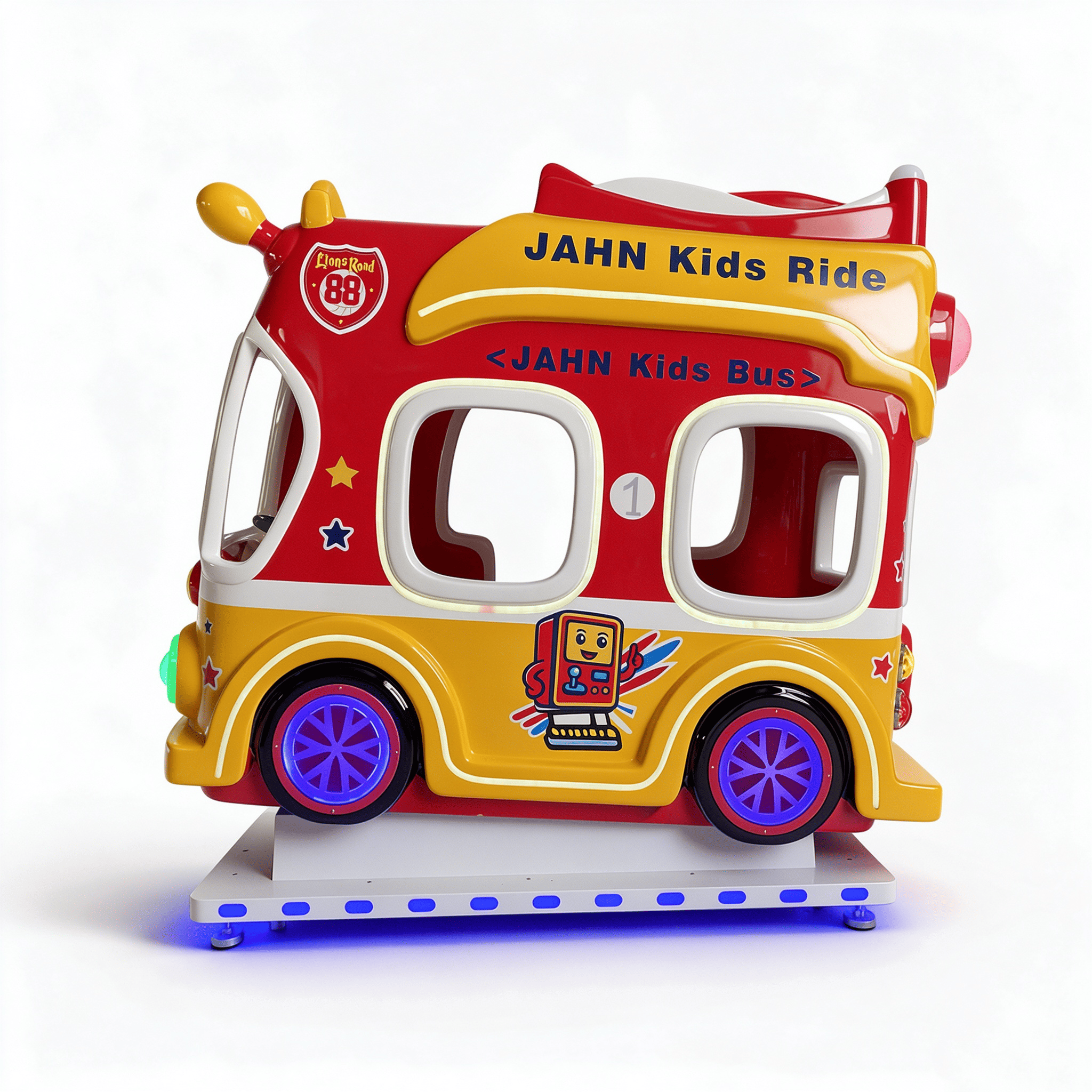
Kids Bus Kiddie Ride | 3-Seat Coin-Operated Swing Machine, Ages 2+
- Product name: Kids Bus Kiddie Ride
- Type: Coin-operated kiddie swing ride, bus theme
- Players: Up to 3 children at a time
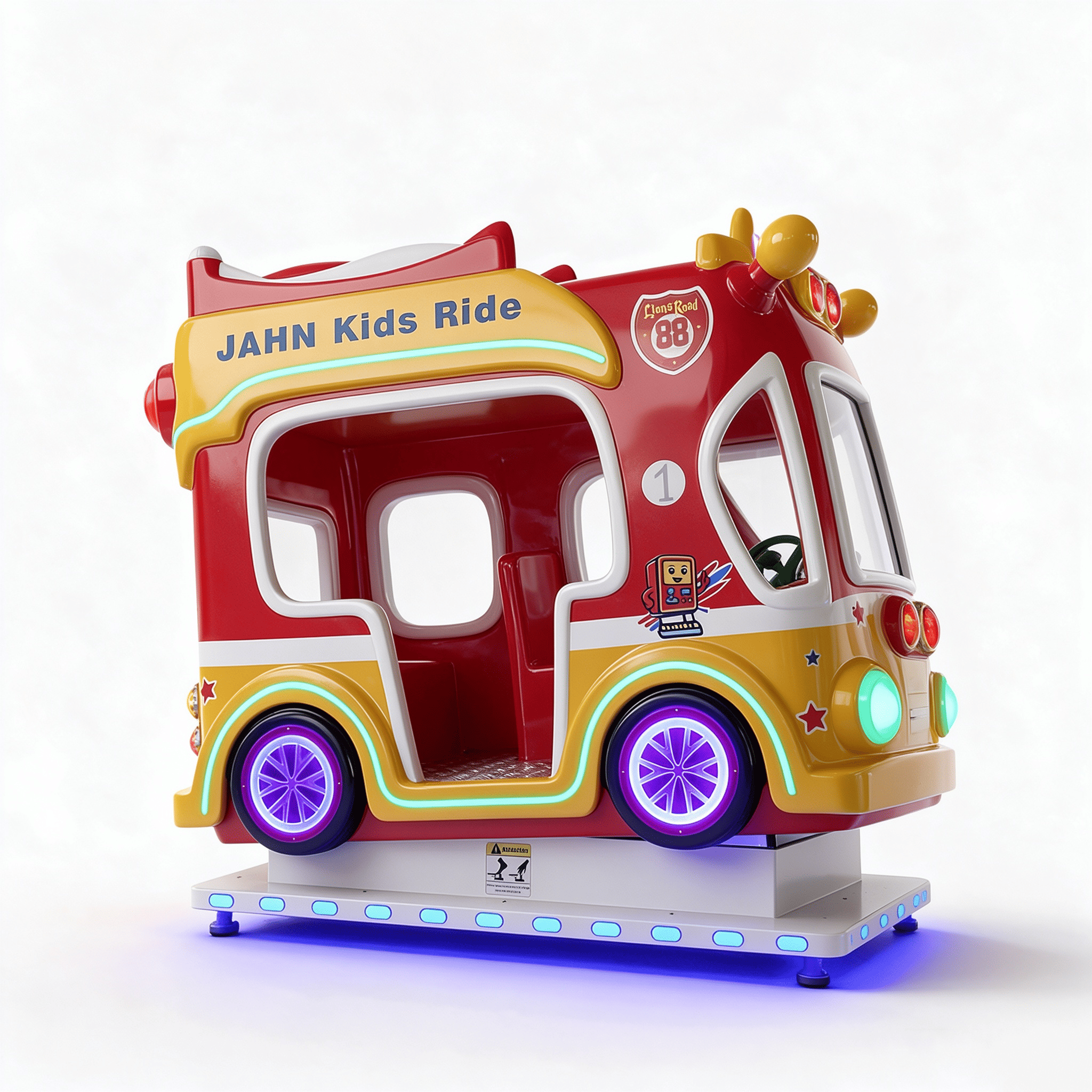
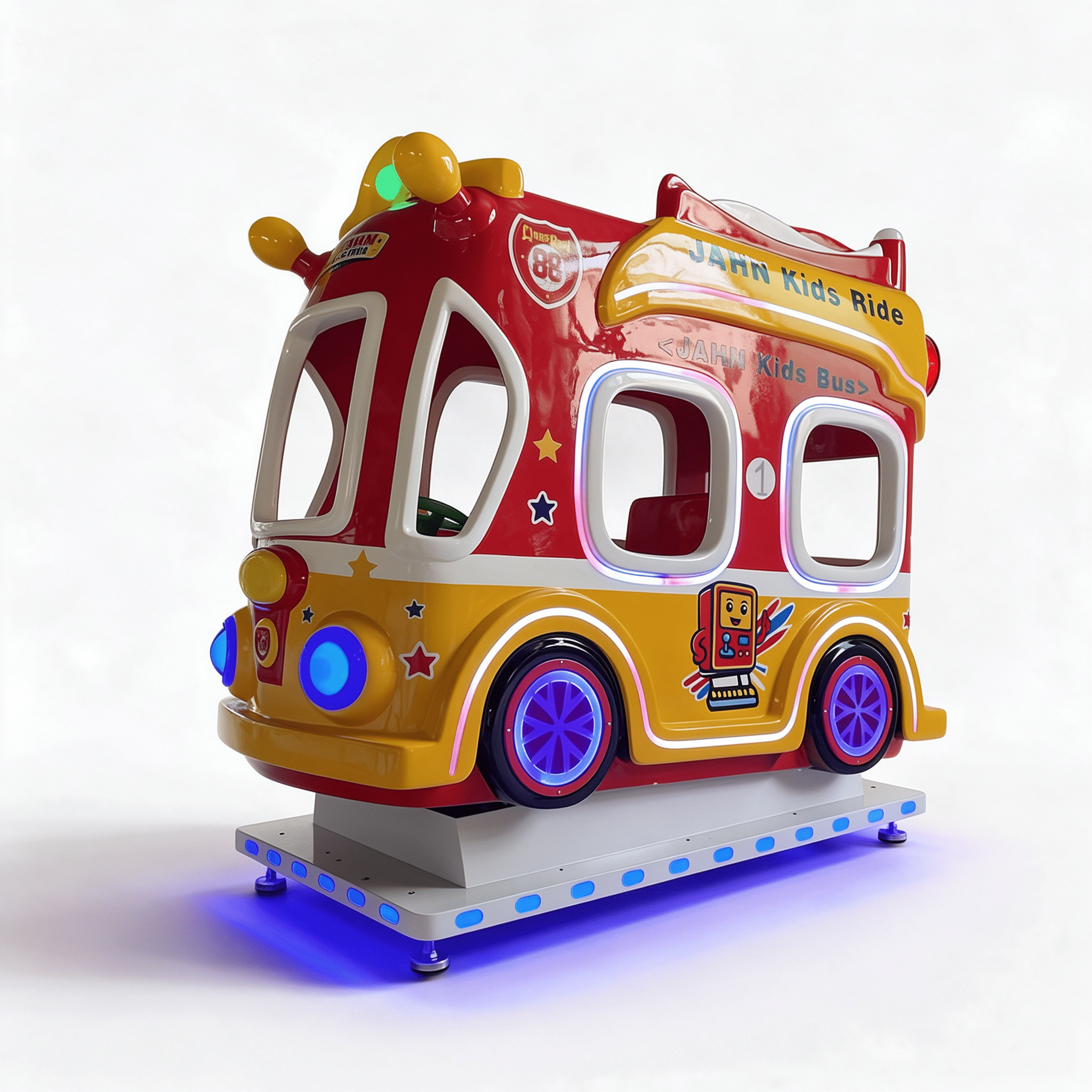
- Theme: Cartoon city bus, red and yellow, open-sided cabin
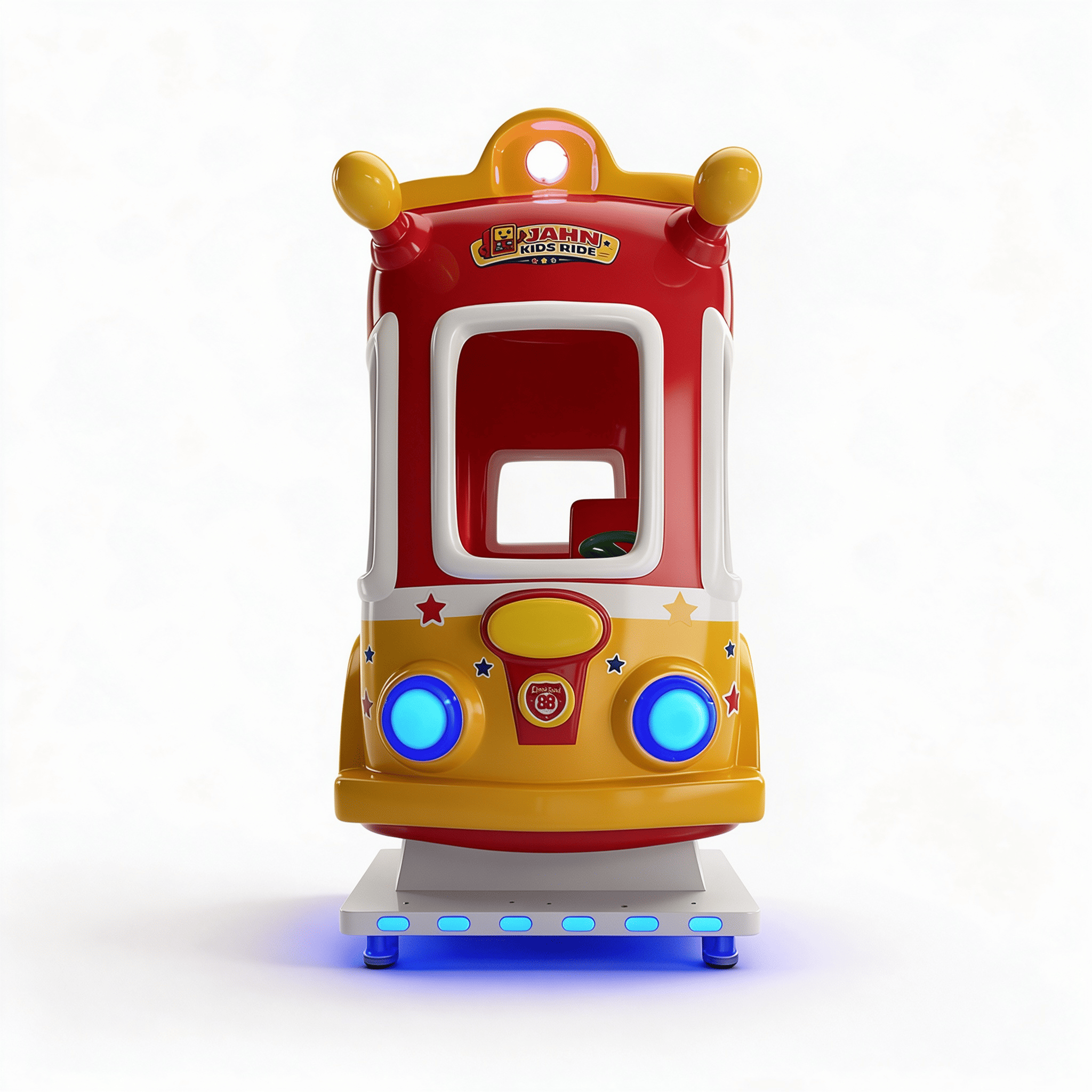
- Lighting: LED headlamps, roof siren domes, LED wheel rims, LED base strip
- Cabinet size (L × W × H): 156 × 95 × 165 cm
- Net weight: 200 kg
- Recommended age: 2 years and up
- Power type: Mains power. No battery version is offered
- Voltage/plug standard: 110V/220V
- Rated power: 200W
- Payment system: Coin, Bill, IC Card, QR Code Payment
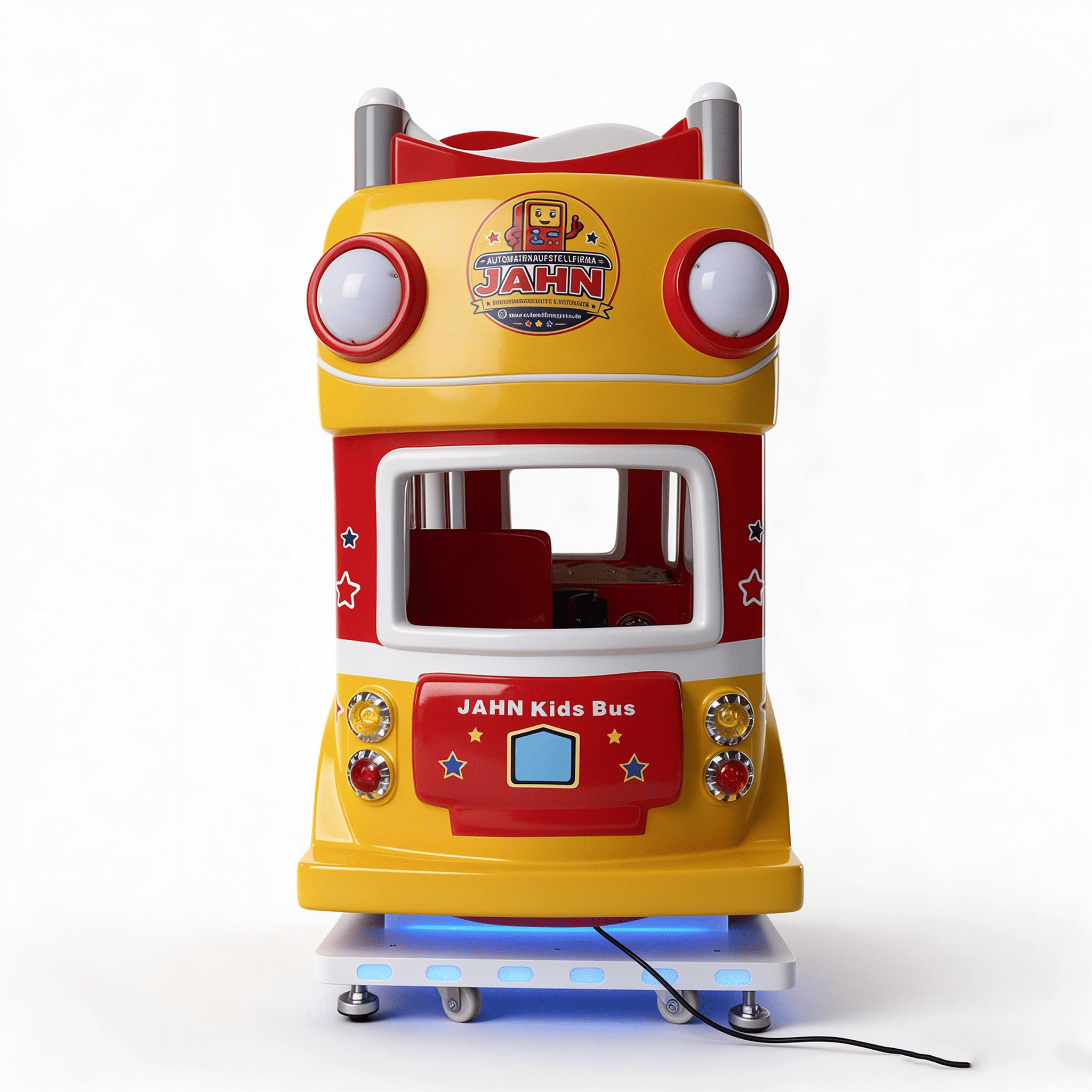
- Base: Flat platform with adjustable leveling feet and warning label
- Warranty: 1-year warranty for the complete machine and core components
The Kids Bus Kiddie Ride is a coin-operated swing ride shaped like a cartoon city bus, seating up to three children at a time, ages 2 and up. The bus body sits on a moving base: children climb in through the open side, take their places on the molded seat and reach for the steering wheel, and the machine rocks through a music-and-light cycle for the duration set on the timer. The cabinet carries the full toy-shop treatment — red and yellow paintwork, lit headlamps, glowing wheel rims, a blue LED strip around the base and siren domes on the roof. On a kiddie ride, that light show is not decoration; it is what a child sees from across a mall, and it is what starts the ride. It runs on mains power, not batteries, so the installation question to settle first is where the socket is. Full specifications, including size, load capacity, and rated power, are listed below and confirmed in the quotation.
What to Check Before You Order
Floor space
Three measurements decide whether a spot works: the cabinet footprint 140×75×155cm (L × W × H), the space for a child to climb in through the open side, and the space for an adult to stand beside the cabinet while fastening a seatbelt or steadying a toddler. Kiddie rides earn best in passing traffic, so most operators place them along a main walkway, near an entrance or beside a checkout — measure that spot before you order, not after the crate arrives.
Power: it needs a socket
This ride is mains-powered, and there is no battery version, so the cabinet stands where the outlet is. That is the constraint to settle before you order, not after delivery: walk the intended spot and confirm a socket exists, and check what it will take to get one there if it does not. On a mall floor the answer is usually a short cable run from a neighbouring tenant or a floor box; on a supermarket entrance it often means an electrician.
Two details follow from that. Voltage and plug standard are configured to the destination country, so state the destination with your enquiry. And the cable needs managing where children walk — plan a run along the base or a covered channel rather than across the open side where children climb in. A ride that has to be unplugged every night because its lead crosses a walkway is a ride that gets unplugged and then forgotten.
The trade is straightforward against battery machines: you give up placement freedom and gain a machine that never has a flat day. Nobody has to remember to charge it, and there is no battery to replace in year three.
Floor and fixing
The base platform carries adjustable leveling feet — visible in the product photos — so small floor unevenness can be taken up on site. The floor should be level and hard. Ask the factory whether anti-tip fixing is recommended for your floor type, and follow the warning label on the base when positioning the machine.
Payment and timer settings
Price per play and ride duration are operator settings, not factory constants: you set the price your market accepts and the duration your throughput needs. Confirm which payment hardware the cabinet takes: coin, bill, IC card, and QR code payment, because retrofitting a different payment system later costs more than ordering the right one.
What a Kiddie Ride Does for a Floor
A kiddie ride is the lowest-friction machine in the building. There are no rules to learn, no score to understand — a child sits, the bus rocks, music plays, lights flash, and the ride ends. The whole loop runs a couple of minutes, and the person paying is usually a parent standing right there with a coin already out.
Three seats change the arithmetic, and it is the part worth doing on paper before you buy. A single-seat kiddie ride earns once per cycle against its footprint; this one can earn three times in the same cycle, and the same square metres, and the cabinet, the freight, and the floor rent are all shared across those three places. On a busy walkway, it also removes the queue — siblings ride together rather than one waiting for the other, which is the version of the problem parents actually care about.
That shapes where the money comes from. Kiddie rides do not compete with big ticket machines; they harvest the minutes a family spends walking past — into the mall, out of the supermarket, waiting for a table. The revenue logic is simple enough to plan on paper before you buy:
| Payback input | Your number |
|---|---|
| Machine price | |
| Seats per cycle | 3 — up to three paying children per ride cycle |
| Price per play (operator-set) | |
| Cycles per day (site-dependent) | |
| Payback period = price ÷ (per-play × seats × cycles/day) |
The honest caveat: a kiddie ride in a dead corner earns nothing, and the same machine beside a checkout can pay for itself in months. Location is most of the ROI on this product — and since the cabinet is mains-powered, location and power are the same decision. Choose the spot for footfall first, then solve the socket; the reverse order is how machines end up in corners.
Design and Safety
The open-sided cabin is the safety feature that matters most, and it is visible in the photos rather than hidden in a spec sheet: children in the cabin can be seen from outside the bus from almost any angle, so a parent supervising from the walkway never loses sight of them. Enclosed video-cab kids rides cannot say the same.
With three children riding together, one more thing is worth checking: whether the seat is one bench or three separate positions. Three separate positions keep children from sliding into each other as the bus rocks, and they make the loading question — who sits where — obvious to the parent standing outside.
Seating and grip. Three places to sit and a steering wheel to hold, so each child has something to hold beyond the ride itself.
Step-in height. Children get in by themselves — check the floor-to-seat step against your youngest visitors.
Pinch points. Ask how the moving base and body joint are shielded. This is the question most buyers forget and the one that matters most on a swing ride.
Surface finish. Rounded edges and enclosed fasteners on the painted body; confirm the finish material and its fire rating.
Lighting. All lamp positions are LED — headlamps, roof domes, wheel rims, and the base strip — which runs cool to the touch.
Where It Works
Shopping mall entrances and walkways
Passing families, a visible light show, and a parent with change in hand. This is the classic position, and the bus theme reads clearly from a distance.
Supermarket and pharmacy checkout zones
The child is captive for the length of the queue. A ride at the checkout converts waiting time into revenue, and the two-minute cycle matches the queue almost exactly.
Indoor playgrounds and small family arcades
As the first machine the youngest visitors play, before they graduate to the bigger floor. Pairs naturally with claw machines and mini basketball games for a wristband package.
Airports, clinics, car dealerships and service centers
Anywhere with a waiting child and no arcade. These sites are usually decided by the socket rather than the floor plan, so check the outlet before committing to a position — and because three children ride at once, one cabinet covers a sibling group that would otherwise need two machines.
Music, Timer and Ride Settings
The ride experience is set by three operator controls: ride duration, swing intensity, and music volume. Volume matters more than buyers expect — in an indoor mall, the ride must be loud enough to attract and quiet enough not to earn noise complaints from the neighboring tenant. Ask how the volume is limited before delivery, not after a complaint.
OEM and Custom Artwork
The paint scheme, decals, and roof lettering are produced in-house, which means they can carry your brand instead of ours. Badge graphics, side artwork, language on the panel, colors, and payment hardware can all be specified per order — custom artwork runs 4–8 weeks from artwork approval.
The unit shown in our product photos is a delivered example of this: the cabinet carries its buyer's own brand name and colour scheme, not ours. That is what "produced to order" means in practice — the machine leaves our floor under whatever name you put on it, so a distributor is not reselling a factory's brand back to its own market.
One thing worth asking any supplier you are comparing us against: whether a cabinet's artwork is a fixed house design or is actually produced per order. A fixed design means your name goes on a sticker at best, and the machine still looks like somebody else's product on your floor.
Build Quality and Service Life
WIDIN states that machines run a 72-hour aging test before shipment, that cabinet steel is 1.2 mm reinforced against a 0.6–0.8 mm industry norm, and that the stable service life of the build is 4–6 years against 2–3 for conventional workshop cabinets. These are the manufacturer's ratings, quoted as such.
On a kiddie ride, the wearing parts are specific and predictable: the swing mechanism and its motor, the payment acceptor, and the button and switch set. Ask which of these are stocked as spares — a ride that cannot swing is furniture, and furniture earns nothing.
Shipping and Packing
Packing: Wooden case / Carton + Pallet Outer, carton size: 145×80×165cm cm (L×W×H), N.W. / G.W.: 200 kg, Loading Qty: 5 pcs for 20GP, 12 pcs for 40HQ (theoretical calculation, for reference only). Shipped as complete machineKiddie rides are compact and stack well in containers, so the loading figure is worth asking for with the quotation — it is what turns a unit price into a landed cost, and it is the number most often missing from a first enquiry.
Frequently Asked Questions
What is a kids bus kiddie ride?
A coin-operated swing ride shaped like a cartoon bus, seating up to three children at a time from two years old. The children sit in the open-sided cabin, the machine rocks through a timed music-and-light cycle, and the ride ends automatically. It runs on mains power. It is the small, entrance-position machine common in malls, supermarkets, and family entertainment centers worldwide.
What age is it suitable for?
Recommended for 2 years and up. Because three children ride together, the limit that actually binds is the total load rather than the age of any one child — check the maximum load against the heaviest realistic combination of children at your venue. The other practical limit is step-in height: a ride a two-year-old cannot climb into does not get played.
How much weight can it carry?
Maximum load capacity: 200 kg. The figure to ask for is the rating for the full cabin — three children at once — not a per-seat number. A two-year-old and an eight-year-old are very different loads, and the swing mechanism is specced against the total. If adults are likely to sit in with a child at your venue, say so with the enquiry so the load rating and mechanism are built for it.
Does it need a power socket?
Yes. The ride is mains-powered, and there is no battery version, so it stands where the outlet is. Confirm a socket at the intended position before ordering; voltage and plug standard are configured to the destination country. If your spot has no outlet, plan the cable run with an electrician first — that cost is small next to choosing the wrong spot.
How much space does it need?
Dimensions: 140×75×155cm (L × W × H), plus room for children to climb in through the open side and for an adult to stand alongside while helping them in. Three seats mean three children arriving at once, so allow a little more clear floor at the open side than a single-seat ride needs. Along a walkway or beside a checkout is where it earns best — measure that spot before ordering.
How do I set the price and ride time?
Both are operator settings: the payment hardware counts credits, and the timer controls duration. You set the price your market accepts and the duration your throughput needs, and you can change both later without a technician.
Is it safe for toddlers?
The cabin is open on the sides, so a supervising parent can see the children from outside at all times. The swing is gentle by design, and its intensity is adjustable. The checks that matter: how the moving base joint is shielded against pinching, whether a seatbelt is fitted, whether anti-tip fixing is recommended for your floor, and — with three children in one cabin — whether the seats are separated so they cannot slide together as the bus rocks.
Can the artwork carry my own brand?
Yes. Paint scheme, decals, roof lettering, panel language, colors, and payment hardware are produced to order, so the cabinet ships under your name rather than a factory's. The ride in our product photographs is a delivered example — the name on it belongs to the buyer, not to us. Custom artwork runs 4–8 weeks from artwork approval. The recommended maintenance interval is about 15 days.
What maintenance does a kiddie ride need?
The wearing parts are the swing mechanism and motor, the payment acceptor, and the switches — ask which are stocked as spares. Day-to-day: wipe the painted body with a non-abrasive cleaner, check the seat and fastenings weekly, and keep the base strip and LEDs clear of dust.
What is the MOQ and lead time?
The minimum order is one unit — you can order a single machine and still specify the configuration. Standard builds ship in seven days; custom artwork runs 4–8 weeks from artwork approval. Tell us quantity, destination country, and required configuration with your first enquiry — voltage, plug standard, and payment hardware are set per market, and a complete brief gets a narrower quotation.
Can it be used outdoors?
The paint and LED fittings are built for indoor duty as standard. If you need it on a covered terrace or semi-outdoor site, say so with your enquiry so the finish and electrical protection are specced for it.
Request a Quote
Send us three things, and we can price it: the quantity — the minimum is one — the destination country, which sets voltage, plug standard, payment hardware, and freight, and whether you want your own artwork on the cabinet. If you do, include the logo, and we will confirm what is possible at your order size.