

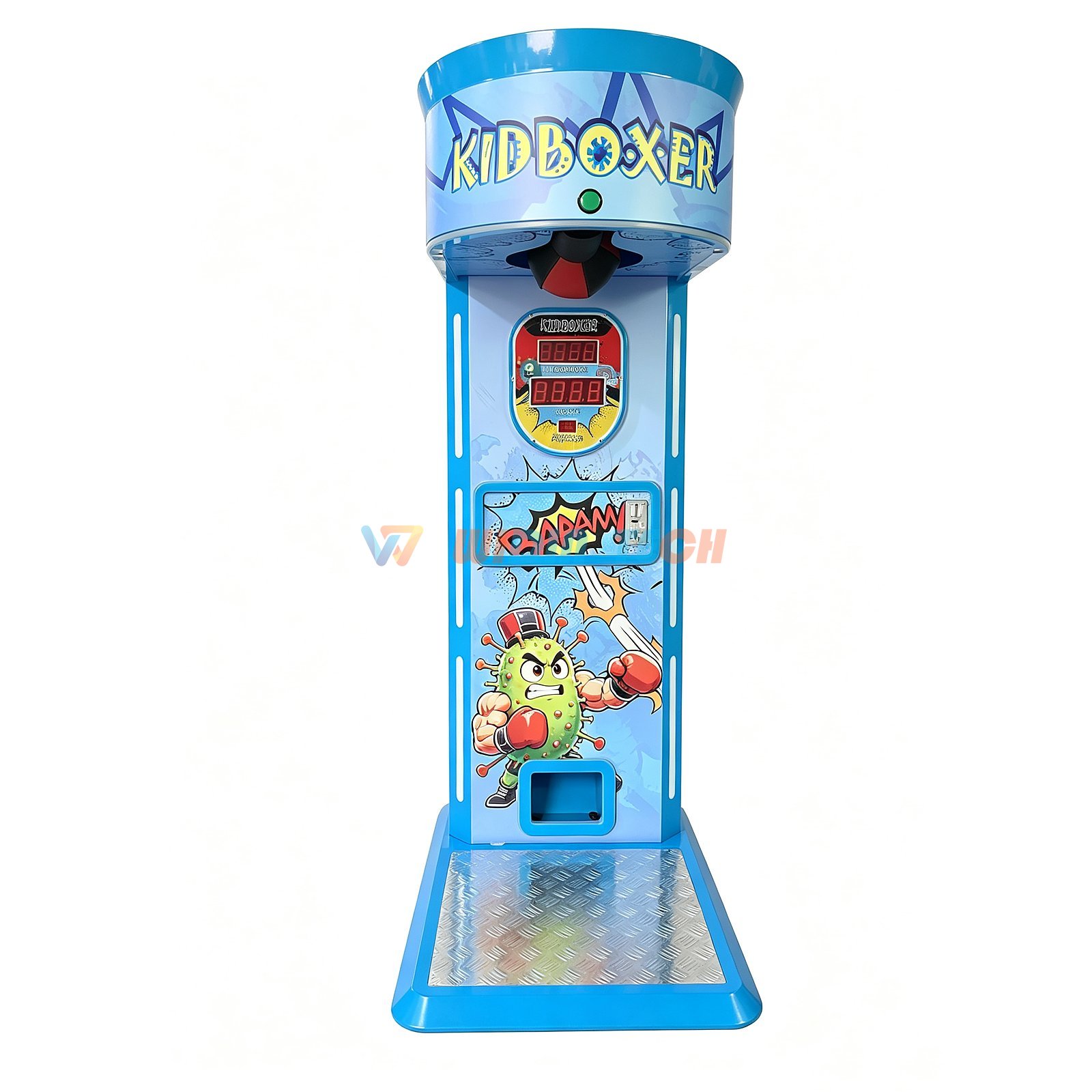
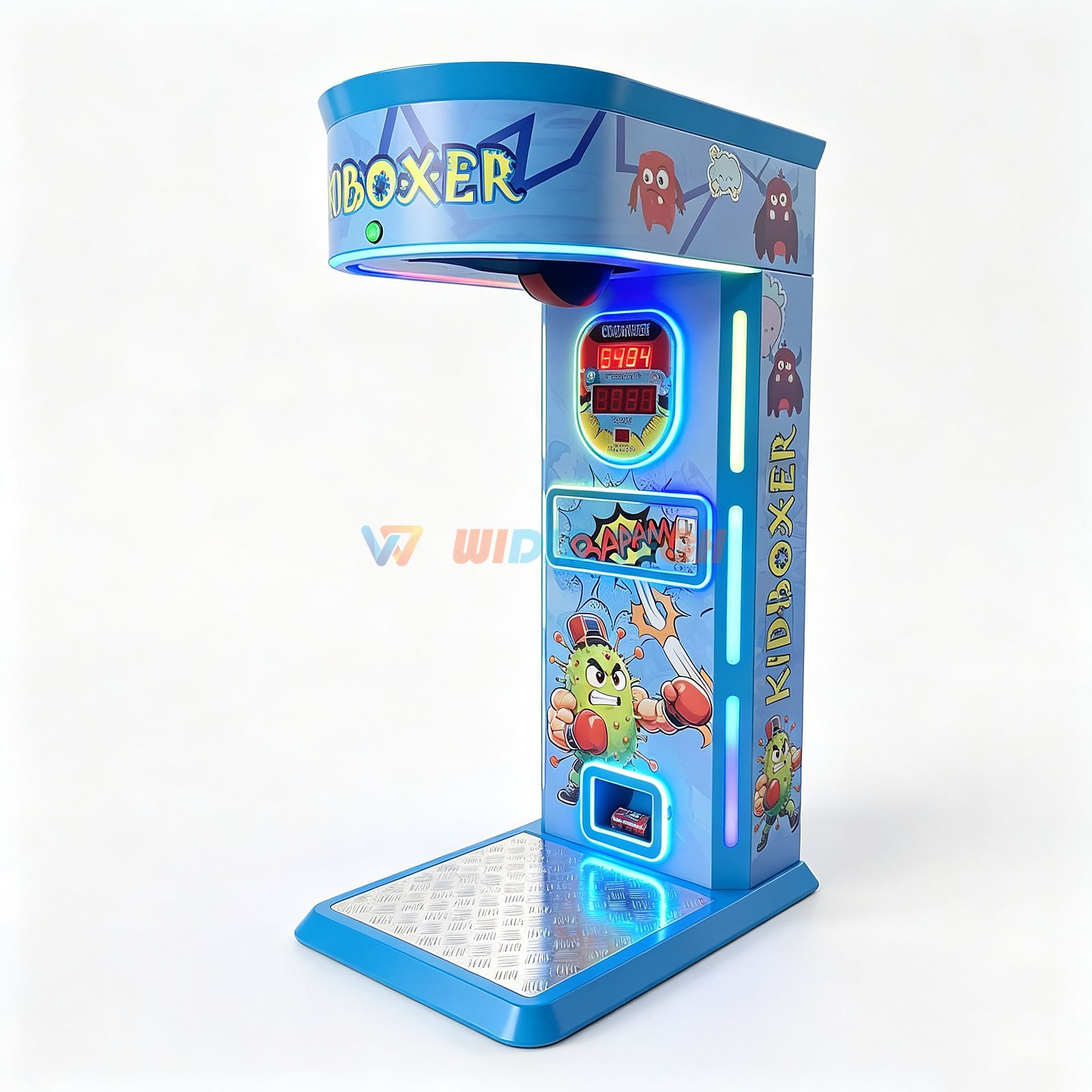
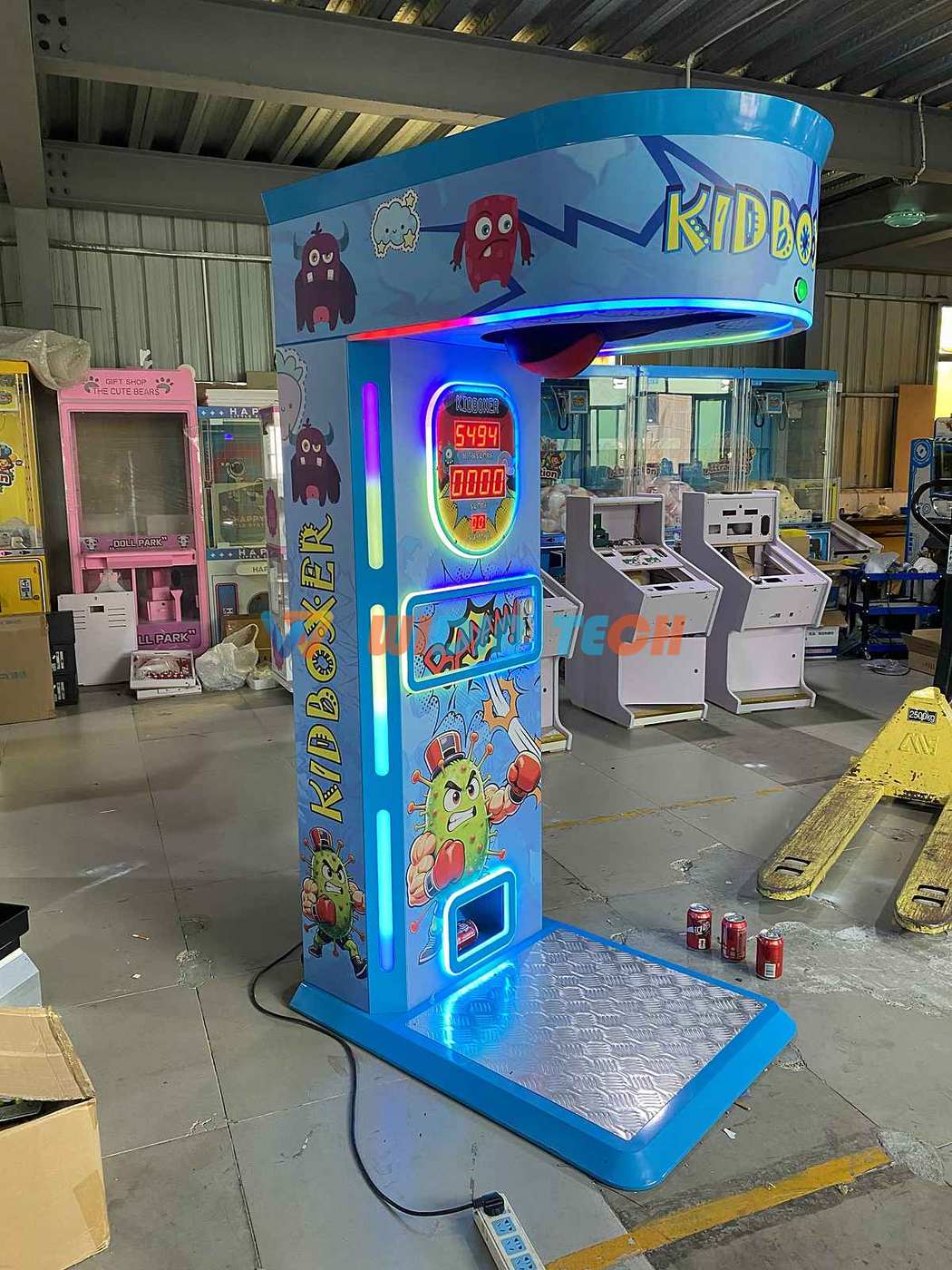
Kids Boxing Arcade Machine
- Product Name: Kids Boxing Arcade Machine
- Game Type: Children's Punching Game
- Players: 1 Player
- Game Mode: Punching + Prize Redemption
- Dimensions: 70 × 120 × 190 cm
- Rated Power: 150 W
- Net Weight: 140 kg/set
- Material: Metal + Acrylic
- Application: Arcade / FEC / Children's Entertainment
- Voltage and plug standard: Customizable to match local voltage and plug specifications of your target market
- Payment system: Coin acceptor, bill validator, card swiping & QR code payment options
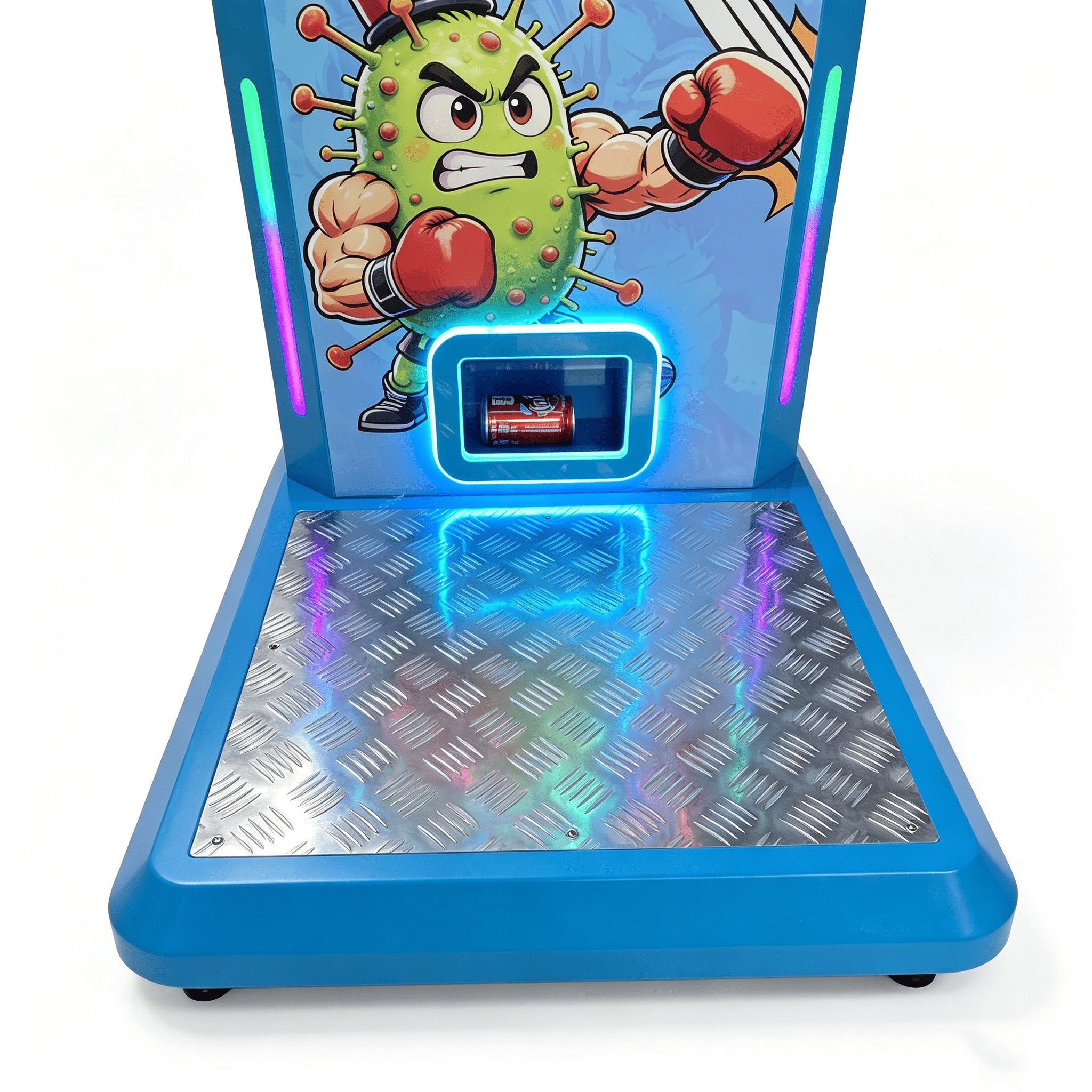
- Prize capacity and prize size range: Accommodates prizes sized similarly to a 330ml canned cola
- Punch target height from floor: 1 meter
- Recommended age range: 8 years and above
- Certification: CE, FCC, RoHS compliant
- Warranty: 1-year full machine warranty
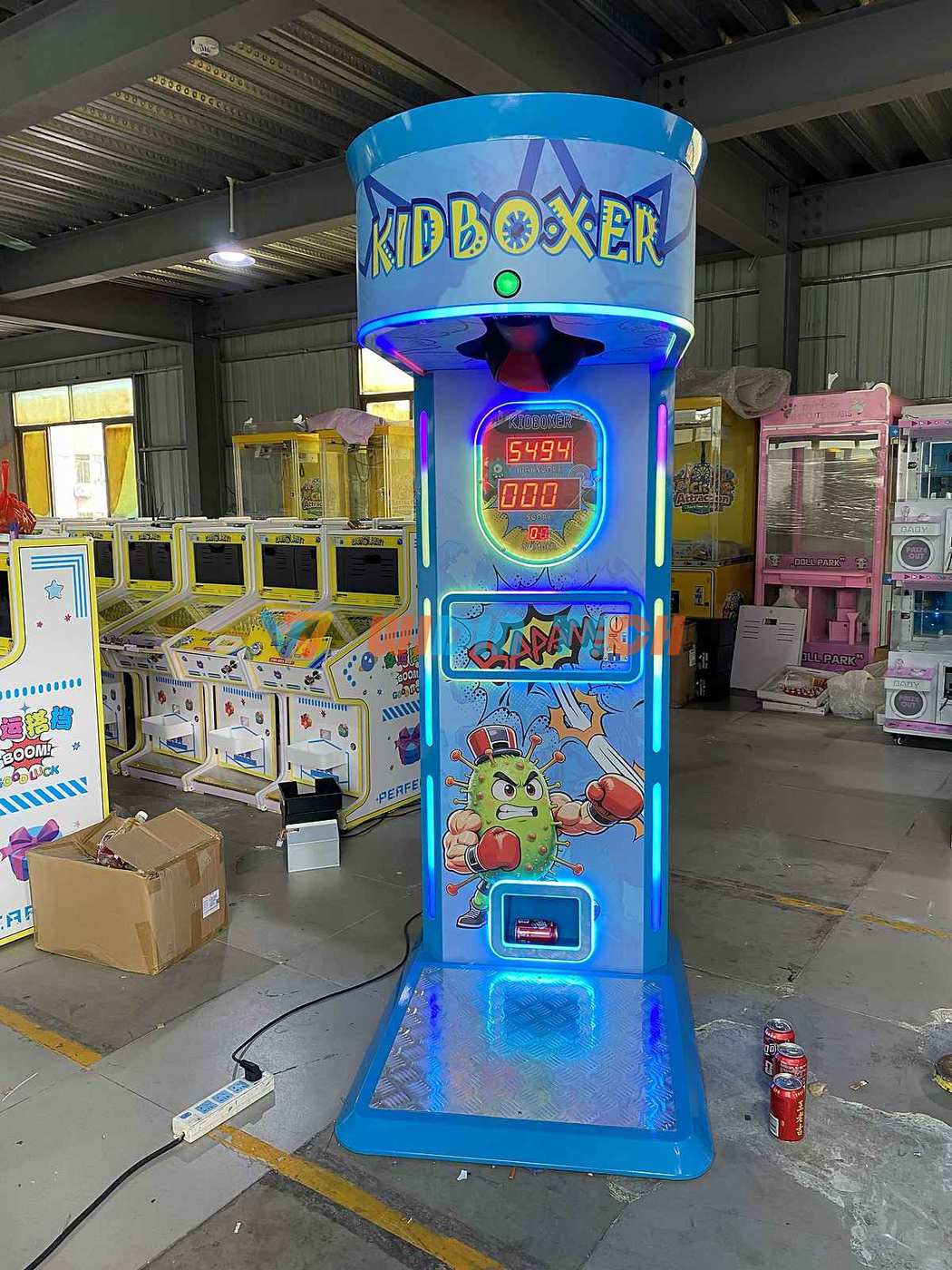
The Kids Boxing Arcade Machine is a single-player children's punching game with prize redemption: the player hits the target, the machine scores the hit, and the round ends in a reward from the configured payout. The cabinet measures 70 × 120 × 190 cm, takes up 0.84 m² of floor, is rated at 150 W and weighs about 140 kg. It is built on a metal frame with acrylic panels and is specified for commercial children's areas — arcades, family entertainment centres, indoor playgrounds and mall entertainment zones. Compared with a full-size adult punch tester, it is the smaller cabinet: less floor space and 45 cm less height, which is the difference between passing through a standard doorway and not.
What to Check Before You Order
Floor space and layout
The cabinet itself is 0.84 m², but that is not what a working position costs you. A child needs room to stand and swing in front of the target, and an adult will step in beside them to help. Plan roughly 1 m of clear floor in front of the cabinet plus 1–1.5 m of walkway behind the player — that is our planning estimate, not a factory figure, so adjust it to your own floor before you commit to a layout. Ten machines in a row then cost you 8.4 m² of cabinet area plus the aisle in front of them.
Doorway, ceiling and delivery route
At 190 cm tall, this cabinet clears a standard interior doorway of about 200–210 cm and can be wheeled in upright. That is worth knowing because the full-size adult punch tester in the same category stands at 235 cm and will not — it has to come in on its end or through a goods entrance. Measure to the lowest obstruction along the route, not to the ceiling slab: lighting track, sprinkler heads, ductwork, and hanging signage are what actually catch a cabinet on the way in.
Delivery weight is 140 kg. Check the lift capacity and the loading dock before the truck arrives, and plan on a pallet truck or three to four people rather than a two-person carry.
Power and electrical
Rated draw is 150 W, which is 6.7 hours of running per kilowatt-hour. On a twelve-hour trading day, that is about 1.8 kWh per machine, or roughly 54 kWh across a thirty-day month — enough to plan a circuit, small enough that it will not show up on your bill next to lighting and HVAC. Both figures come from the rated value, not from a measured meter reading, so treat them as planning numbers. Confirm voltage and plug standard for your market before ordering: 100v/220v
What a Kids Punching Game Does for a Floor
A punching game is the shortest loop on the floor. There is no tutorial, no menu, no learning curve — a child already knows what to do with a target, and a round lasts seconds instead of minutes. That gives you three practical advantages.
Throughput. Fast rounds mean the position frees up quickly during peak hours, when a queue of parents is the thing you are trying to avoid.
Repeat play. Prize redemption turns effort into something the child walks away holding. A score on a screen is forgotten by the car park; a small prize is shown to a parent, and the parent is the one who pays for the next round.
Visibility. A child mid-swing is noticeable from across a mall concourse. Punching games recruit their next player in a way a seated cabinet does not.
The honest limitation: it is one player at a time, and it does not hold anyone for long. If your traffic skews teenage or adult, the full-size boxing strength tester earns better per square metre, because score competition between adults keeps a group at the machine longer. Put this cabinet where the children are.
Kids Boxing Machine vs. Adult Punch Tester
| Kids Boxing Arcade Machine | Adult punch tester (140 × 80 × 235 cm) | |
|---|---|---|
| Gameplay | Punching + prize redemption | Punch strength measurement + score competition |
| Cabinet footprint | 0.84 m² | 1.12 m² |
| Height | 190 cm | 235 cm |
| Through a standard 200–210 cm doorway | Yes, upright | No — needs a goods entrance or goes in on its end |
| Rated power | 150 W | Not published — ask the factory |
| Audience | Children's zones, family areas | Teen and adult traffic, bars and FECs |
| Revenue model | Prize redemption drives the repeat | Score comparison drives the repeat |
Footprint and height come from the published cabinet sizes on each product page; the adult machine's wattage has not been published, so we have not guessed at it.
Where It Works
Shopping malls
A punching game earns from passing traffic rather than from destination visitors, which suits a concourse or a mall play corner. The cabinet is narrow enough to sit against a wall without blocking the walkway, and the height means it does not need a special delivery route.
Family entertainment centres
In an FEC, it belongs in the children's zone alongside claw machines, mini basketball games and redemption counters, where one wristband covers several short-play machines rather than one long-session attraction.
Indoor playgrounds and soft play
Physical play that does not require staff supervision is the fit here. Check the punch target height against the age band you actually admit — a target set for a nine-year-old is unreachable for a four-year-old, and an unreachable target is a machine that never gets played.
Arcades and game centres
Used as a visual anchor for the kids' section: it draws the eye, it is cheap to run at 150 W, and it fills the gap between ticket games and riding attractions.
Home and private use
It is specified and packed as commercial equipment, so a home install is not the default — but it runs on a standard supply, and the cabinet passes a normal doorway, so a large playroom or a covered games room can take one. Get 140 kg across the threshold and onto a level floor first; that is the part people underestimate.
Safety and Materials in a Children's Area
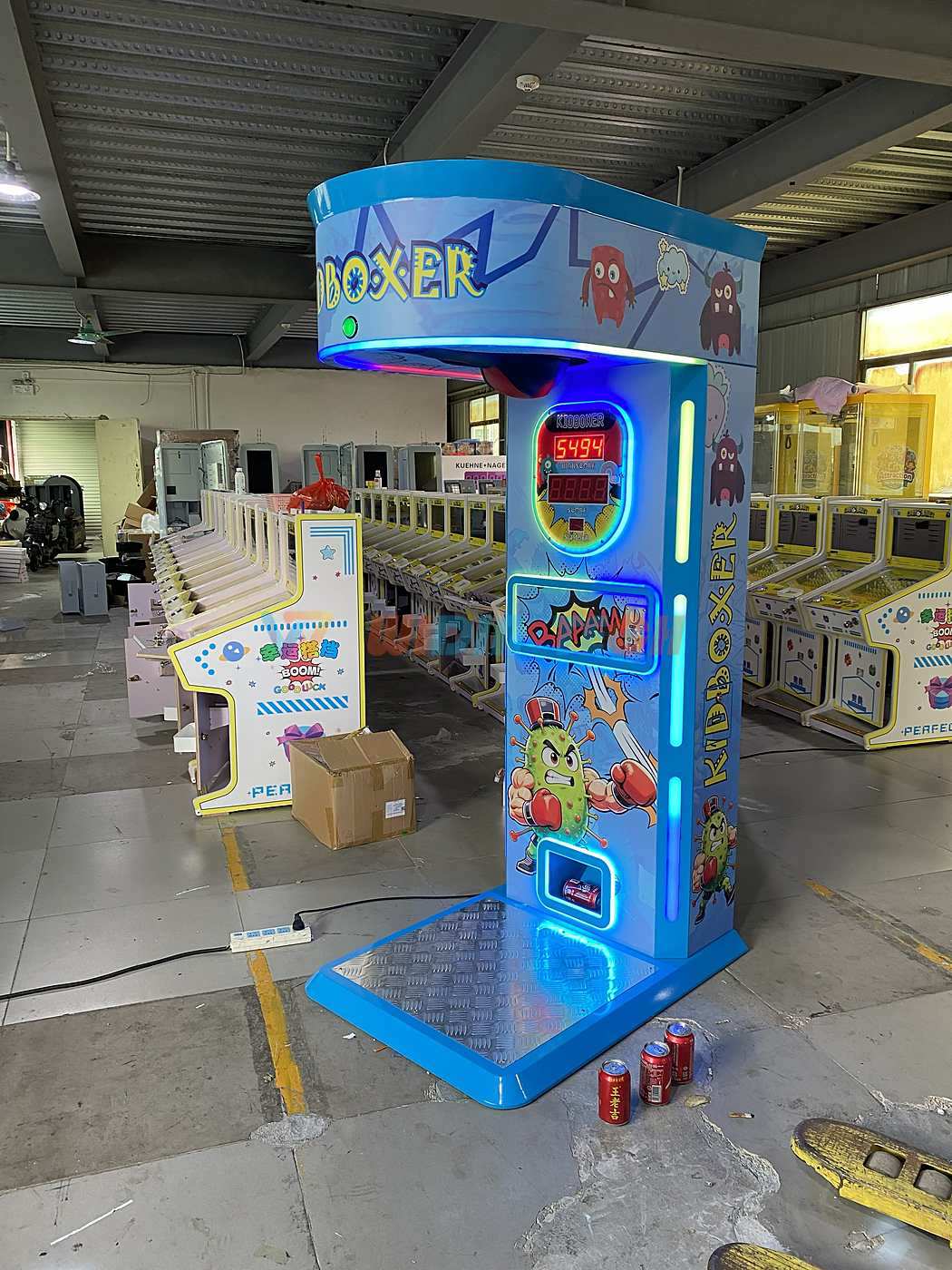
The cabinet is a metal frame with acrylic panels — the metal carries the load and the impact, the acrylic carries the graphics and the lighting. For a children's area, four things are worth pinning down with the factory before you sign:
Edge and corner treatment. Children contact the cabinet at hip and head height, not at eye level. Ask what the exposed corners and panel edges are finished with.
Punch pad and mounting. The pad takes every hit the machine will ever see. Ask for the pad material, how it is mounted, and whether it is a replaceable spare.
Tip stability. A 140 kg cabinet on a 0.84 m² base is stable in normal use, but a child who climbs or leans changes the maths. Ask whether an anti-tip fixing or floor anchoring is recommended.
Prize size. Prize redemption puts small objects into children's hands. Keep prizes above the small-parts threshold for the youngest age you admit, which is your venue's rule to set, not the factory's.
On paperwork: coin-operated machines installed in venues are generally regulated as amusement equipment rather than as toys, but mall landlords, insurers and some markets ask for toy-standard documentation anyway. For the EU, that means CE marking under the Machinery Directive 2006/42/EC with the Low Voltage and EMC directives and RoHS; if the buyer treats it as children's equipment, EN 71-1 (mechanical and physical), EN 71-2 (flammability) and EN 71-3 (migration of elements) may be requested as well. For the US, ASTM F963 plus a Children's Product Certificate applies where a product is marketed for children twelve and under. Whatever is claimed, ask for the test report that names your model and comes from an accredited laboratory, and ask for the Declaration of Conformity behind it. A certificate photo with no report behind it is not worth the paper.
Supervision is the operator's call. We would put it where staff walk past it rather than in an unsupervised corner.
Build Quality and Service Life
WIDIN states that machines are run for 72 hours under continuous full load before shipment, that cabinet steel is 1.2 mm reinforced against a 0.6–0.8 mm industry norm, and that the stable service life of the build is 4–6 years against 2–3 years for conventional workshop cabinets.
Why it matters on a children's machine specifically: kid zones are harder on cabinets than adult floors. Impact loads are unpredictable, and the machine is in use every hour the venue is open. A cabinet that needs replacing in year three costs you the purchase price a second time, plus freight, plus the downtime of a dead position in the busiest part of your floor.
Day-to-Day Maintenance
Nothing here needs a technician on call. What a kids' punching machine asks for:
Wipe acrylic panels with a soft cloth and a cleaner that is safe for acrylic — ammonia-based glass cleaner crazes the surface and leaves it permanently hazy.
Check the punch pad mounting weekly. It is the part that takes the load, and a loose pad both misreads and rattles.
Empty and restock the prize compartment on a schedule. An empty prize window is a machine that stops earning before it breaks.
Inspect the power cable and any accessible fixings monthly, and keep the ventilation path clear.
Custom Builds and OEM Orders
For distributors, arcade operators and entertainment projects, OEM and ODM requirements can be discussed, including cabinet graphics, brand logo, colours, language, lighting, payment system, and prize redemption configuration. WIDIN’s MOQ for custom arcade machines is 1 unit for prototypes and 100 units for mass production.
Two things make custom orders go faster: tell us the destination country so voltage, plug, and payment hardware are specified correctly the first time, and tell us the expected volume even if the first order is small. A machine that will eventually be produced in quantity is engineered differently from a one-off.
Shipping and Packing
At 140 kg per set, this ships as heavy cargo, not as a parcel. Packing options: Wooden case or carton with pallet. Outer package dimensions are 90 × 130 × 200 cm. Machines are shipped fully assembled. Both FCL (full container load) and LCL (less than container load) are supported. Theoretical loading quantity: 8 units for a 20GP container, 18 units for a 40HQ container. Actual loading number may vary subject to packaging gap and loading scheme. Confirm the container loading figures with your quote — they are what turns a unit price into a landed cost, and they are the number most often missing from a first enquiry.
Frequently Asked Questions
What is a kids boxing arcade machine?
A single-player commercial punching game built for children's areas. The player hits the target, the machine scores the hit, and the configured prize redemption mechanism pays out. It is a shorter, lower-impact version of the adult boxing strength tester, which measures punch force for score competition rather than paying out prizes.
What age range is it suitable for?
Recommended age: 8 years and older. The practical constraint is the punch target height, which we have not published — ask for it with your quote and match it against the age band your venue admits. A target a four-year-old cannot reach is a machine that never gets played.
Is it safe for children to use?
The cabinet is a metal frame with acrylic panels, and at 140 kg on a 0.84 m² base, it does not move in normal use. Safety at a venue level comes down to four checks: how corners and edges are finished, how the punch pad is mounted, whether anti-tip fixing is recommended, and whether prizes stay above the small-parts threshold for your youngest visitors. Ask the factory for each of these in writing, and put the machine where staff walk past it.
What size is it, and how much space does it need?
The cabinet is 70 × 120 × 190 cm and occupies 0.84 m² of floor. A working position needs more than that: plan roughly 1 m of clear floor in front for the player plus 1–1.5 m of walkway behind. That clearance is our planning estimate rather than a factory specification, so adjust it to your own layout.
Will it fit through a standard doorway?
Yes. At 190 cm tall, it clears a standard interior doorway of about 200–210 cm and can be wheeled in upright. The full-size adult punch tester at 235 cm cannot, and needs a goods entrance or has to travel on its end. Measure to the lowest obstruction along the route — lighting track, sprinkler heads, ductwork or signage — not to the ceiling slab.
How much power does it use?
Rated power is 150 W, or about 6.7 hours of operation per kilowatt-hour. On a twelve-hour trading day, that is roughly 1.8 kWh per machine and about 54 kWh over thirty days. These are derived from the rated figure rather than from a meter reading, so treat them as planning numbers.
How heavy is it and what does delivery involve?
140 kg per set. It is heavy cargo: check lift capacity and loading dock access, and plan on a pallet truck or three to four handlers. The 190 cm height means no special route is needed for the cabinet itself.
What maintenance does it need?
Wipe acrylic panels with an acrylic-safe cleaner, check the punch pad mounting weekly, restock the prize compartment before it empties, and inspect the cable and fixings monthly. The punch pad is the wearing part.
Can it be customized, and what is the MOQ?
OEM and ODM customization can be discussed for commercial and bulk projects: cabinet graphics, brand logo, colours, language, lighting, payment system, and prize redemption configuration. A typical cycle is 2–6 weeks for prototype work and 8–16 weeks for pre-production preparation.
How is it shipped?
Packing options: Wooden case or carton with pallet. Outer package dimensions are 90 × 130 × 200 cm. Machines are shipped fully assembled. Both FCL (full container load) and LCL (less than container load) are supported. Theoretical loading quantity: 8 units for a 20GP container, 18 units for a 40HQ container. Actual loading number may vary subject to packaging gap and loading scheme. Ask for the loading figures with your quotation — they are what converts a unit price into a landed cost.
Can I install one at home?
It is specified and packed as commercial equipment, so home use is not the default, but it runs on a standard supply, and the 190 cm cabinet passes through a normal doorway. A large playroom or covered games room can take one. The part that catches people out is moving 140 kg across the threshold and onto a level floor.
Request a Commercial Quote
Send us three things, and we can price it: the quantity, the destination country (it sets voltage, plug standard, and freight), and the configuration you need — graphics, payment system, and prize redemption setup. If you know the target age band, include it; it determines whether the punch target height works for your floor.